• HOME
  • NEWS
  • EXPLORE
    • CAREER
      • Companies
      • Jobs
    • EVENTS
    • iGEM
      • News
      • Team
    • PHOTOS
    • VIDEO
    • WIKI
  • BLOG
  • COMMUNITY
    • FACEBOOK
    • INSTAGRAM
    • TWITTER
Saturday, February 7, 2026
BIOENGINEER.ORG
No Result
View All Result
  • Login
  • HOME
  • NEWS
  • EXPLORE
    • CAREER
      • Companies
      • Jobs
        • Lecturer
        • PhD Studentship
        • Postdoc
        • Research Assistant
    • EVENTS
    • iGEM
      • News
      • Team
    • PHOTOS
    • VIDEO
    • WIKI
  • BLOG
  • COMMUNITY
    • FACEBOOK
    • INSTAGRAM
    • TWITTER
  • HOME
  • NEWS
  • EXPLORE
    • CAREER
      • Companies
      • Jobs
        • Lecturer
        • PhD Studentship
        • Postdoc
        • Research Assistant
    • EVENTS
    • iGEM
      • News
      • Team
    • PHOTOS
    • VIDEO
    • WIKI
  • BLOG
  • COMMUNITY
    • FACEBOOK
    • INSTAGRAM
    • TWITTER
No Result
View All Result
Bioengineer.org
No Result
View All Result
Home NEWS Science News Chemistry

Pushing periodic disorder induced phase-matching into deep-ultraviolet spectral region

Bioengineer by Bioengineer
March 24, 2020
in Chemistry
Reading Time: 2 mins read
0
IMAGE
Share on FacebookShare on TwitterShare on LinkedinShare on RedditShare on Telegram

IMAGE

Credit: Mingchuan Shao, Fei Liang, Haohai Yu, Huaijin Zhang


Nonlinear optical frequency conversion is an important technique to extend the wavelength of lasers which has been widely used in modern technology. The efficiency of frequency conversion depends on the phase relationship among the interacting light waves. High conversion efficiency requires the satisfaction of phase matching. However, due to the dispersion property of nonlinear optical crystals, the phase mismatching always occurs, thus, phase matching condition should be specially designed. There are two widely used techniques for phase-matching: birefringence phase matching (BPM) and quasi-phase matching (QPM). Normally, BPM employs the natural birefringence properties of nonlinear optical crystals, and QPM is mainly focused on the periodically inversion of the ferroelectric domains. However, most of nonlinear optical crystals hold neither sufficient birefringence nor controllable ferroelectric domains. Therefore, it is in urgent demand to develop new route to meet phase-matching in arbitrary nonlinear crystals and in broad wavelength ranges.

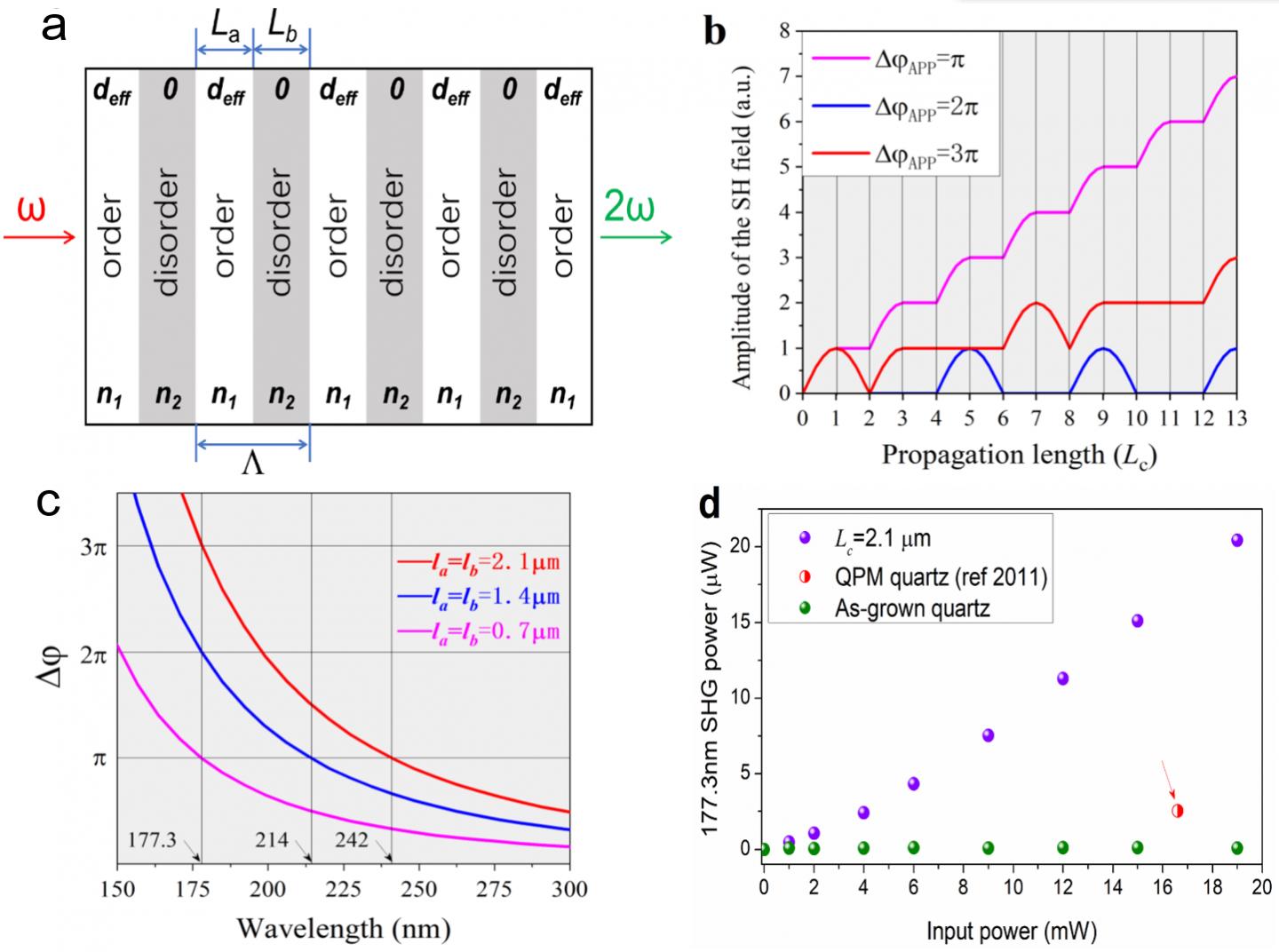
In a new paper published in Light Science & Application, scientists from the State Key Laboratory of Crystal Materials and Institute of Crystal Materials, Shandong University, China, proposed a concept based on the basic principles of nonlinear frequency transformation, additional periodic phase (APP) from the disorder alignment, which can intercept the energy transmission channel of nonlinear light to fundamental light and compensate for mismatched phase. The APP concept means that after the light propagating at the coherence length Lc, the generated phase difference Δφ_PD was compensated by the additional phase difference Δφ_APP with Δφ_APP+Δφ_PD=2mπ (m is the integer). Based on the APP concept, a periodic ordered/disordered structure is introduced into crystal quartz by femtosecond laser writing technology to achieve an effective output from ultraviolet to deep-ultraviolet at the wavelength of 177.3nm. More interestingly, the APP phase matching may get rid of the limitations of birefringent and ferroelectric materials on nonlinear frequency conversion and should be applicable to all non-centrosymmetric nonlinear crystals for achieving effective output at any wavelength in the transmission range of the materials.

“To the best of our knowledge, the phase-matched deep-ultraviolet 177.3 nm generation was firstly achieved via quartz crystal with a high efficiency of 1.07‰.” they added.

“This APP strategy may provide a versatile route for arbitrary nonlinear crystal in broadband wavelength. More importantly, this order/disorder alignment adds a variable physical parameter into optical system, thus leading to next-generation revolution in nonlinear or linear modulation and classical or quantum photonics.” the scientists forecast.

###

Media Contact
Haohai Yu
[email protected]

Related Journal Article

http://dx.doi.org/10.1038/s41377-020-0281-4

Tags: Chemistry/Physics/Materials SciencesOptics
Share12Tweet8Share2ShareShareShare2

Related Posts

blank

Breakthrough in Environmental Cleanup: Scientists Develop Solar-Activated Biochar for Faster Remediation

February 7, 2026
blank

Cutting Costs: Making Hydrogen Fuel Cells More Affordable

February 6, 2026

Scientists Develop Hand-Held “Levitating” Time Crystals

February 6, 2026

Observing a Key Green-Energy Catalyst Dissolve Atom by Atom

February 6, 2026
Please login to join discussion

POPULAR NEWS

  • Robotic Ureteral Reconstruction: A Novel Approach

    Robotic Ureteral Reconstruction: A Novel Approach

    82 shares
    Share 33 Tweet 21
  • Digital Privacy: Health Data Control in Incarceration

    63 shares
    Share 25 Tweet 16
  • Study Reveals Lipid Accumulation in ME/CFS Cells

    57 shares
    Share 23 Tweet 14
  • Breakthrough in RNA Research Accelerates Medical Innovations Timeline

    53 shares
    Share 21 Tweet 13

About

We bring you the latest biotechnology news from best research centers and universities around the world. Check our website.

Follow us

Recent News

TPMT Expression Predictions Linked to Azathioprine Side Effects

Improving Dementia Care with Enhanced Activity Kits

Decoding Prostate Cancer Origins via snFLARE-seq, mxFRIZNGRND

Subscribe to Blog via Email

Enter your email address to subscribe to this blog and receive notifications of new posts by email.

Join 73 other subscribers
  • Contact Us

Bioengineer.org © Copyright 2023 All Rights Reserved.

Welcome Back!

Login to your account below

Forgotten Password?

Retrieve your password

Please enter your username or email address to reset your password.

Log In
No Result
View All Result
  • Homepages
    • Home Page 1
    • Home Page 2
  • News
  • National
  • Business
  • Health
  • Lifestyle
  • Science

Bioengineer.org © Copyright 2023 All Rights Reserved.