• HOME
  • NEWS
  • EXPLORE
    • CAREER
      • Companies
      • Jobs
    • EVENTS
    • iGEM
      • News
      • Team
    • PHOTOS
    • VIDEO
    • WIKI
  • BLOG
  • COMMUNITY
    • FACEBOOK
    • INSTAGRAM
    • TWITTER
Saturday, February 7, 2026
BIOENGINEER.ORG
No Result
View All Result
  • Login
  • HOME
  • NEWS
  • EXPLORE
    • CAREER
      • Companies
      • Jobs
        • Lecturer
        • PhD Studentship
        • Postdoc
        • Research Assistant
    • EVENTS
    • iGEM
      • News
      • Team
    • PHOTOS
    • VIDEO
    • WIKI
  • BLOG
  • COMMUNITY
    • FACEBOOK
    • INSTAGRAM
    • TWITTER
  • HOME
  • NEWS
  • EXPLORE
    • CAREER
      • Companies
      • Jobs
        • Lecturer
        • PhD Studentship
        • Postdoc
        • Research Assistant
    • EVENTS
    • iGEM
      • News
      • Team
    • PHOTOS
    • VIDEO
    • WIKI
  • BLOG
  • COMMUNITY
    • FACEBOOK
    • INSTAGRAM
    • TWITTER
No Result
View All Result
Bioengineer.org
No Result
View All Result
Home NEWS Science News Chemistry

Scientists reveal hidden catalytic surface of Ni-Au core-shell in CO2 hydrogenation

Bioengineer by Bioengineer
March 23, 2020
in Chemistry
Reading Time: 2 mins read
0
IMAGE
Share on FacebookShare on TwitterShare on LinkedinShare on RedditShare on Telegram

IMAGE

Credit: LIU Wei


For years, core-shell structured particles have been recognized as well-designed catalysts that can facilitate reaction activity owing to their distinct synergism at the interface.

Recently, by using a combination of in situ methods, Dr. LIU Wei and his colleagues from the Dalian Institute of Chemical Physics (DICP) of the Chinese Academy of Sciences have found that the core-shell configuration of a Ni-Au catalyst was lost during the actual reaction and recovered afterwards. The Ni-Au alloy as the real active surface can solely be observed via in situ microscopy. The results were published in Nature Catalysis.

Supported metal nanoparticles can change their size, structure, and active surface composition under reaction conditions, thus functioning differently than expected.

As for core-shell nanoparticles – one of the most popular heterogeneous catalysts – it is accepted that their catalytic properties derive from the synergy of electronics and geometry between the core and shell layer.

However, lack of direct in situ evidence visualizing the localized atomic coordination/arrangement during real reactions impedes our understanding of actual structure-activity mechanism and core-shell functionality.

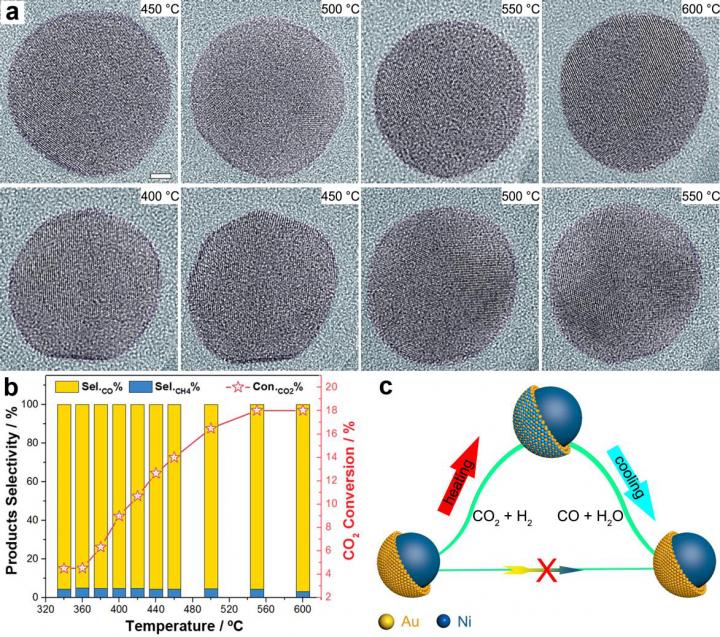
The researchers from DICP described the real catalytic surface of a Ni-Au bimetallic catalyst. Without in situ characterization, it showed no difference from any other reported core-shell catalysis. Its high CO selectivity (>95%) (Fig. 1b) could be attributed to the well-controlled ultra-thin (about two atoms thick) Au shell, since a nickel catalyst always yields methane.

However, by using environmental transmission electron microscopy to directly visualize the dynamic process at the atomic level (Fig. 1a), the researchers disclosed that the core-shell structure contributed nothing to the reactivity because the core-shell Ni-Au kinetically transformed into a Ni-Au alloy during the reaction and dramatically reverted to the core-shell configuration after the reaction (Fig. 1c).

This discovery has been well supported by results from multiple in situ techniques, including synchrotron X-ray spectroscopy and infrared spectroscopy as well as theoretical simulations.

This finding regarding core-shell nanoparticles overturns our conventional understanding. As a result, researchers may begin to question whether core-shell catalysts are really in core-shell structure under working conditions or not. The discovery of this hidden transformation also indicates that efforts to synthesize core-shell structures may be unnecessary in some reactions.

###

Media Contact
CHEN Si
[email protected]

Related Journal Article

http://dx.doi.org/10.1038/s41929-020-0440-2

Tags: Atomic/Molecular/Particle PhysicsChemistry/Physics/Materials Sciences
Share12Tweet8Share2ShareShareShare2

Related Posts

blank

Breakthrough in Environmental Cleanup: Scientists Develop Solar-Activated Biochar for Faster Remediation

February 7, 2026
blank

Cutting Costs: Making Hydrogen Fuel Cells More Affordable

February 6, 2026

Scientists Develop Hand-Held “Levitating” Time Crystals

February 6, 2026

Observing a Key Green-Energy Catalyst Dissolve Atom by Atom

February 6, 2026
Please login to join discussion

POPULAR NEWS

  • Robotic Ureteral Reconstruction: A Novel Approach

    Robotic Ureteral Reconstruction: A Novel Approach

    82 shares
    Share 33 Tweet 21
  • Digital Privacy: Health Data Control in Incarceration

    63 shares
    Share 25 Tweet 16
  • Study Reveals Lipid Accumulation in ME/CFS Cells

    57 shares
    Share 23 Tweet 14
  • Breakthrough in RNA Research Accelerates Medical Innovations Timeline

    53 shares
    Share 21 Tweet 13

About

We bring you the latest biotechnology news from best research centers and universities around the world. Check our website.

Follow us

Recent News

Phage-Antibiotic Combo Beats Resistant Peritoneal Infection

Boosting Remote Healthcare: Stepped-Wedge Trial Insights

Barriers and Boosters of Seniors’ Physical Activity in Karachi

Subscribe to Blog via Email

Enter your email address to subscribe to this blog and receive notifications of new posts by email.

Join 73 other subscribers
  • Contact Us

Bioengineer.org © Copyright 2023 All Rights Reserved.

Welcome Back!

Login to your account below

Forgotten Password?

Retrieve your password

Please enter your username or email address to reset your password.

Log In
No Result
View All Result
  • Homepages
    • Home Page 1
    • Home Page 2
  • News
  • National
  • Business
  • Health
  • Lifestyle
  • Science

Bioengineer.org © Copyright 2023 All Rights Reserved.