• HOME
  • NEWS
  • EXPLORE
    • CAREER
      • Companies
      • Jobs
    • EVENTS
    • iGEM
      • News
      • Team
    • PHOTOS
    • VIDEO
    • WIKI
  • BLOG
  • COMMUNITY
    • FACEBOOK
    • INSTAGRAM
    • TWITTER
Saturday, July 4, 2026
BIOENGINEER.ORG
No Result
View All Result
  • Login
  • HOME
  • NEWS
  • EXPLORE
    • CAREER
      • Companies
      • Jobs
        • Lecturer
        • PhD Studentship
        • Postdoc
        • Research Assistant
    • EVENTS
    • iGEM
      • News
      • Team
    • PHOTOS
    • VIDEO
    • WIKI
  • BLOG
  • COMMUNITY
    • FACEBOOK
    • INSTAGRAM
    • TWITTER
  • HOME
  • NEWS
  • EXPLORE
    • CAREER
      • Companies
      • Jobs
        • Lecturer
        • PhD Studentship
        • Postdoc
        • Research Assistant
    • EVENTS
    • iGEM
      • News
      • Team
    • PHOTOS
    • VIDEO
    • WIKI
  • BLOG
  • COMMUNITY
    • FACEBOOK
    • INSTAGRAM
    • TWITTER
No Result
View All Result
Bioengineer.org
No Result
View All Result
Home NEWS Science News Chemistry

A milestone in ultrafast gel fabrication

Bioengineer by Bioengineer
March 20, 2020
in Chemistry
Reading Time: 2 mins read
0
IMAGE
Share on FacebookShare on TwitterShare on LinkedinShare on RedditShare on Telegram

Counter-intuition disturbance-directed fabrication of self-healable noble metal gels for photo-assisted electrocatalysis
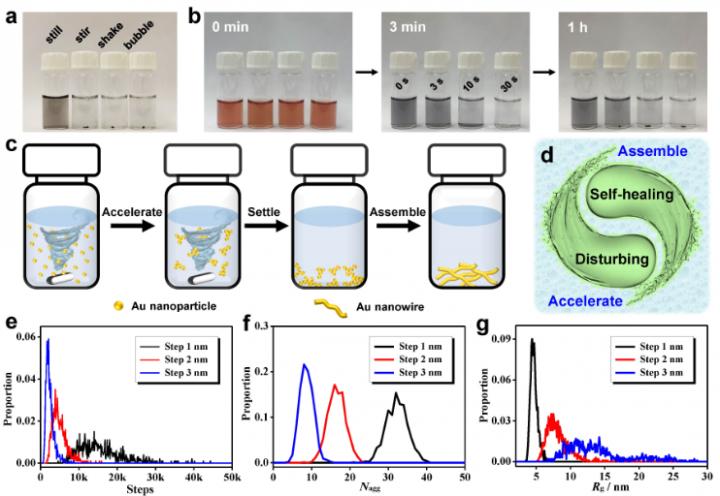
IMAGE

Credit: Copyright: Ran DU et al. Matter 2020.


Electrocatalysis is one of the most studied topics in the field of material science, because it is extensively involved in many important energy-related processes, such as the oxygen reduction reaction (ORR) for fuel cells, the hydrogen evolution reaction (HER) for green hydrogen production, and the oxygen evolution reaction (OER) for metal-air batteries. Noble metal aerogels (NMAs) emerge as a new class of outstanding electrocatalysts due to the combined features of metals and aerogels. However, the development of these porous materials has yet been impeded by the sluggish fabrication methods, which require several hours to even several weeks. In addition, the unique optical properties of noble metals, for instance the plasmonic resonance, have so far been ignored in NMAs, limiting their potential high performance in electrocatalysis.

Ran Du from China is an Alexander von Humboldt research fellow working as postdoc in the physical chemistry group of Professor Alexander Eychmüller at TU Dresden since 2017. Together, they recently revealed an unconventional self-healing behaviour in noble metal gels, which is rare in the solely inorganic gel systems. On this basis, a counter-intuition method was developed for tremendously accelerating the gelation speed. Their pioneering findings were published in the renowned journal Matter.

Ran Du and his team developed an unconventional and conceptually new strategy for rapid gelation: a counter-intuitive disturbance-promoted gelation method. The in situ introduction of a disturbing field during the gelation greatly facilitates mass transportation and induces accelerated reaction kinetics. Upon removal of the disturbing field, the resulting gel pieces can re-assemble to a monolith in light of the self-healing property. In this way, the transportation barrier in presence of traditional gelation methods is overcome, leading to a gelation within one to ten minutes at room temperature without affecting the microstructures of gels. This is two to three orders of the magnitude quicker than traditional approaches. The mechanism was also supported by Monte Carlo simulations. Notably, the disturbance ways can be expanded to shaking and bubbling, and the method is applicable to various compositions, such as gold (Au), palladium (Pd), rhodium (Rh), gold-palladium (Au-Pd), gold-palladium-platinum (Au-Pd-Pt), and morphologies, for example the core-shell structure or homogeneous structure.

Moreover, Ran Du took advantage of the combined optic and catalytic activities of noble metals: “We also were first to demonstrate the photoelectrocatalytic properties of NMAs by using ethanol oxidation reaction (EOR) as a model reaction, displaying an activity increase of up to 45.5 % by illumination and realizing a current density of up to 7.3 times higher than that of commercial palladium/carbon (Pd/C). Thus we pioneered the exploration of photoelectrocatalysis on NMAs opening up new space for both fundamental and application-orientated studies for noble metal gels and other systems.”

###

Media Contact
Ran DU
[email protected]

Related Journal Article

http://dx.doi.org/10.1016/j.matt.2020.01.002

Tags: Chemistry/Physics/Materials Sciences
Share12Tweet8Share2ShareShareShare2

Related Posts

Intelligent Microgrid Management Promises Lower Household Energy Bills and Reduced Diesel Emissions — Chemistry

Intelligent Microgrid Management Promises Lower Household Energy Bills and Reduced Diesel Emissions

July 4, 2026
Graz University of Technology Deciphers the Structural Secrets of MOF Thin Films — Chemistry

Graz University of Technology Deciphers the Structural Secrets of MOF Thin Films

July 2, 2026

Breaking Thermodynamic Limits: Wavelength-Driven Catalysis Advances Ammonia Synthesis

July 2, 2026

From Quantum Mechanics to AI-Powered Materials Discovery: MARVEL Marks 12 Years of Transforming Computational Science

July 2, 2026
Please login to join discussion

POPULAR NEWS

  • Detection of EDCs in Breast Milk and Infant Urine Up to Six Months Highlights Early Exposure Risks

    77 shares
    Share 31 Tweet 19
  • Saying Goodbye to PGY-6: Pediatric Fellowship Realities

    103 shares
    Share 41 Tweet 26
  • New Drug Candidate Developed at McMaster Shows Potential for Treating Brain Cancer

    58 shares
    Share 23 Tweet 15
  • KTU Researchers Explore Ultrasound’s Role in Enhancing Blood Flow Beyond Diagnostics

    53 shares
    Share 21 Tweet 13

About

We bring you the latest biotechnology news from best research centers and universities around the world. Check our website.

Follow us

Recent News

Quasi-Bound States Boost Quantum Well Photoresponse

Lysine Pyruvylation Links Glycolysis to Epigenetics

Multiphysics Coupling: Single vs. Multiple DeepONet Branches

Subscribe to Blog via Email

Success! An email was just sent to confirm your subscription. Please find the email now and click 'Confirm' to start subscribing.

Join 83 other subscribers
  • Contact Us

Bioengineer.org © Copyright 2023 All Rights Reserved.

Welcome Back!

Login to your account below

Forgotten Password?

Retrieve your password

Please enter your username or email address to reset your password.

Log In
No Result
View All Result
  • Homepages
    • Home Page 1
    • Home Page 2
  • News
  • National
  • Business
  • Health
  • Lifestyle
  • Science

Bioengineer.org © Copyright 2023 All Rights Reserved.