Scientists proposed a new method of statistical analysis of intermolecular interactions and sizes of atoms.
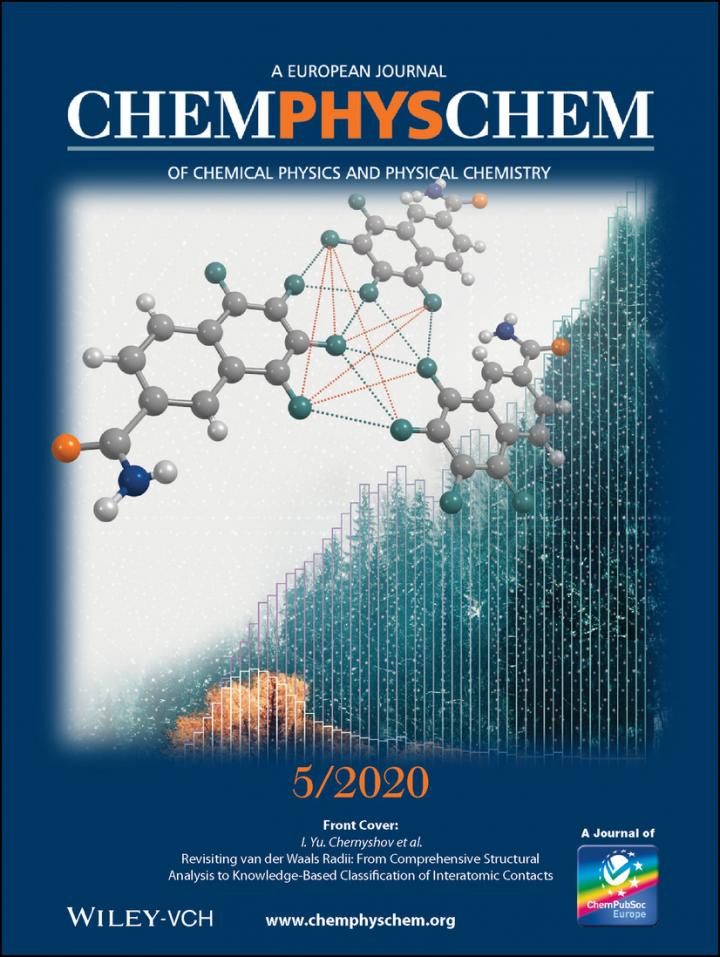
Credit: ChenPhysChem
Today, when new drugs are designed with the help of supercomputers, and electronic devices operate on a nanoscale, it is very important for scientists to understand how neighboring molecules behave towards each other. For this purpose, they need to know the sizes of atoms with the highest degree of precision. Modern quantum chemistry methods can be of help here, but the answers they offer are either not accurate enough or take months of work to produce. Scientists from ITMO University and their colleagues from the Russian Academy of Science proposed a new method of statistical analysis of intermolecular interactions and sizes of atoms. Their research made the front page of the ChemPhysChem journal.
From the chemistry standpoint, we all live in a world of perpetual intermolecular interactions. The process of brewing tea, digesting our meals or the rigidity of a new type of plastic – all of this depends on the manner of interaction of specific molecules. The problem is that modern quantum chemistry methods aren’t enough to completely and precisely describe the characteristics of intermolecular interactions.
Then again, today it is very important for scientists to know the energy of intermolecular interactions. Researchers need precise data on how molecules of a new drug interact with an organism’s cells, or on the molecular structure of a new semiconductor. The smallest changes in the manner of molecules’ interaction can make an invention very effective or completely unfeasible. Chemists found a way out: in order to identify the extent to which intermolecular interactions affect the properties of a chemical system, they started using the principle of the effective size of atoms, most commonly known as van der Waals radii. This concept implies that if atoms get closer to each other than a specific distance, then their interaction is significant; otherwise, it can be neglected.
Yet, due to the specifics of the method for determining van der Waals radii, their values are usually undersized by 10-15%. As a result, mistakes make their way into the analysis of chemical systems, and many interactions are neglected as insignificant. A team of scientists from ITMO University in collaboration with specialists from Nesmeyanov Institute of Organoelement Compounds proposed a new method of statistical analysis that allows to determine the size of atoms better.
“How do you usually calculate the efficient size of atoms? says Ivan Chernyshov, one of the article’s authors, – well, we have data on all possible interactions between two atoms. If we draw up a graph of the distribution of interatomic distances, we’ll be able to get an average distance that corresponds to the analyzed interaction. Still, this is not always possible, so instead of the most probable distance from the graph we get a different, approximate value. We succeeded in getting round this problem by coming up with a way to sift the accidental contacts from direct interactions where there are no other screening atoms on the “line of sight” between the centers of the two atoms.”
Despite this method for solving an extremely complex task from the field of quantum chemistry being quite simple, it allows to get sufficiently precise data that is essential for assessing the sizes of atoms and molecules and the manner of intermolecular interactions, which is very important in the light of today’s applications.
“Today, scientists actively research interactions between drugs and proteins in organisms, explains Mr. Chernyshov. You have a good molecule that has already shown its efficiency, but need to improve it by amplifying the bond with the active center. In order to do that, you take data on the efficient size of these atoms and see which interactions in the structure of the bound protein are important and which can be neglected. The values that have been used till now were determined empirically and had no specific physical sense. Our method will make it possible to significantly increase the precision of such calculations, especially for systems that have not been studied yet.”
###
Media Contact
Alena Gupaisova
pressa@itmo.ru
7-909-160-5018
Related Journal Article
http://dx.