• HOME
  • NEWS
  • EXPLORE
    • CAREER
      • Companies
      • Jobs
    • EVENTS
    • iGEM
      • News
      • Team
    • PHOTOS
    • VIDEO
    • WIKI
  • BLOG
  • COMMUNITY
    • FACEBOOK
    • INSTAGRAM
    • TWITTER
Saturday, February 7, 2026
BIOENGINEER.ORG
No Result
View All Result
  • Login
  • HOME
  • NEWS
  • EXPLORE
    • CAREER
      • Companies
      • Jobs
        • Lecturer
        • PhD Studentship
        • Postdoc
        • Research Assistant
    • EVENTS
    • iGEM
      • News
      • Team
    • PHOTOS
    • VIDEO
    • WIKI
  • BLOG
  • COMMUNITY
    • FACEBOOK
    • INSTAGRAM
    • TWITTER
  • HOME
  • NEWS
  • EXPLORE
    • CAREER
      • Companies
      • Jobs
        • Lecturer
        • PhD Studentship
        • Postdoc
        • Research Assistant
    • EVENTS
    • iGEM
      • News
      • Team
    • PHOTOS
    • VIDEO
    • WIKI
  • BLOG
  • COMMUNITY
    • FACEBOOK
    • INSTAGRAM
    • TWITTER
No Result
View All Result
Bioengineer.org
No Result
View All Result
Home NEWS Science News Chemistry

Heterostructure and Q-factor engineering for low-threshold and persistent nanowire lasing

Bioengineer by Bioengineer
March 20, 2020
in Chemistry
Reading Time: 2 mins read
0
IMAGE
Share on FacebookShare on TwitterShare on LinkedinShare on RedditShare on Telegram

IMAGE

Credit: by Stefan Skalsky, Yunyan Zhang, Juan Arturo Alanis, H. Aruni Fonseka, Ana M. Sanchez, Huiyun Liu and Patrick Parkinson


Over the past decade, the idea of photonic computing – where electrons are replaced with light in microelectronic circuits – has emerged as a future technology. This promises low-cost, ultra-high-speed and potentially quantum-enhanced computing, with specific applications in high-efficiency machine learning and neuromorphic computing. While the computing elements and detectors have been developed, the need for nanoscale, high-density and easily-integrated light sources remains unmet. Semiconductor nanowires are seen as a potential candidate, due to their small size (on the order of the wavelength of light), the possibility for direct growth onto industry-standard silicon, and their use of established materials. However, to date, such nanowire lasers on silicon have not been demonstrated to operate continuously at room temperature.

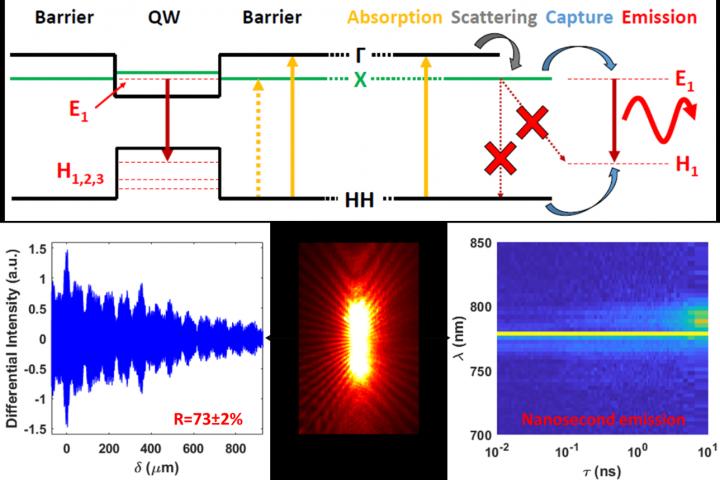
In a new paper published in Light Science & Application, scientists from the Photon Science Institute in Manchester, UK with colleagues at University College London and the University of Warwick demonstrate a new route to achieving low-threshold silicon-integratable nanowire lasers. Based on a novel direct-indirect semiconductor heterostructures enabled by the nanowire platform, they demonstrate multi-nanosecond lasing at room temperature. A key design element is the need for high-reflectivity nanowire ends; this is typically a challenging requirement, as common growth methods do not allow simple optimization for high quality end-facets. However, in this study, by employing a novel time-gated interferometer the researchers demonstrate that the reflectivity can be over 70% – around double that expected for a conventional flat-ended laser due to the confinement of light.

Together, the novel material structure and high quality cavity contribute to a low lasing threshold – a measure of the power required to activate lasing in the nanowires – of just 6uJ/cm^2, orders of magnitude lower than previously demonstrated. Not only does this new approach provide high quality nanolasers, but the MBE growth provides a high-yield of functioning wires, with over 85% of nanowires tested working at full power without thermal damage. This high yield is critical for industrial integration of this new structure.

###

Media Contact
Patrick Parkinson
[email protected]

Related Journal Article

http://dx.doi.org/10.1038/s41377-020-0279-y

Tags: Chemistry/Physics/Materials SciencesOptics
Share12Tweet8Share2ShareShareShare2

Related Posts

blank

Breakthrough in Environmental Cleanup: Scientists Develop Solar-Activated Biochar for Faster Remediation

February 7, 2026
blank

Cutting Costs: Making Hydrogen Fuel Cells More Affordable

February 6, 2026

Scientists Develop Hand-Held “Levitating” Time Crystals

February 6, 2026

Observing a Key Green-Energy Catalyst Dissolve Atom by Atom

February 6, 2026
Please login to join discussion

POPULAR NEWS

  • Robotic Ureteral Reconstruction: A Novel Approach

    Robotic Ureteral Reconstruction: A Novel Approach

    82 shares
    Share 33 Tweet 21
  • Digital Privacy: Health Data Control in Incarceration

    63 shares
    Share 25 Tweet 16
  • Study Reveals Lipid Accumulation in ME/CFS Cells

    57 shares
    Share 23 Tweet 14
  • Breakthrough in RNA Research Accelerates Medical Innovations Timeline

    53 shares
    Share 21 Tweet 13

About

We bring you the latest biotechnology news from best research centers and universities around the world. Check our website.

Follow us

Recent News

Succinate Receptor 1 Limits Blood Cell Formation, Leukemia

Palmitoylation of Tfr1 Drives Platelet Ferroptosis and Exacerbates Liver Damage in Heat Stroke

Oxygen-Enhanced Dual-Section Microneedle Patch Improves Drug Delivery and Boosts Photodynamic and Anti-Inflammatory Treatment for Psoriasis

Subscribe to Blog via Email

Enter your email address to subscribe to this blog and receive notifications of new posts by email.

Join 73 other subscribers
  • Contact Us

Bioengineer.org © Copyright 2023 All Rights Reserved.

Welcome Back!

Login to your account below

Forgotten Password?

Retrieve your password

Please enter your username or email address to reset your password.

Log In
No Result
View All Result
  • Homepages
    • Home Page 1
    • Home Page 2
  • News
  • National
  • Business
  • Health
  • Lifestyle
  • Science

Bioengineer.org © Copyright 2023 All Rights Reserved.