• HOME
  • NEWS
  • EXPLORE
    • CAREER
      • Companies
      • Jobs
    • EVENTS
    • iGEM
      • News
      • Team
    • PHOTOS
    • VIDEO
    • WIKI
  • BLOG
  • COMMUNITY
    • FACEBOOK
    • INSTAGRAM
    • TWITTER
Monday, October 5, 2026
BIOENGINEER.ORG
No Result
View All Result
  • Login
  • HOME
  • NEWS
  • EXPLORE
    • CAREER
      • Companies
      • Jobs
        • Lecturer
        • PhD Studentship
        • Postdoc
        • Research Assistant
    • EVENTS
    • iGEM
      • News
      • Team
    • PHOTOS
    • VIDEO
    • WIKI
  • BLOG
  • COMMUNITY
    • FACEBOOK
    • INSTAGRAM
    • TWITTER
  • HOME
  • NEWS
  • EXPLORE
    • CAREER
      • Companies
      • Jobs
        • Lecturer
        • PhD Studentship
        • Postdoc
        • Research Assistant
    • EVENTS
    • iGEM
      • News
      • Team
    • PHOTOS
    • VIDEO
    • WIKI
  • BLOG
  • COMMUNITY
    • FACEBOOK
    • INSTAGRAM
    • TWITTER
No Result
View All Result
Bioengineer.org
No Result
View All Result
Home NEWS Science News Chemistry

Coronavirus testing kits to be developed using SFU-invented RNA imaging technology

Bioengineer by Bioengineer
March 19, 2020
in Chemistry
Reading Time: 2 mins read
0
IMAGE
Share on FacebookShare on TwitterShare on LinkedinShare on RedditShare on Telegram

IMAGE

Credit: Simon Fraser University


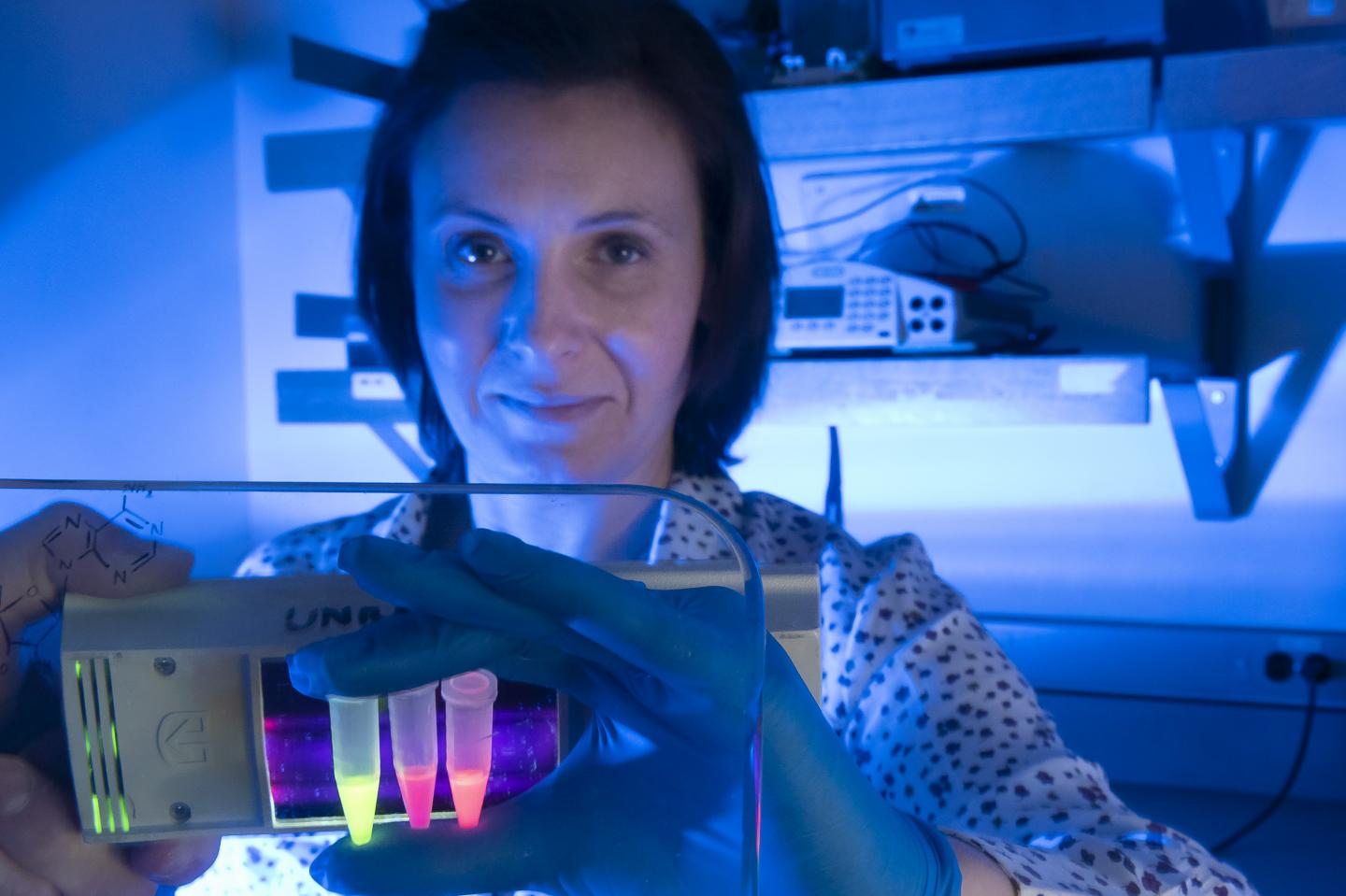
Simon Fraser University researchers will use their pioneering imaging technology–called Mango, for its bright colour– to develop coronavirus testing kits. They’re among a small set of Canadian researchers who responded to the rapid funding opportunity recently announced by the Canadian Institutes of Health Research (CIHR) to help address COVID-19.

SFU researchers Lena Dolgosheina, a post-doctoral fellow and Peter Unrau, a professor of molecular biology and biochemistry, developed Mango to sensitively detect RNA molecules, helping to improve viral screening for viruses such as the coronavirus while enabling basic discoveries into the functioning of cells.

The latest research, led by Unrau, involves using Mango to detect individual molecules of RNA within a living cell.

“We are made of molecules so when something goes wrong within a cell it happens at the molecular level, says Unrau. “We are using the Mango system as a catalyst, to allow us to not only extend fundamental research questions but also to detect pathogens like the coronavirus, faster and more efficiently.”

The Mango system consists of an RNA Mango aptamer that binds tightly and specifically to a fluorescent dye. The aptamer acts like a magnet – targeting and binding those dye molecules. The dye becomes excitable when bound and glows brightly. RNA molecules modified to contain the aptamer ‘magnet’ now stand out from the other parts of the cell, which makes it much easier for researchers to see and study RNA molecules under a microscope.

“Cell regulation takes place at the level of RNA,” he says. “For a long time, the focus has been on protein but it is RNA and not protein that regulates the vast majority of processes within a cell.”

RNA Mango dyes are currently available from Applied Biological Materials (ABM) in Richmond, B.C. The coronavirus research made possible by CIHR funding will allow the team to develop an isothermal testing methodology, known as Mango NABSA (nucleic acid sequence-based amplification).

The Mango NABSA kits can be used to test for the coronavirus, which is a positive strand RNA virus. ABM is actively involved with this project as a partner and will supply the enzymes and buffers needed, which the SFU team originally developed.

“Mango technology is state of the art and the development of effective cures for cancer and other diseases demand better imaging methodologies to rapidly learn how cells work in detail,” Unrau adds.

The team’s research is published in Nature Communications.

###

Contact:

Peter Unrau, molecular biology and biochemistry, 604-346-7375 [email protected]

Melissa Shaw; University Communications and Marketing, 236.880.3297, [email protected]

Media Contact
Melissa Shaw
[email protected]
236-880-3297

Original Source

http://sfu.ca/university-communications/media-releases/2020/03/coronavirus-testing-kits-to-be-developed-using-sfu-invented-rna-.html

Related Journal Article

http://dx.doi.org/10.1038/s41467-020-14932-7

Tags: BiochemistryBiologyMolecular Biology
Share12Tweet8Share2ShareShareShare2

Related Posts

Chemists Fine-Tune Superplasticizer Recipe to Make Stronger, Flowing Concrete

Chemists Fine-Tune Superplasticizer Recipe to Make Stronger, Flowing Concrete

October 5, 2026
Cabbage Extract Yields Iron Oxide Nanoparticles With Potent Biological Activity

Cabbage Extract Yields Iron Oxide Nanoparticles With Potent Biological Activity

October 5, 2026

Scientists Decode the Atomic Birth of Nickel Thin Films

October 5, 2026

Soft Flexible Framework Material Could Improve Solid-State Battery Design

October 5, 2026
Please login to join discussion

POPULAR NEWS

  • Alloys That Shrink Their Own Grains: New PIX Mechanism Refines Metals With Heat Alone

    Alloys That Shrink Their Own Grains: New PIX Mechanism Refines Metals With Heat Alone

    29 shares
    Share 12 Tweet 7
  • Endurance Exercise Reshapes the Liver in Males and Females Through Distinct Molecular Routes

    29 shares
    Share 12 Tweet 7
  • Single Transcription Factor PU.1 Rapidly Converts Fibroblasts into Macrophage-Lineage Cells

    29 shares
    Share 12 Tweet 7
  • New Scale Measures How Ready Nurse Educators Really Are for the AI Era

    29 shares
    Share 12 Tweet 7

About

We bring you the latest biotechnology news from best research centers and universities around the world. Check our website.

Follow us

Recent News

Alloys That Shrink Their Own Grains: New PIX Mechanism Refines Metals With Heat Alone

Endurance Exercise Reshapes the Liver in Males and Females Through Distinct Molecular Routes

Single Transcription Factor PU.1 Rapidly Converts Fibroblasts into Macrophage-Lineage Cells

Subscribe to Blog via Email

Success! An email was just sent to confirm your subscription. Please find the email now and click 'Confirm' to start subscribing.

Join 85 other subscribers
  • Contact Us

Bioengineer.org © Copyright 2023 All Rights Reserved.

Welcome Back!

Login to your account below

Forgotten Password?

Retrieve your password

Please enter your username or email address to reset your password.

Log In
No Result
View All Result
  • Homepages
    • Home Page 1
    • Home Page 2
  • News
  • National
  • Business
  • Health
  • Lifestyle
  • Science

Bioengineer.org © Copyright 2023 All Rights Reserved.