Credit: Photo: Bryce Vickmark
ARLINGTON, Va.–With support from the Office of Naval Research (ONR), engineers at the Massachusetts Institute of Technology (MIT) have designed a portable measurement system to precisely and cheaply monitor the amount of electricity used by individual household appliances, lighting fixtures and electronic devices.
"Supporting research that targets key military and national energy challenges is a vital component of ONR's mission, which is to drive technology advancements," said Dr. Richard Carlin, head of ONR's Sea Warfare and Weapons Department. "Projects like this have the potential to address broad energy needs."
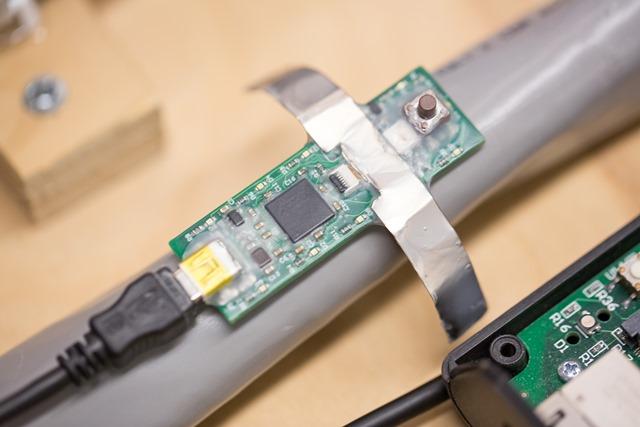
The system was developed by Dr. Steven Leeb, an MIT engineering professor, and Dr. John Donnal, one of Leeb's graduate students and a former U.S. Army captain. It comprises five postage stamp-sized sensors placed above or near power lines coming into a house. The sensors are designed to be self-calibrating–enabling them to automatically pinpoint the strongest electrical signals.
The system can distinguish between each type of light, appliance and device based on unique signatures; which ones turn on and off; and how often and at what times. It then displays this data in real time on an app that allows users to focus on specific time segments–revealing when, for example, a refrigerator goes into its defrost cycle, or how regularly a water heater switches on and off each day.
"There are already ways to monitor household energy use," said Leeb, "but they involve hiring a licensed electrician or cutting through power lines or pipes to attach expensive, specialized equipment. With our system, you can install non-contact sensors using zip ties or even velcro, and use signal processing to measure power consumption. It's fast, easy and much less expensive. It also could serve as a way to tell when equipment needs maintenance or replacement."
While the benefits to civilians are obvious, the system could be a valuable tool for the military. Consider a forward operating base in a combat zone, for example. Using MIT's technology not only could generate major savings in fuel or power–it also may safeguard the lives of warfighters responsible for base resupply.
"The military is an ideal customer for this technology," said Donnal. "At a forward operating base, fuel conservation is paramount. Heating and air-conditioning thermostats run too high or too low. Large tents are heated all day during winter, even if they're unoccupied during daytime hours.
"Or take the case of a Navy vessel," he continued. "By cutting back on fuel and power consumption, a vessel might be able to sail for longer periods of time before needing replenishment. Having a way to track energy usage in real time would be extremely valuable."
Leeb is conducting at-sea tests of the system aboard three U.S. Coast Guard cutters based in the Boston area, to mirror some of the conditions and challenges facing Navy vessels. Donnal, an assistant professor at the U.S. Naval Academy, plans additional tests on the training ships the school uses to teach midshipmen navigation and seamanship.
Leeb's research is part of the Naval Enterprise Partnership Teaming with Universities for National Excellence initiative, or NEPTUNE, conducted by ONR and the Department of the Navy.
NEPTUNE's goals are to help the Navy and Marine Corps discover ways to improve energy conservation, generate renewable energy and implement energy-efficient technologies–while giving active-duty military, military students and veterans the chance to immerse themselves in university-level research.
###
Media Contact
Bob Freeman
[email protected]
703-696-5031
@usnavyresearch
http://www.onr.navy.mil
############
Story Source: Materials provided by Scienmag