Credit: UCSB
Studies of brain activity typically draw their findings from measurement averages across entire groups of subjects. But new research out of UC Santa Barbara that highlights a novel method of characterizing and comparing the brain dynamics in individuals may signal a shift in that approach.
While UCSB scientists have demonstrated that the groups of regions of the brain that synchronize their activity during memory-related tasks get smaller and more numerous with age, the number of connections is as individual as the study participants. The research findings appear in the journal PLOS Computational Biology.
"We found that the way our brain organizes its communications changes as we age," said co-author Kimberly Schlesinger, a Ph.D. student at UCSB. "Even though we saw different patterns of brain activity in older people, we didn't see any changes in memory performance. This suggests that while older people have less synchronized communication across their entire brains, they may be compensating for this by using different strategies to successfully remember things."
The scientists used functional magnetic resonance imaging (fMRI) to record healthy people's brain activity during memory tasks, attention tasks and periods of rest. For each person, fMRI data was recast as a network composed of brain regions and the connections among them. The investigators then measured how closely different groups of connections changed together over time.
They found that regardless of whether a person is using memory, directing attention or resting, the number of synchronous groups of connections within one brain is consistent for that person. However, among multiple people, these numbers vary dramatically.
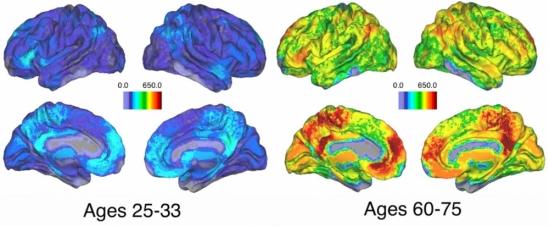
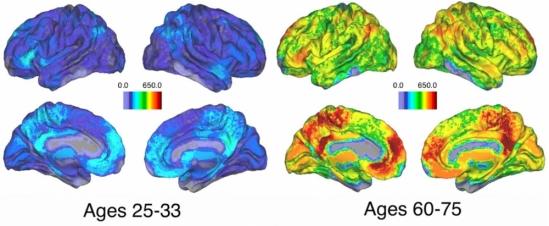
Specifically during memory, variations among people are closely linked to age. Younger participants had only a few large synchronous groups that link nearly the entire brain in coordinated activity, while older participants showed progressively more and smaller groups of connections, indicating loss of cohesive brain activity — even in the absence of memory impairment.
"This method elegantly captures important differences between individual brains, which are often complex and difficult to describe," said Elizabeth Davison, who initiated the work as an undergraduate at UCSB, where Schlesinger served as her mentor. Davison is now a graduate student at Princeton University. "The resulting tools show promise for understanding how different brain characteristics are related to behavior, health and disease."
The research originated from the Worster Summer Research Fellowship in UCSB's Department of Physics. Other UCSB members of the project team included physics professor Jean Carlson, neuroscientist Scott Grafton and then-postdoctoral scholar Danielle Bassett, now an assistant professor at the University of Pennsylvania.
Future work will investigate how to use individual brain signatures to differentiate between brains that are healthily aging and those with age-related impairments.
###
This study was supported by the David and Lucile Packard Foundation and the Institute for Collaborative Biotechnologies through a grant from the U.S. Army Research Office. Schlesinger was supported by the National Science Foundation Graduate Research Fellowship Program and by the Worster Summer Research Fellowship.
Media Contact
Julie Cohen
[email protected]
805-893-7220
@ucsantabarbara
http://www.ucsb.edu
############
Story Source: Materials provided by Scienmag