Texas A&M researchers discover previously unknown response within gut microbiota
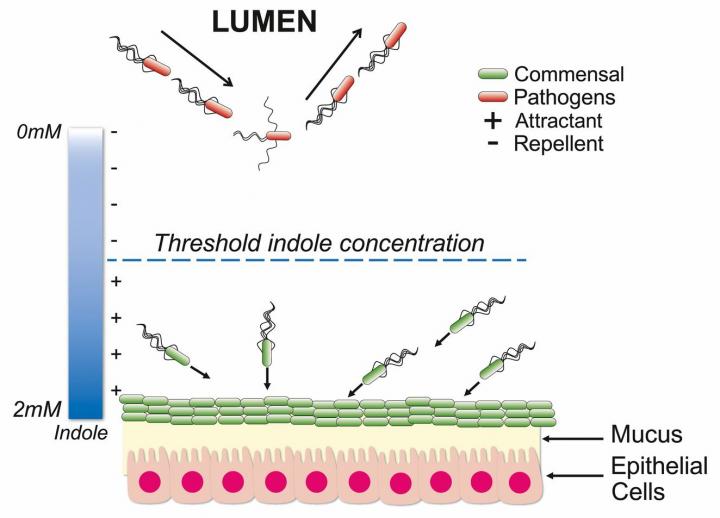
Credit: Proceedings of the National Academy of Sciences Mar. 2020, 201916974; DOI: 10.1073/pnas.1916974117
The gut microbiome, which is a collection of numerous beneficial bacteria species, is key to our overall well-being and good health. Recent studies have linked the gut microbiome with several beneficial properties, such as aiding in the development of our immune system and warding off pathogen infections.
Many deadly pathogens are motile, meaning they can move spontaneously, and their ability to infect is based on their response to different environmental cues. Major cues for the pathogens are the molecules (or metabolites) produced in the gut. Pathogens interpret distinctive metabolites differently and are either attracted or repelled by them (i.e., migrate toward or away from them).
The metabolite indole is an example of a microbiome-produced small molecule that is abundant in the gut and is a powerful repellent for bacteria. According to Dr. Pushkar Lele, assistant professor, and Dr. Arul Jayaraman, professor, in the Artie McFerrin Department of Chemical Engineering at Texas A&M University, this fact led to a simple question: “Why does indole – which is produced by many of our beneficial bacterial species – not repel the good gut bacteria along with the bad ones?”
To answer this question, a research team including Lele, Jayaraman and Dr. Michael Manson from the Department of Biology at Texas A&M, studied the response of the beneficial gut bacteria, E. coli to indole. In an article in the Proceedings of the National Academy of Sciences, the researchers describe the discovery of a previously unknown response to indole, in which the molecule seems to both repel and attract bacteria. This Janus response – named after the Roman god Janus who had two faces, one looking into the future and one looking into the past – has to do with the way indole is interpreted by the bacterial chemo-receptors.
“We found that there are two receptors in E. coli that sense indole,” Lele said. “One senses indole as a repellent, and one senses indole as an attractant. Sustained exposure to high concentrations of indole desensitizes the receptor that interprets it as a repellent. This leads to indole being sensed only as an attractant.”
According to Jayaraman, the Janus response displays a large amount of sophistication, and the discovery could lead to a better understanding of the complexities of the gut microbiome. “Beneficial bacteria aggregate on the surfaces within the gut based on some common feature,” said Jayaraman. “We propose that one such feature is the ability to produce or sense indole. Bacteria that produce indole could group together and be attracted to niches where indole concentrations are high.”
Since the bacteria that produce indole in the gut typically are enmeshed in mucus layers among other bacteria, the indole concentration drops as one gets further away from the source of indole. Since pathogens tend to pass through the gut relatively far from the bacteria that produce indole, they are not likely to encounter high concentrations of indole for a sustained period. Therefore, they are not sensitized to indole, and any indole they encounter repels them.
Studies continue to show that it is important to have a diverse mix of beneficial bacteria in the gut. According to Lele, this research is a step toward understanding how the gut microbiome might change with time. “The key question is, ‘How do different species of bacteria colonize specific niches?’ We have addressed a part of that question,” said Lele. “The next step is to examine the response of multiple species of bacteria to a mix of different metabolites that are found in the gut.”
###
Media Contact
Amy Halbert
[email protected]
979-458-4243
Original Source
https:/
Related Journal Article
http://dx.