Credit: Department of Molecular Virology,TMDU
Researchers from Tokyo Medical and Dental University (TMDU) discover a novel mechanism by which immunodeficiency viruses evolved over time to evade the protective measures of the host
Tokyo, Japan – When Charles Darwin theorized how the struggle for existence drives natural selection, he laid the cornerstone of modern biology. Now, researchers from Tokyo Medical and Dental University (TMDU) have investigated the process of selection in the context of human immunodeficiency virus (HIV) infection. In a new study published in the Journal of Virology, they showed how certain primate immunodeficiency viruses (PIVs) acquire the ability to survive in a hostile environment in the midst of the host’s protective apparatus.
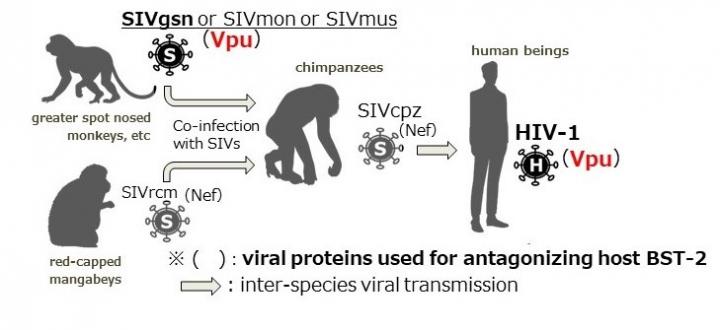
The goal of viruses is to infect cells of a host and to use them to multiply and infect more cells. In contrast, the defense system of animals including immune system protects the host from foreign invaders, such as viruses, by suppressing their proliferation. Many viruses adapt to this constant pressure by the host by finding new ways to circumvent the host’s defense system. One of the important players in this system is a protein called BST-2, which ensures that PIVs are not released from the cell where they originate. Many PIVs make a protein called viral protein U (Vpu) to antagonize host BST-2.
“This interaction between BST-2 and Vpu is highly species-specific, meaning that not all BST-2 and Vpu proteins from different species interact with each other,” says corresponding author of the study Takeshi Yoshida. “The goal of our study was to understand how PIVs that infect primates learn to evade the human defense system by inactivating human BST-2.”
To achieve their goal, the researchers infected human cells with virus expressing Vpu protein from simian immunodeficiency viruses (SIVs) that infect wild chimpanzees or various monkeys, and found that only Vpu from the SIV that infects the greater spot-nosed monkey (SIVgsn) had the ability to neutralizehuman BST-2 and thus to be able to release virus efficiently from human cells.
“We wanted to know what this particular Vpu does differently from the other Vpu proteins to ensure that the SIV can inactivate the human defense system,” says lead author of the study Weitong Yao.
The researchers then investigated the molecular interaction between human BST-2 and this particular Vpu, and specifically focused on a certain amino acid sequence, also called a motif, in Vpu that had previously been shown to be important for its interaction with BST-2. Interestingly, they found that Vpu from SIVgsn possesses two such motifs, and that only one of them is required to inactivate BST-2 of its natural host, the greater spot-nosed monkey, but both to inactivate human BST-2.
“These are striking results that implyhow PIVs learn during the course of evolution to adapt to new situations and to survive,” says Yoshida.
HIV is responsible for acquired immunodeficiency syndrome (AIDS) and is thought to have been derived from an SIV that infects wild chimpanzees (SIVcpz). While HIV can antagonize human BST-2, SIVcpz cannot. The findings of this study shed new light on the evolution of a virus that is the cause of the worst pandemic in human history.
###
The article, “Vpu of a Simian Immunodeficiency Virus Isolated from Greater Spot-Nosed Monkey Antagonizes Human BST-2 via Two AxxxxxxxW Motifs,” was published in Journal of Virology at DOI: 10.1128/JVI.01669-19
Media Contact
Shoji YAMAOKA,Takeshi YOSHIDA
[email protected]
Original Source
http://www.
Related Journal Article
http://dx.