New insights into how fluids transform from order to disorder
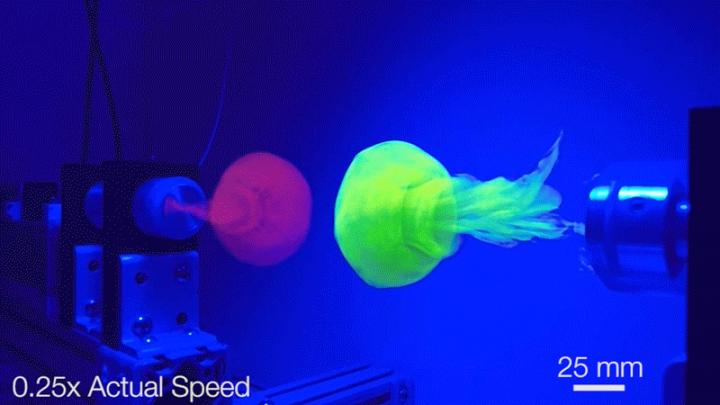
Credit: Video courtesy of Harvard SEAS
Turbulence is everywhere — it rattles our planes and makes tiny whirlpools in our bathtubs — but it is one of the least understood phenomena in classical physics.
Turbulence occurs when an ordered fluid flow breaks into small vortices, which interact with each other and break into even smaller vortices, which interact with each other and so-on, becoming the chaotic maelstrom of disorder that makes white water rafting so much fun.
But the mechanics of that descent into chaos have puzzled scientists for centuries.
When they don’t understand something, physicists have a go-to solution: smash it together. Want to understand the fundamental building blocks of the universe? Smash particles together. Want to unravel the underlying mechanics of turbulence? Smash vortices together.
Researchers at the Harvard John A. Paulson School of Engineering and Applied Sciences (SEAS) may have identified a fundamental mechanism by which turbulence develops by smashing vortex rings head-on into each other, recording the results with ultra-high-resolution cameras, and reconstructing the collision dynamics using a 3D visualization program. Coupled with the analysis of numerical simulations performed by collaborators at the University of Houston and ENS de Lyon, the researchers have gained unprecedented insight into how fluidic systems transform from order to disorder.
The research is described in Science Advances.
“Our ability to predict the weather, understand why a Boeing 747 flies even with turbulent currents in its wake, and determine the global flows in the ocean depends on how well we model turbulence,” said Shmuel Rubinstein, Associate Professor of Applied Physics at SEAS and corresponding author of the paper. “However, our understanding of turbulence still lacks a mechanistic description that explains how energy cascades to smaller and smaller scales until it is eventually dissipated. This research opens the door to just that kind of understanding.”
“Trying to make sense of what is going on in an exceedingly complex system like turbulence is always a challenge,” said Rodolfo Ostilla-Mónico, Assistant Professor of Mechanical Engineering at the University of Houston and corresponding author of the paper. “At every length-scale, vortices are straining and compressing each other to generate a chaotic picture. With this work, we can begin to isolate and watch simple pair interactions, and how these lead to rich dynamics when enough of them are present.”
Physicists have been using vortex colliders to understand turbulences since the 1990s, but previous experiments haven’t been able to slow down and reconstruct the mechanics of the collision, the moment it descends into chaos. To do that, the researchers synchronized a powerful scanning laser sheet with a high-speed camera — capable of snapping hundreds of thousands of images per second — to rapidly scan the entire collision in real time.
They used vortex cannons in a 75-gallon aquarium to produce the vortices. Each vortex was dyed a different color, so researchers could observe how they interact when they violently collide. It takes less than a second for the rings to disappear into a puff of dye after the collision, but within that time, a lot of physics happens.
First, the rings stretch outward as they smash into each other and the edges form antisymmetric waves. The crests of these waves develop into finger-like filaments, which grow perpendicularly between the colliding cores.
These filaments counter-rotate with their neighbors, creating a new array of miniature vortices that interact with each other for milliseconds. Those vortices also form filaments, which in turn form vortices. The research team observed three generations of this cascading cycle, each one the same as before, only smaller — a Russian nesting doll of disorder.
“This similar behavior from the large scale to the small scale emerges very rapidly and orderly before it all breaks down into turbulence,” said Ryan McKeown, a graduate student at SEAS and first author of the paper. “This cascading effect is really exciting because it could point to a universal mechanism for how these interactions work, independent of scale.”
In addition to the experiments, the research team also developed numerical simulations to understand the dynamics of the breakdown and quantify how the energy spectrum of the cascade evolves. Turbulence has a very specific and well-defined energy spectrum. While this system is considerably simpler than the turbulence that rattles a plane, the researchers found that the energy spectrum at the late-stage breakdown of the vortices follows the same tell-tale scaling of fully developed turbulence.
“This is a great indication that while this is a different system–for a brief time–it is creating the same conditions of turbulence. It’s a starting point,” said McKeown.
###
This research was co-authored by Alain Pumir, Professor of Physics at ENS de Lyon, and Michael P. Brenner, the Glover Professor of Applied Mathematics and Applied Physics.
It was supported by the National Science Foundation through the Harvard Materials Research Science and Engineering Center (MRSEC) under grant number DMR-1420570 and through the Division of Mathematical Sciences under grant numbers DMS-1411694 and DMS-1715477.
Media Contact
Leah Burrows
[email protected]
617-496-1351
Original Source
https:/
Related Journal Article
http://dx.