• HOME
  • NEWS
  • EXPLORE
    • CAREER
      • Companies
      • Jobs
    • EVENTS
    • iGEM
      • News
      • Team
    • PHOTOS
    • VIDEO
    • WIKI
  • BLOG
  • COMMUNITY
    • FACEBOOK
    • INSTAGRAM
    • TWITTER
Saturday, February 7, 2026
BIOENGINEER.ORG
No Result
View All Result
  • Login
  • HOME
  • NEWS
  • EXPLORE
    • CAREER
      • Companies
      • Jobs
        • Lecturer
        • PhD Studentship
        • Postdoc
        • Research Assistant
    • EVENTS
    • iGEM
      • News
      • Team
    • PHOTOS
    • VIDEO
    • WIKI
  • BLOG
  • COMMUNITY
    • FACEBOOK
    • INSTAGRAM
    • TWITTER
  • HOME
  • NEWS
  • EXPLORE
    • CAREER
      • Companies
      • Jobs
        • Lecturer
        • PhD Studentship
        • Postdoc
        • Research Assistant
    • EVENTS
    • iGEM
      • News
      • Team
    • PHOTOS
    • VIDEO
    • WIKI
  • BLOG
  • COMMUNITY
    • FACEBOOK
    • INSTAGRAM
    • TWITTER
No Result
View All Result
Bioengineer.org
No Result
View All Result
Home NEWS Science News Biology

Male-killing bacteria linked to butterfly color changes

Bioengineer by Bioengineer
February 28, 2020
in Biology
Reading Time: 3 mins read
0
IMAGE
Share on FacebookShare on TwitterShare on LinkedinShare on RedditShare on Telegram

IMAGE

Credit: Claude Martin


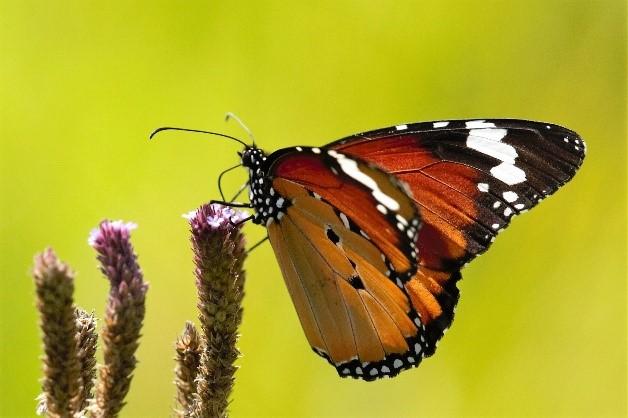
Like many poisonous animals, the African monarch butterfly’s orange, white and black pattern warns predators that it is toxic. Warning patterns like this are usually consistent across individuals to help predators learn to avoid them. However, a recent study, published February 27 in the open-access journal PLOS Biology, shows how a population of African monarch butterflies (Danaus chrysippus) breaks this rule and has highly variable warning patterns. The study, by Simon Martin of the University of Edinburgh, UK and colleagues shows that the unlikely answer lies in the interaction with a bacterium that specifically kills male butterflies.

Previous research had shown that all female butterflies in this East African population have two unusual features: Firstly, they have a new arrangement of their chromosomes where the chromosome containing genes that control color patterns is fused to their one of their sex chromosomes (called the W chromosome). This new chromosome is called the neo-W. Secondly, they are all infected with a bacterium called Spiroplasma that kills all of their sons. What was not clear, however, was whether these two features were linked, and whether they could explain the highly variable color patterns that changed from season to season.

To answer this, the researchers analyzed the entire DNA sequence of the bacteria and the female butterflies’ chromosomes. This showed that the neo-W chromosome alters color patterns and has spread rapidly through the population, aided by the male-killing bacteria. However, because the bacterium only allows female offspring, it promotes the survival of one particular color pattern gene that is always passed from mother to daughter. This left one puzzle for the scientists still to solve – if the females all carried the same color gene, then why was the East African population so variable?

The study found that this female color gene has only a weak effect that is overridden by color genes from the father. Therefore, fathers with different patterns will produce daughters with different patterns. Seasonal fluctuations in wind patterns are thought to affect which subspecies of male immigrants end up in this region, leading to seasonal changes in female color patterns. Even though they always resemble their father, the infected hybrid daughters, unable to produce sons, represent a genetic dead-end for fathers, whose color pattern genes only survive for one generation before being wiped out.

Dr. Simon Martin said, “The relatively fast emergence and spread of a new chromosome, combined with the short life cycle of the butterfly, allows us to study how the microbe is altering the evolution of the butterfly, almost in real-time. We are continually discovering new ways in which microbes manipulate their hosts, and male-killing is just one example of this. It makes you wonder to what extent the evolution of other organisms – even humans – is affected by such unseen forces.”

###

In your coverage please use this URL to provide access to the freely available article in PLOS Biology: https://journals.plos.org/plosbiology/article?id=10.1371/journal.pbio.300610

Citation: Martin SH, Singh KS, Gordon IJ, Omufwoko KS, Collins S, Warren IA, et al. (2020) Whole-chromosome hitchhiking driven by a male-killing endosymbiont. PLoS Biol 18(2): e3000610. https://doi.org/10.1371/journal.pbio.3000610

Funding: This work was funded by European Research Council (https://erc.europa.eu) European Union Horizon 2020 research and innovation programme grant 646625 (CB), ERC grant 339873 (CDJ), National Geographic Society (https://www.nationalgeographic.org) Research Grant WW-138R-17 (IJG), and a Royal Society (https://royalsociety.org) University Research Fellowship URFR1180682 (SHM). The funders had no role in study design, data collection and analysis, decision to publish, or preparation of the manuscript.

Competing Interests: The authors have declared that no competing interests exist.

Media Contact
Simon H. Martin
[email protected]

Original Source

https://journals.plos.org/plosbiology/article?id=10.1371/journal.pbio.300610

Related Journal Article

http://dx.doi.org/10.1371/journal.pbio.3000610

Tags: Biology
Share12Tweet8Share2ShareShareShare2

Related Posts

Florida Cane Toad: Complex Spread and Selective Evolution

Florida Cane Toad: Complex Spread and Selective Evolution

February 7, 2026
New Study Uncovers Mechanism Behind Burn Pit Particulate Matter–Induced Lung Inflammation

New Study Uncovers Mechanism Behind Burn Pit Particulate Matter–Induced Lung Inflammation

February 6, 2026

DeepBlastoid: Advancing Automated and Efficient Evaluation of Human Blastoids with Deep Learning

February 6, 2026

Navigating the Gut: The Role of Formic Acid in the Microbiome

February 6, 2026
Please login to join discussion

POPULAR NEWS

  • Robotic Ureteral Reconstruction: A Novel Approach

    Robotic Ureteral Reconstruction: A Novel Approach

    82 shares
    Share 33 Tweet 21
  • Digital Privacy: Health Data Control in Incarceration

    63 shares
    Share 25 Tweet 16
  • Study Reveals Lipid Accumulation in ME/CFS Cells

    57 shares
    Share 23 Tweet 14
  • Breakthrough in RNA Research Accelerates Medical Innovations Timeline

    53 shares
    Share 21 Tweet 13

About

We bring you the latest biotechnology news from best research centers and universities around the world. Check our website.

Follow us

Recent News

Evaluating Pediatric Emergency Care Quality in Ethiopia

TPMT Expression Predictions Linked to Azathioprine Side Effects

Improving Dementia Care with Enhanced Activity Kits

Subscribe to Blog via Email

Enter your email address to subscribe to this blog and receive notifications of new posts by email.

Join 73 other subscribers
  • Contact Us

Bioengineer.org © Copyright 2023 All Rights Reserved.

Welcome Back!

Login to your account below

Forgotten Password?

Retrieve your password

Please enter your username or email address to reset your password.

Log In
No Result
View All Result
  • Homepages
    • Home Page 1
    • Home Page 2
  • News
  • National
  • Business
  • Health
  • Lifestyle
  • Science

Bioengineer.org © Copyright 2023 All Rights Reserved.