• HOME
  • NEWS
  • EXPLORE
    • CAREER
      • Companies
      • Jobs
    • EVENTS
    • iGEM
      • News
      • Team
    • PHOTOS
    • VIDEO
    • WIKI
  • BLOG
  • COMMUNITY
    • FACEBOOK
    • INSTAGRAM
    • TWITTER
Saturday, February 7, 2026
BIOENGINEER.ORG
No Result
View All Result
  • Login
  • HOME
  • NEWS
  • EXPLORE
    • CAREER
      • Companies
      • Jobs
        • Lecturer
        • PhD Studentship
        • Postdoc
        • Research Assistant
    • EVENTS
    • iGEM
      • News
      • Team
    • PHOTOS
    • VIDEO
    • WIKI
  • BLOG
  • COMMUNITY
    • FACEBOOK
    • INSTAGRAM
    • TWITTER
  • HOME
  • NEWS
  • EXPLORE
    • CAREER
      • Companies
      • Jobs
        • Lecturer
        • PhD Studentship
        • Postdoc
        • Research Assistant
    • EVENTS
    • iGEM
      • News
      • Team
    • PHOTOS
    • VIDEO
    • WIKI
  • BLOG
  • COMMUNITY
    • FACEBOOK
    • INSTAGRAM
    • TWITTER
No Result
View All Result
Bioengineer.org
No Result
View All Result
Home NEWS Science News Biology

Genetic signature boosts protein production during cell division

Bioengineer by Bioengineer
February 28, 2020
in Biology
Reading Time: 3 mins read
0
IMAGE
Share on FacebookShare on TwitterShare on LinkedinShare on RedditShare on Telegram

IMAGE

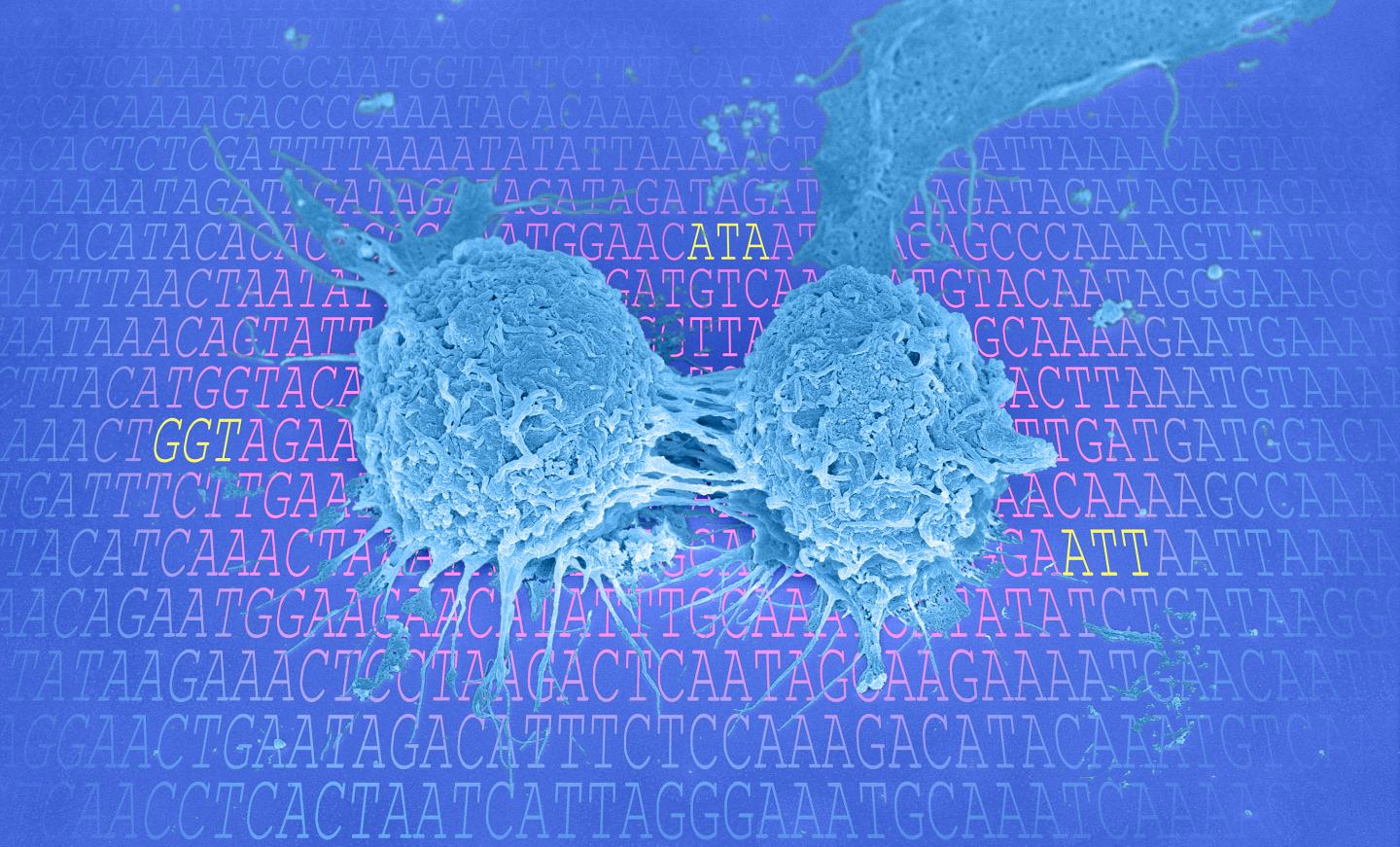
Credit: Image: University of Basel, Biozentrum


A research team has uncovered a genetic signature that enables cells to adapt their protein production according to their state. The researchers of the University of Basel’s Biozentrum report in Genome Biology that this newly discovered mechanism plays a role in the regulation of protein production during cell division.

The production of proteins is the most energy-consuming activity of cells. It needs to be tightly regulated, to ensure efficient use of cellular resources. Researchers led by Prof. Mihaela Zavolan at the Biozentrum of the University of Basel have now discovered how the genetic code is used to adjust the protein production depending on the cell growth and division. This mechanism may also be involved in uncontrolled cell division.

Several codons for one amino acid

The genetic code is like a language consisting solely of three letter words, known as ‘codons’. Each codon stands for an amino acid, the building blocks of proteins. As there are 64 codons for the 20 amino acids, most amino acids are encoded by more than one codon.

The multiple codons that represent one and the same amino acid are not equally frequent in the genome. Some occur frequently while others are rare. “Previously it was assumed that rare codons generally reduce the rate of protein synthesis,” says Zavolan. “Our findings, however, provide a more subtle picture. We could show that rare codons allow the production of specific proteins to be boosted during cell division.”

Rare codons regulate protein synthesis

To synthesize a protein, the gene that encodes that protein must first be copied. This copy, called mRNA, is then decoded into a sequence of amino acids by specific molecules in the cell’s protein factories. In proliferation-related mRNAs, amino acids tend to be encoded by rare codons, which leads to relatively inefficient protein synthesis when the cells are in resting state. This is because rare codons take longer to be ‘read’ due to the low availability of decoding molecules.

“The situation changes when the cell switches to division. In this case, more decoding molecules are available to ‘read’ the rare codons,” explains Joao Guimaraes, the first author of the study. “The mRNAs enriched in such codons, which turn out to be important for cell proliferation, are more efficiently translated and thus, experience a boost in protein synthesis.” In this way, rare codons help to control the production of a particular class of proteins and to adapt it to the needs of the cell.

Genetic signature for cell proliferation

“Our study challenges the current view that the rare codons are simply detrimental for protein production,” says Guimaraes. “We have demonstrated that rare codons are involved in specifically boosting the production of proteins necessary for cell division.” The findings on the genetic signature may have implications for understanding the dysregulation of protein synthesis during tumor development, which is caused by uncontrolled cell growth and proliferation.

###

Media Contact
Reto Caluori
[email protected]
41-612-072-495

Original Source

https://www.unibas.ch/en/News-Events/News/Uni-Research/Genetic-signature-boosts-protein-production-during-cell-division.html

Related Journal Article

http://dx.doi.org/10.1186/s13059-020-1943-5

Tags: BiologyCell BiologyGeneticsMolecular Biology
Share12Tweet8Share2ShareShareShare2

Related Posts

Florida Cane Toad: Complex Spread and Selective Evolution

Florida Cane Toad: Complex Spread and Selective Evolution

February 7, 2026
New Study Uncovers Mechanism Behind Burn Pit Particulate Matter–Induced Lung Inflammation

New Study Uncovers Mechanism Behind Burn Pit Particulate Matter–Induced Lung Inflammation

February 6, 2026

DeepBlastoid: Advancing Automated and Efficient Evaluation of Human Blastoids with Deep Learning

February 6, 2026

Navigating the Gut: The Role of Formic Acid in the Microbiome

February 6, 2026
Please login to join discussion

POPULAR NEWS

  • Robotic Ureteral Reconstruction: A Novel Approach

    Robotic Ureteral Reconstruction: A Novel Approach

    82 shares
    Share 33 Tweet 21
  • Digital Privacy: Health Data Control in Incarceration

    63 shares
    Share 25 Tweet 16
  • Study Reveals Lipid Accumulation in ME/CFS Cells

    57 shares
    Share 23 Tweet 14
  • Breakthrough in RNA Research Accelerates Medical Innovations Timeline

    53 shares
    Share 21 Tweet 13

About

We bring you the latest biotechnology news from best research centers and universities around the world. Check our website.

Follow us

Recent News

Evaluating Pediatric Emergency Care Quality in Ethiopia

TPMT Expression Predictions Linked to Azathioprine Side Effects

Improving Dementia Care with Enhanced Activity Kits

Subscribe to Blog via Email

Success! An email was just sent to confirm your subscription. Please find the email now and click 'Confirm' to start subscribing.

Join 73 other subscribers
  • Contact Us

Bioengineer.org © Copyright 2023 All Rights Reserved.

Welcome Back!

Login to your account below

Forgotten Password?

Retrieve your password

Please enter your username or email address to reset your password.

Log In
No Result
View All Result
  • Homepages
    • Home Page 1
    • Home Page 2
  • News
  • National
  • Business
  • Health
  • Lifestyle
  • Science

Bioengineer.org © Copyright 2023 All Rights Reserved.