• HOME
  • NEWS
  • EXPLORE
    • CAREER
      • Companies
      • Jobs
    • EVENTS
    • iGEM
      • News
      • Team
    • PHOTOS
    • VIDEO
    • WIKI
  • BLOG
  • COMMUNITY
    • FACEBOOK
    • INSTAGRAM
    • TWITTER
Saturday, February 7, 2026
BIOENGINEER.ORG
No Result
View All Result
  • Login
  • HOME
  • NEWS
  • EXPLORE
    • CAREER
      • Companies
      • Jobs
        • Lecturer
        • PhD Studentship
        • Postdoc
        • Research Assistant
    • EVENTS
    • iGEM
      • News
      • Team
    • PHOTOS
    • VIDEO
    • WIKI
  • BLOG
  • COMMUNITY
    • FACEBOOK
    • INSTAGRAM
    • TWITTER
  • HOME
  • NEWS
  • EXPLORE
    • CAREER
      • Companies
      • Jobs
        • Lecturer
        • PhD Studentship
        • Postdoc
        • Research Assistant
    • EVENTS
    • iGEM
      • News
      • Team
    • PHOTOS
    • VIDEO
    • WIKI
  • BLOG
  • COMMUNITY
    • FACEBOOK
    • INSTAGRAM
    • TWITTER
No Result
View All Result
Bioengineer.org
No Result
View All Result
Home NEWS Science News Biology

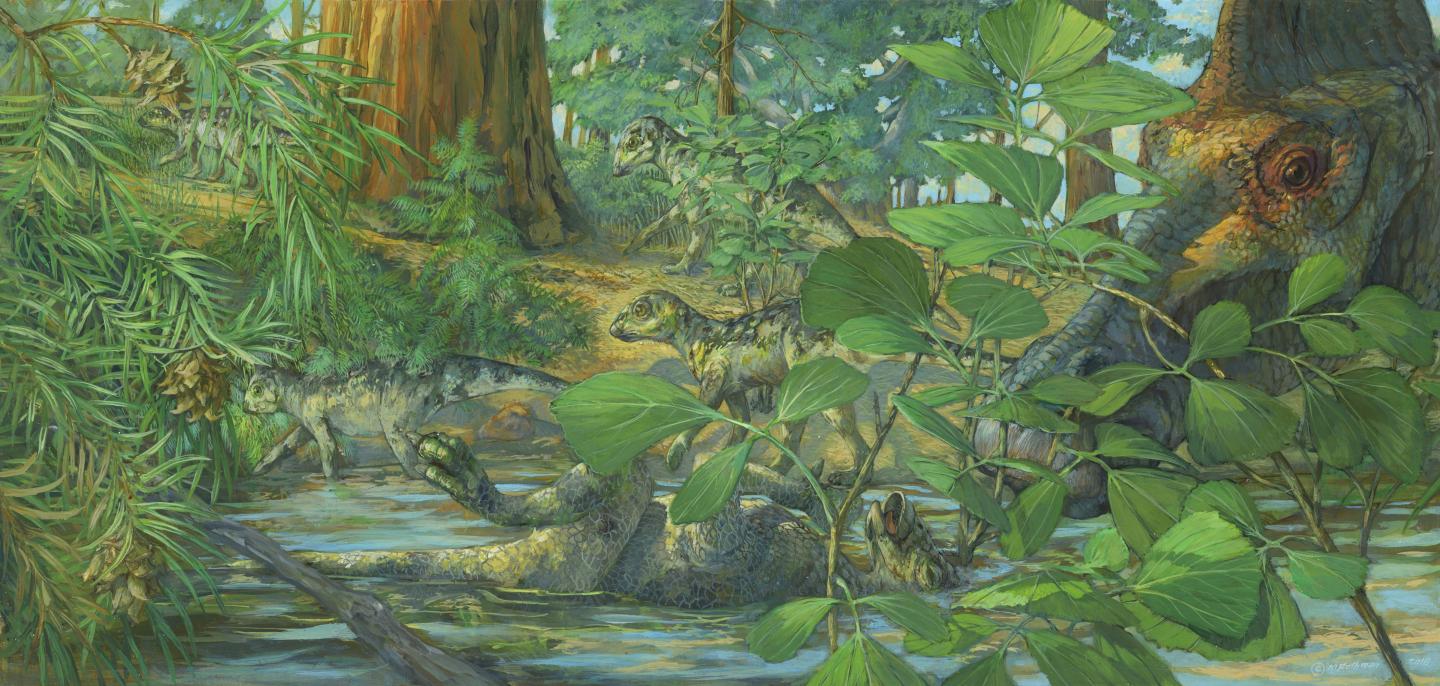
Cartilage cells, chromosomes and DNA preserved in 75 million-year-old baby duck-billed dinosaur

Bioengineer by Bioengineer
February 28, 2020
in Biology
Reading Time: 2 mins read
0
IMAGE
Share on FacebookShare on TwitterShare on LinkedinShare on RedditShare on Telegram

IMAGE

Credit: ©Science China Press


This study is lead by Dr. Alida Bailleul (Institute of Vertebrate Paleontology and Paleoanthropology, the Chinese Academy of Sciences) and Dr. Mary Schweitzer (North Carolina State University, NC Museum of Natural Sciences, Lund University and Museum of the Rockies). Microscopic analyses of skull fragments from these nestling dinosaurs were conducted by Alida Bailleul at the Museum of the Rockies. In one fragment she noticed some exquisitely preserved cells within preserved calcified cartilage tissues on the edges of a bone. Two cartilage cells were still linked together by an intercellular bridge, morphologically consistent with the end of cell division (see left image below). Internally, dark material resembling a cell nucleus was also visible. One cartilage cell preserved dark elongated structures morphologically consistent with chromosomes (center image below). “I couldn’t believe it, my heart almost stopped beating,” Bailleul says.

Bailleul and Schweitzer, together with lab director Wenxia Zheng, sought to determine whether original molecules were also preserved in this dinosaur cartilage. The team performed immunological and histochemical analyses on the skull of another nestling Hypacrosaurus from that same nesting ground in Schweitzer’s North Carolina laboratory.

The team found that the organic matrix surrounding the fossilized cartilage cells reacted to antibodies of Collagen II, the dominant protein in cartilage in all vertebrates. “This immunological test supports the presence of remnants of original cartilaginous proteins in this dinosaur,” Schweitzer says.

The researchers also isolated individual Hypacrosaurus cartilage cells and applied two DNA-stains, DAPI (4?,6-diamidino-2-phenylindole) and PI (propidium iodide). These bind specifically to DNA fragments in extant material, and some of the isolated dinosaur cells showed internal, positive binding in the same pattern as seen in modern cells, suggesting some original dinosaur DNA is preserved (see below, right image).

“These new exciting results add to growing evidence that cells and some of their biomolecules can persist in deep-time. They suggest DNA can preserve for tens of millions of years, and we hope that this study will encourage scientists working on ancient DNA to push current limits and to use new methodology in order to reveal all the unknown molecular secrets that ancient tissues have” Bailleul says.

The possibility that DNA can survive for tens of millions of years is not currently recognized by the scientific community. Rather, based upon kinetic experiments and modelling, it is generally accepted that DNA persists less than 1 million years. These new data support other results that suggest DNA in some form can persist in Mesozoic tissues, and lay the foundation for future efforts to recover and sequence DNA from other very ancient fossils in laboratories worldwide.

###

link: https://doi.org/10.1093/nsr/nwz206

Media Contact
Alida Bailleul
[email protected]

Related Journal Article

http://dx.doi.org/10.1093/nsr/nwz206

Tags: Biology
Share12Tweet8Share2ShareShareShare2

Related Posts

Florida Cane Toad: Complex Spread and Selective Evolution

Florida Cane Toad: Complex Spread and Selective Evolution

February 7, 2026
New Study Uncovers Mechanism Behind Burn Pit Particulate Matter–Induced Lung Inflammation

New Study Uncovers Mechanism Behind Burn Pit Particulate Matter–Induced Lung Inflammation

February 6, 2026

DeepBlastoid: Advancing Automated and Efficient Evaluation of Human Blastoids with Deep Learning

February 6, 2026

Navigating the Gut: The Role of Formic Acid in the Microbiome

February 6, 2026
Please login to join discussion

POPULAR NEWS

  • Robotic Ureteral Reconstruction: A Novel Approach

    Robotic Ureteral Reconstruction: A Novel Approach

    82 shares
    Share 33 Tweet 21
  • Digital Privacy: Health Data Control in Incarceration

    63 shares
    Share 25 Tweet 16
  • Study Reveals Lipid Accumulation in ME/CFS Cells

    57 shares
    Share 23 Tweet 14
  • Breakthrough in RNA Research Accelerates Medical Innovations Timeline

    53 shares
    Share 21 Tweet 13

About

We bring you the latest biotechnology news from best research centers and universities around the world. Check our website.

Follow us

Recent News

Phage-Antibiotic Combo Beats Resistant Peritoneal Infection

Boosting Remote Healthcare: Stepped-Wedge Trial Insights

Barriers and Boosters of Seniors’ Physical Activity in Karachi

Subscribe to Blog via Email

Enter your email address to subscribe to this blog and receive notifications of new posts by email.

Join 73 other subscribers
  • Contact Us

Bioengineer.org © Copyright 2023 All Rights Reserved.

Welcome Back!

Login to your account below

Forgotten Password?

Retrieve your password

Please enter your username or email address to reset your password.

Log In
No Result
View All Result
  • Homepages
    • Home Page 1
    • Home Page 2
  • News
  • National
  • Business
  • Health
  • Lifestyle
  • Science

Bioengineer.org © Copyright 2023 All Rights Reserved.