Credit: ©Science China Press
A research group from Zhejiang University in China has found that the noncentrosymmetric compound CaPtAs is a superconductor, which shows evidence for unconventional properties. This compound provides a new opportunity for studying unconventional superconductivity in systems with broken inversion symmetry.
The lack of an inversion center in the crystal structure of a compound can have profound effects on its physical properties. The interesting phenomena which have been found to arise includes spin-splitting of the Fermi surfaces, the lifting of the four-fold degeneracy of a Dirac point to yield two doubly degenerate Weyl nodes in Weyl semimetals, magnetic skyrmions with complex spin textures, and the characteristic properties of noncentrosymmetric superconductors.
The intensive study of noncentrosymmetric superconductors can be traced back to 2004, when the first example of this class of materials with strong electronic correlations was discovered by E. Bauer et al. In such a superconductor lacking an inversion center, the symmetry-allowed antisymmetric spin-orbit coupling (ASOC) allows for the admixture of spin-singlet and spin-triplet pairing states, which can give rise to a nodal superconducting gap. This has been evidenced in the weakly correlated noncentrosymmetric superconductors Li2(Pt, Pd)3B, where H. Q. Yuan et al. found that the strength of the ASOC can tune the relative strengths of the singlet and triplet components in the superconducting pairing wave function. In recent years, an increasing number of noncentrosymmetric superconductors with novel properties have been discovered, where some systems have been theoretically predicted to potentially exhibit topological superconductivity.
Recently, noncentrosymmetric superconductors where there are weak correlations but time reversal symmetry is broken below the superconducting transition temperature, have been much discussed. However, most of the other properties of these systems appear to be analogous to those of conventional BCS superconductors, with a fully open superconducting gap. The origin of this unusual behavior still requires explanation.
Here a research group led by Prof. Huiqiu Yuan from the Center for Correlated Matter (CCM) and Department of Physics at Zhejiang University have discovered a new noncentrosymmetric superconductor CaPtAs with possible unconventional pairing, which is published in SCIENCE CHINA: Physics, Mechanics & Astronomy, entitled “CaPtAs: a new noncentrosymmetric superconductor”.
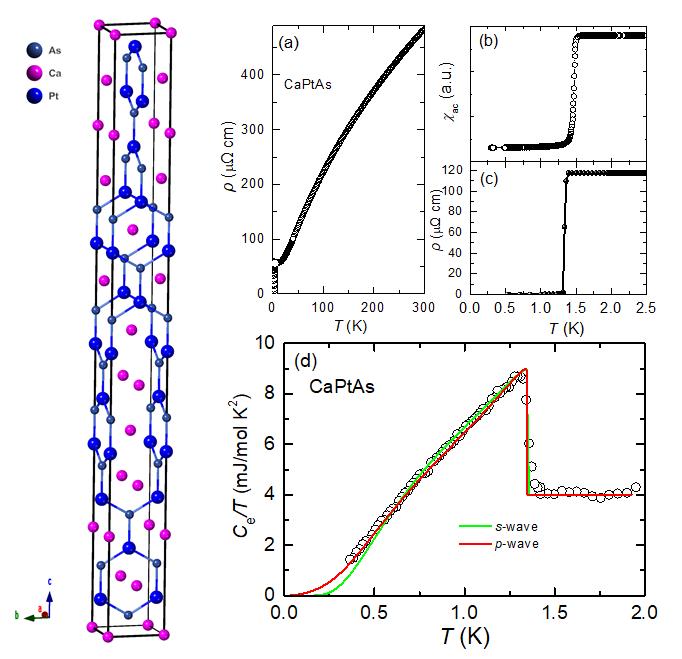
CaPtAs is a member of the alkaline-earth based equiatomic ternary compounds, crystallizing in a noncentrosymmetric tetragonal structure (space group I41md, No.109) with three-dimensional (3D) honeycomb networks. This is different to compounds such as SrPtAs, BaPtAs, and BaPtSb, which have structures consisting of stacked hexagonal honeycomb layers. Both single- and poly- crystals of CaPtAs have been successfully synthesized, and bulk superconductivity is confirmed below 1.5 K. Measurements of thermodynamic properties indicate possible nodes in the superconducting gap, where the electronic specific heat is well fitted by a p-wave model, as shown in Figure 1(d). Further collaborative studies are currently ongoing to determine the nature of the superconducting pairing state of CaPtAs.
###
More information about noncentrosymmetric superconductors can be found in the review paper: M. Smidman, et al. Superconductivity and spin-orbit coupling in non-centrosymmetric materials: a review, Rep. Prog. Phys. 80, 036501 (2017) (highly cited paper).
This research was funded by the National Key R&D Program of China (Grant Nos. 2016YFA0300202, and 2017YFA0303100), the National Natural Science Foundation of China (Grant Nos. U1632275, and 11874320), the Science Challenge Project of China (Grant No. TZ2016004), and the Fundamental Research Funds for the Central Universities.
See the article:
W. Xie, P. R. Zhang, B. Shen, W. B. Jiang, G. M. Pang, T. Shang, C. Cao, M. Smidman, and H. Q. Yuan, CaPtAs: A new noncentrosymmetric superconductor, Sci. China-Phys. Mech. Astron. 63, 237412 (2020), https:/
http://engine.
Media Contact
Yuan Huiqiu
[email protected]
Related Journal Article
http://dx.