KIT team develops printable organic photodiodes that can distinguish wavelengths and, hence, enable data transmission by light
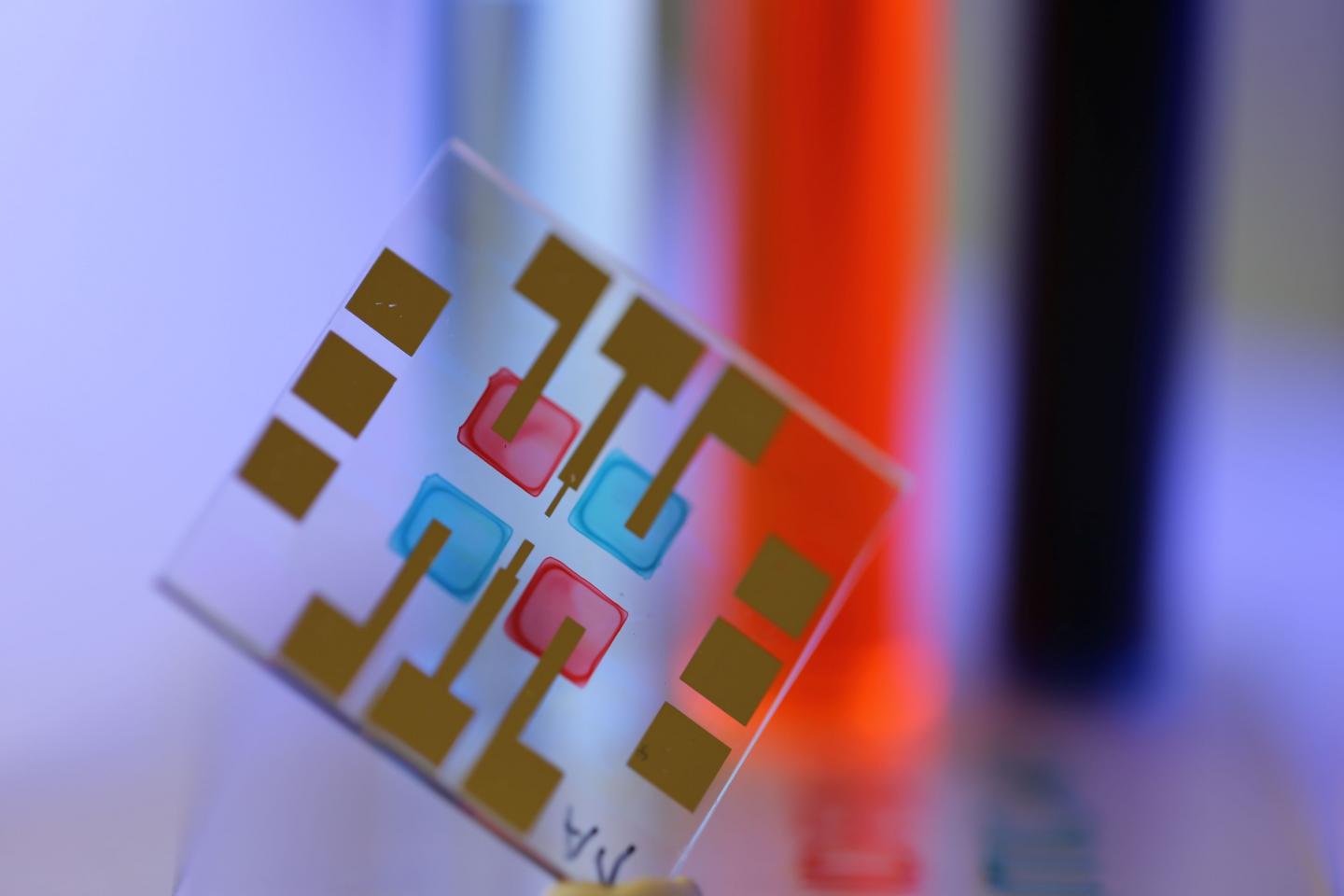
Credit: Photo: Noah Strobel, KIT
Cameras, light barriers, and movement sensors have one thing in common: They work with light sensors that are already found in many applications. In future, these sensors might also play an important role in telecommunications, as they enable data transmission via light. At the InnovationLab in Heidelberg, scientists of Karlsruhe Institute of Technology (KIT) succeeded in making decisive progress: Printable light sensors that can see colors. The results are now reported in Advanced Materials (DOI: 10.1002/adma.201908258).
New technologies will increase the demand for optical sensors for a variety of applications, including visible light communication (VLC). VLC uses interior lighting of buildings for optical communication. In terms of security, speed, and accessibility, this technology has a number of advantages over conventional transmission processes, such as WLAN or Bluetooth. “Our research is based on the idea of combining the advantages of a special type of materials, namely, organic semiconductors, and their production by printing processes,” says Dr. Gerardo Hernandez-Sosa of KIT’s Light Technology Institute, one of the authors of the publication.
Semiconductors are the basis of computers, smartphones, solar cells, and many other technologies. Some of the semiconducting materials react to light by changing their conductivity. Light intensity can be measured as electrical current. Using a printer, some materials can be applied to a carrier material like printing ink. These materials react to varying wavelengths, which means that they can distinguish colors. The team of Hernandez-Sosa has now succeeded in finding a composition of materials suited for use as wavelength-sensitive light detector as well as for printing onto flexible carriers. Printing can be performed on very small to very large areas. The layout can be designed easily with the help of a computer. “High numbers of these photodetectors of any design can be produced on flexible, light materials. Hence, they are particularly suited for mobile devices,” first author Noah Strobel points out.
Printing of semiconductor components is a relatively young process, but has a considerable potential for future applications. Industry is already making large investments in the production of printed OLED displays for TVs and smartphones. Printed flexible solar cells or pressure sensors are commercially available already. Production of printed light detectors has also reached the industrial scale. It is therefore highly probable that these elements will be used in many applications in future, even more so, as the demand for sensors is increasing in the internet of things, in smart cities, and in Industry 4.0.
###
Original Publication:
Noah Strobel, Nikolaos Droseros, Wolfgang Köntges, Mervin Seiberlich, Manuel Pietsch, Stefan Schlisske, Felix Lindheimer, Rasmus R. Schröder, Uli Lemmer, Martin Pfannmöller, Natalie Banerji, Gerardo Hernandez-Sosa: “Color-selective Printed Organic Photodiodes for Filterless Multichannel Visible Light Communication.” Advanced Materials, 2020.
DOI: 10.1002/adma.201908258.
https:/
More about the KIT Center Materials in Technical and Life Sciences: http://www.
Being “The Research University in the Helmholtz Association”, KIT creates and imparts knowledge for the society and the environment. It is the objective to make significant contributions to the global challenges in the fields of energy, mobility, and information. For this, about 9,300 employees cooperate in a broad range of disciplines in natural sciences, engineering sciences, economics, and the humanities and social sciences. KIT prepares its 24,400 students for responsible tasks in society, industry, and science by offering research-based study programs. Innovation efforts at KIT build a bridge between important scientific findings and their application for the benefit of society, economic prosperity, and the preservation of our natural basis of life. KIT is one of the German universities of excellence.
Media Contact
Monika Landgraf
[email protected]
49-721-608-21105
Original Source
https:/
Related Journal Article
http://dx.