Blue tits that are already associated in winter are more likely to have young together in spring
Credit: Kristina Beck
Winter associations predict social and extra-pair mating patterns in blue tits. Researchers of the Max Planck Institutes for Ornithology in Seewiesen and for Animal Behavior in Radolfzell show in their new study that blue tits that often foraged together during winter were more likely to end up as breeding pairs or as extra-pair partners, whereby bonds between future breeding partners seem to establish earlier in winter than those between future extra-pair partners.
Many socially monogamous bird species engage in sexual behaviour outside their pair bond, often resulting in extra-pair young. However, despite decades of research, the ability to explain who will have extra-pair young with whom is limited. Researchers of the Max Planck Institute for Ornithology and the Max Planck Institute of Animal Behavior now examined whether social associations prior to the breeding season influenced patterns of social and extra-pair mating. They studied blue tits that typically form socially monogamous pairs, but frequently engage in extra-pair mating. About half of all nests contain at least one young with a genetic father other than the social one, and up to 15 percent of all offspring are sired by extra-pair males. During winter, blue tits forage in large mixed-species flocks where they potentially already meet future mating partners.
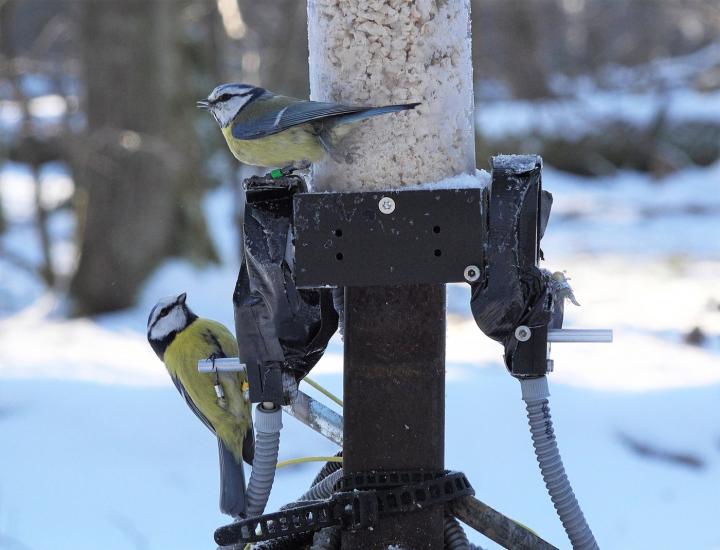
The researchers quantified the birds’ social associations during foraging events at local bird feeders and while visiting nest-boxes during winter. To obtain these data, they installed a self-designed, custom-built automated monitoring system including 20 feeders and 277 nest-boxes in their forest study site in Southern Germany. Blue tits in the study area carried a tiny “Passive Integrated Transponder” (PIT-tag) with an individual code activated externally by the scanning device in the feeder or nest-box. With this setup, the researchers could record the date, time, and identity of every PIT-tagged blue tit visiting. Using these data the researchers created a social network that visualizes who hangs out with whom and how often. They found that 39 percent of the birds present in the study site in winter bred in the subsequent spring. Nearly all social breeding pairs were formed by the individuals present during winter and those that foraged more often together were also more likely to end up as breeding pairs.
Most extra-pair sires are close neighbours
The social network analysis further shows that individuals that are more strongly associated during winter tend to nest closer together. “As most extra-pair sires are close neighbours, one could think that extra-pair paternity in blue tits might simply be the result of coincidental meetings between neighbours, and not a social preference for specific mating partners,” says Kristina Beck, first-author of the study. However, the analysis shows that mating patterns can be explained by the strong social association itself: males and females foraging together and those that co-inspected nest-boxes were more likely to have extra-pair young together in the subsequent breeding season.
The researchers also found temporal changes in the social network: social bonds between future breeding partners seem to be established earlier in winter than those between future extra-pair partners. Bart Kempenaers, leading the study, adds: “When and how individuals make mating decisions is still largely unknown. However, our research provides new insights into the dynamics of different types of social relationships. Our work shows that extra-pair mating often happens between individuals that already know each other.”
###
Original publication
Beck KB, Farine DR, Kempenaers B. 2020
Winter associations predict social and extra-pair mating patterns in a wild songbird.
Proc. R. Soc. B 20192626
Published:19 February 2020
https:/
Media Contact
Kristina Beck
[email protected]
49-815-793-2231
Original Source
https:/
Related Journal Article
http://dx.