• HOME
  • NEWS
  • EXPLORE
    • CAREER
      • Companies
      • Jobs
    • EVENTS
    • iGEM
      • News
      • Team
    • PHOTOS
    • VIDEO
    • WIKI
  • BLOG
  • COMMUNITY
    • FACEBOOK
    • INSTAGRAM
    • TWITTER
Saturday, February 7, 2026
BIOENGINEER.ORG
No Result
View All Result
  • Login
  • HOME
  • NEWS
  • EXPLORE
    • CAREER
      • Companies
      • Jobs
        • Lecturer
        • PhD Studentship
        • Postdoc
        • Research Assistant
    • EVENTS
    • iGEM
      • News
      • Team
    • PHOTOS
    • VIDEO
    • WIKI
  • BLOG
  • COMMUNITY
    • FACEBOOK
    • INSTAGRAM
    • TWITTER
  • HOME
  • NEWS
  • EXPLORE
    • CAREER
      • Companies
      • Jobs
        • Lecturer
        • PhD Studentship
        • Postdoc
        • Research Assistant
    • EVENTS
    • iGEM
      • News
      • Team
    • PHOTOS
    • VIDEO
    • WIKI
  • BLOG
  • COMMUNITY
    • FACEBOOK
    • INSTAGRAM
    • TWITTER
No Result
View All Result
Bioengineer.org
No Result
View All Result
Home NEWS Science News Chemistry

Nanolaminate-based design for UV laser mirror coating

Bioengineer by Bioengineer
February 18, 2020
in Chemistry
Reading Time: 2 mins read
0
IMAGE
Share on FacebookShare on TwitterShare on LinkedinShare on RedditShare on Telegram

IMAGE

Credit: by Meiping Zhu, Nuo Xu, Behshad Roshanzadeh, S. T. P. Boyd, Wolfgang Rudolph, Yingjie Chai, and Jianda Shao


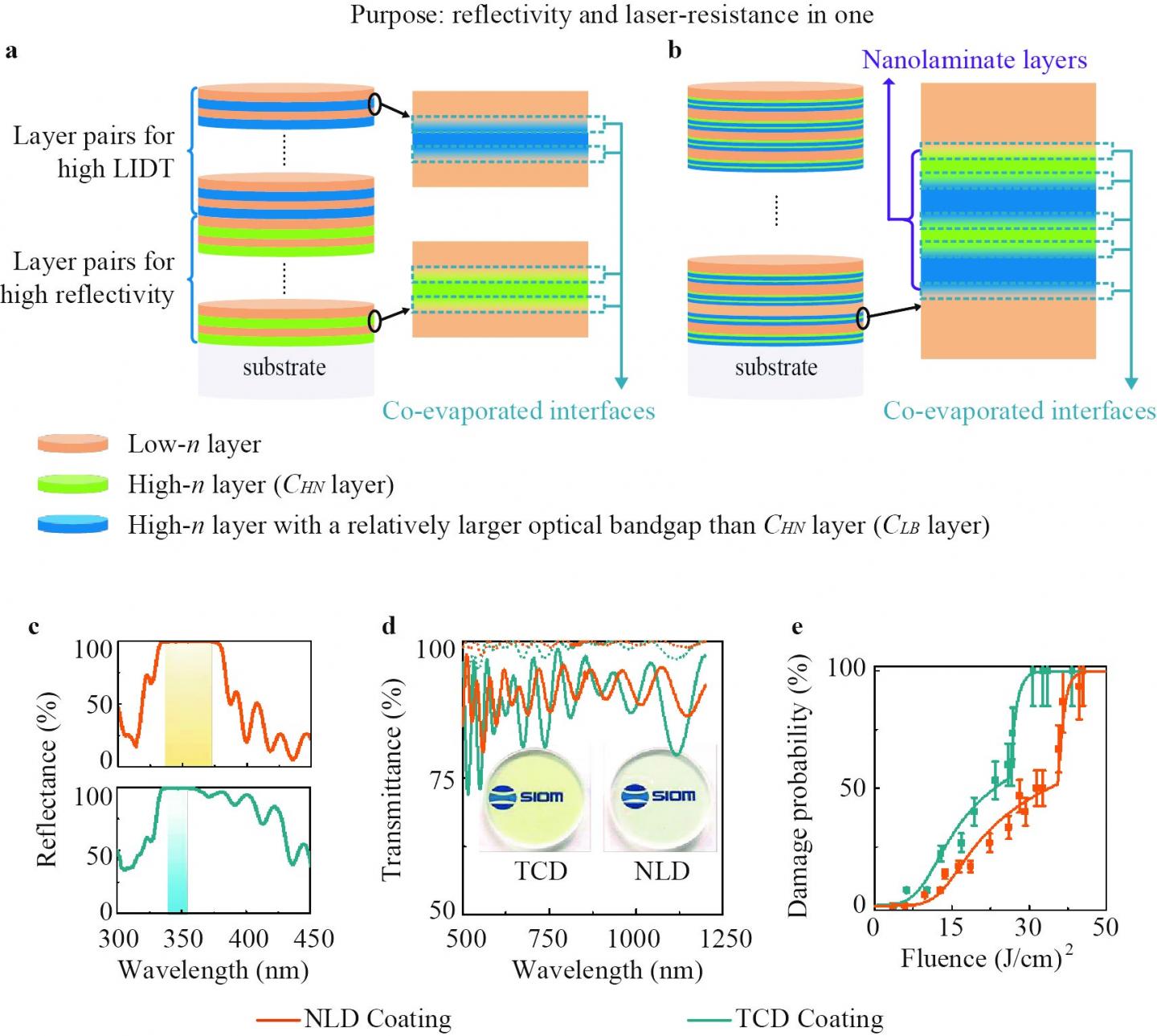
The demand for laser-resistant mirror coatings is increasing in Inertial Confinement Fusion, Extreme Light Infrastructure and other laser applications. The ideal UV laser mirror (UVLM) coating requires high reflectivity with large bandwidth and high laser-induced damage threshold (LIDT). Unfortunately, these requirements are difficult to satisfy simultaneously. This is due, for example, to the fact that high reflectivity requires high refractive index (n) materials, while higher n materials tend to have a smaller optical bandgap and therefore a lower LIDT. Traditionally, UVLMs were achieved by deposition of laser-resistant layers on high reflective layers. However, compromises are made for the seemingly contradictory requirements.

In a new paper published in Light Science & Application, scientists from the Laboratory of Thin Film Optics, Shanghai Institute of Optics and Fine Mechanics, Chinese Academy of Sciences, China, the Department of Physics and Astronomy, University of New Mexico, USA, and co-workers proposed a “reflectivity and laser-resistance in one” design by using tunable nanolaminate layers (NLD coating). An Al2O3-HfO2 nanolaminate-based mirror coating for UV laser applications was experimentally demonstrated using e-beam deposition. The bandwidth, over which the reflectance is larger than 99.5%, is more than twice that of a traditional “reflectivity bottom and LIDT top” combination design (TCD coating) mirror of comparable overall thickness. The LIDT is increased by a factor of ~1.3 for 7.6 ns pulses at a wavelength of 355 nm. The reported concept resulting in improved performance parameters paves the way toward a new generation of UV coatings for high-power laser applications.

The proposed new structure replaces the high-n materials in the traditional designs with nanolaminate layers. These scientists summarize the principle of their design structure:

“The (average) refractive index and optical bandgap can be tuned by adjusting the thickness ratio of the two materials in the nanolaminate layers, while keeping the total optical thickness constant.” “The proposed method enables UVML coatings with larger high reflectivity bandwidth, higher LIDT and smaller transmission ripples in the VIS-NIR region compared to traditional designs of comparable overall thickness.”

“Compared to the TCD coating, the NLD coating has a lower E-field intensification, a faster E-field decay with depth and smaller absorption, which are consistent with the observed higher LIDT.” they added.

“The e-beam deposited nanolaminate materials can be used for large-size (meter-scale) UVML coatings. We believe that the described concept opens new avenues for improved UV coatings and can benefit many areas of laser technology that rely on high-quality optical coatings.” the scientists forecast.

###

Media Contact
Meiping Zhu
[email protected]

Related Journal Article

http://dx.doi.org/10.1038/s41377-020-0257-4

Tags: Chemistry/Physics/Materials SciencesOptics
Share12Tweet8Share2ShareShareShare2

Related Posts

blank

Breakthrough in Environmental Cleanup: Scientists Develop Solar-Activated Biochar for Faster Remediation

February 7, 2026
blank

Cutting Costs: Making Hydrogen Fuel Cells More Affordable

February 6, 2026

Scientists Develop Hand-Held “Levitating” Time Crystals

February 6, 2026

Observing a Key Green-Energy Catalyst Dissolve Atom by Atom

February 6, 2026
Please login to join discussion

POPULAR NEWS

  • Robotic Ureteral Reconstruction: A Novel Approach

    Robotic Ureteral Reconstruction: A Novel Approach

    82 shares
    Share 33 Tweet 21
  • Digital Privacy: Health Data Control in Incarceration

    63 shares
    Share 25 Tweet 16
  • Study Reveals Lipid Accumulation in ME/CFS Cells

    57 shares
    Share 23 Tweet 14
  • Breakthrough in RNA Research Accelerates Medical Innovations Timeline

    53 shares
    Share 21 Tweet 13

About

We bring you the latest biotechnology news from best research centers and universities around the world. Check our website.

Follow us

Recent News

Phage-Antibiotic Combo Beats Resistant Peritoneal Infection

Boosting Remote Healthcare: Stepped-Wedge Trial Insights

Barriers and Boosters of Seniors’ Physical Activity in Karachi

Subscribe to Blog via Email

Enter your email address to subscribe to this blog and receive notifications of new posts by email.

Join 73 other subscribers
  • Contact Us

Bioengineer.org © Copyright 2023 All Rights Reserved.

Welcome Back!

Login to your account below

Forgotten Password?

Retrieve your password

Please enter your username or email address to reset your password.

Log In
No Result
View All Result
  • Homepages
    • Home Page 1
    • Home Page 2
  • News
  • National
  • Business
  • Health
  • Lifestyle
  • Science

Bioengineer.org © Copyright 2023 All Rights Reserved.