• HOME
  • NEWS
  • EXPLORE
    • CAREER
      • Companies
      • Jobs
    • EVENTS
    • iGEM
      • News
      • Team
    • PHOTOS
    • VIDEO
    • WIKI
  • BLOG
  • COMMUNITY
    • FACEBOOK
    • INSTAGRAM
    • TWITTER
Saturday, February 7, 2026
BIOENGINEER.ORG
No Result
View All Result
  • Login
  • HOME
  • NEWS
  • EXPLORE
    • CAREER
      • Companies
      • Jobs
        • Lecturer
        • PhD Studentship
        • Postdoc
        • Research Assistant
    • EVENTS
    • iGEM
      • News
      • Team
    • PHOTOS
    • VIDEO
    • WIKI
  • BLOG
  • COMMUNITY
    • FACEBOOK
    • INSTAGRAM
    • TWITTER
  • HOME
  • NEWS
  • EXPLORE
    • CAREER
      • Companies
      • Jobs
        • Lecturer
        • PhD Studentship
        • Postdoc
        • Research Assistant
    • EVENTS
    • iGEM
      • News
      • Team
    • PHOTOS
    • VIDEO
    • WIKI
  • BLOG
  • COMMUNITY
    • FACEBOOK
    • INSTAGRAM
    • TWITTER
No Result
View All Result
Bioengineer.org
No Result
View All Result
Home NEWS Science News Chemistry

Gold nanoclusters: new frontier for developing medication for treatment of Alzheimer’s disease

Bioengineer by Bioengineer
February 14, 2020
in Chemistry
Reading Time: 2 mins read
0
IMAGE
Share on FacebookShare on TwitterShare on LinkedinShare on RedditShare on Telegram

IMAGE

Credit: ©Science China Press


Alzheimer’s disease (AD) is a progressive neurodegenerative disorder characterized by amyloid-β (Aβ) fibrillation and plaque formation. While more than 50 millions of people are devastated by AD, no treatment is available. Recently, anti-Aβ antibody-based immunotherapy has failed in clinical trials, partially due to the increased cytotoxicity of soluble Aβ oligomers. Therefore, developing a medication for AD treatment becomes an even more grave challenge.

In a new research article published in the Beijing-based National Science Review, scientists at the State Key Laboratory of Advanced Technology for Materials Synthesis and Processing, Wuhan University of Technology in China explored the possibility of treating with gold nanoclusters.

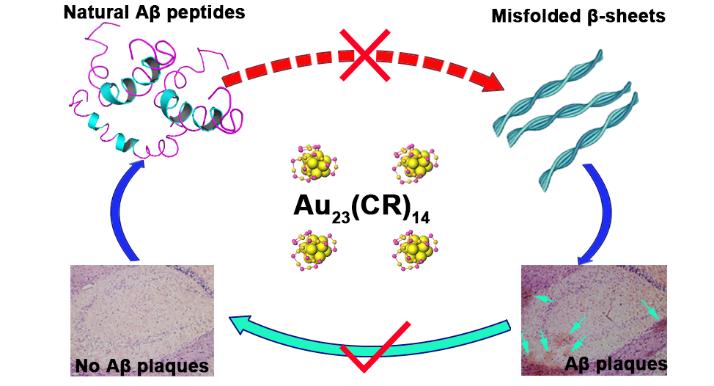
As illustrated in Figure 1, Au23(CR)14, a novel gold nanocluster modified with Cys-Arg (CR) dipeptide, functions in multiple stages of the progression from Aβ monomer to Aβ plaques: inhibiting the misfolding and fibrillation of amyloid-β (Aβ), fully dissolving the preformed/mature Aβ fibrils and restoring the conformation of Aβ peptides from misfolded β-sheets into unfolded monomer state with abolished cytotoxicity, and more importantly, completely dissolving endogenous Aβ plaques in the brain slices from transgenic AD model mice. Furthermore, Au23(CR)14 has good biocompatibility and infiltration ability across the blood brain barrier (BBB).

This article not only presents a compelling nanotherapeutic candidate for AD treatment, but also opens a new frontier for developing nanomaterial-based medications for AD treatment. Undoubtedly, more researches studying the basic mechanisms by which gold nanoclusters dissolve Aβ plaques will spur the development of new medications for AD treatment.

###

This research received funding from the National Natural Science Foundation of China (21975191, 21805218, 51873168, 81803515, 51533007 and 51521001) and the Natural Science Foundation of Hubei Province (2018CFA002 and 2018CFB348).

See the article:

Wenkang Zhang, Guanbin Gao*, Zhongjie Ma, Zhuoying Luo, Meng He, and Taolei Sun*

Au23(CR)14 Nanocluster Restores Fibril Aβ’s Unfolded State with Abolished Cytotoxicity and Dissolves Endogenous Aβ Plaques

Natl Sci Rev Doi:10.1093/nsr/nwz215

https://doi.org/10.1093/nsr/nwz215

The National Science Review is the first comprehensive scholarly journal released in English in China that is aimed at linking the country’s rapidly advancing community of scientists with the global frontiers of science and technology. The journal also aims to shine a worldwide spotlight on scientific research advances across China.

Media Contact
Taolei Sun
[email protected]

Related Journal Article

http://dx.doi.org/10.1093/nsr/nwz215

Tags: Chemistry/Physics/Materials Sciences
Share12Tweet8Share2ShareShareShare2

Related Posts

blank

Breakthrough in Environmental Cleanup: Scientists Develop Solar-Activated Biochar for Faster Remediation

February 7, 2026
blank

Cutting Costs: Making Hydrogen Fuel Cells More Affordable

February 6, 2026

Scientists Develop Hand-Held “Levitating” Time Crystals

February 6, 2026

Observing a Key Green-Energy Catalyst Dissolve Atom by Atom

February 6, 2026
Please login to join discussion

POPULAR NEWS

  • Robotic Ureteral Reconstruction: A Novel Approach

    Robotic Ureteral Reconstruction: A Novel Approach

    82 shares
    Share 33 Tweet 21
  • Digital Privacy: Health Data Control in Incarceration

    63 shares
    Share 25 Tweet 16
  • Study Reveals Lipid Accumulation in ME/CFS Cells

    57 shares
    Share 23 Tweet 14
  • Breakthrough in RNA Research Accelerates Medical Innovations Timeline

    53 shares
    Share 21 Tweet 13

About

We bring you the latest biotechnology news from best research centers and universities around the world. Check our website.

Follow us

Recent News

Evaluating Pediatric Emergency Care Quality in Ethiopia

TPMT Expression Predictions Linked to Azathioprine Side Effects

Improving Dementia Care with Enhanced Activity Kits

Subscribe to Blog via Email

Enter your email address to subscribe to this blog and receive notifications of new posts by email.

Join 73 other subscribers
  • Contact Us

Bioengineer.org © Copyright 2023 All Rights Reserved.

Welcome Back!

Login to your account below

Forgotten Password?

Retrieve your password

Please enter your username or email address to reset your password.

Log In
No Result
View All Result
  • Homepages
    • Home Page 1
    • Home Page 2
  • News
  • National
  • Business
  • Health
  • Lifestyle
  • Science

Bioengineer.org © Copyright 2023 All Rights Reserved.