• HOME
  • NEWS
  • EXPLORE
    • CAREER
      • Companies
      • Jobs
    • EVENTS
    • iGEM
      • News
      • Team
    • PHOTOS
    • VIDEO
    • WIKI
  • BLOG
  • COMMUNITY
    • FACEBOOK
    • INSTAGRAM
    • TWITTER
Wednesday, April 8, 2026
BIOENGINEER.ORG
No Result
View All Result
  • Login
  • HOME
  • NEWS
  • EXPLORE
    • CAREER
      • Companies
      • Jobs
        • Lecturer
        • PhD Studentship
        • Postdoc
        • Research Assistant
    • EVENTS
    • iGEM
      • News
      • Team
    • PHOTOS
    • VIDEO
    • WIKI
  • BLOG
  • COMMUNITY
    • FACEBOOK
    • INSTAGRAM
    • TWITTER
  • HOME
  • NEWS
  • EXPLORE
    • CAREER
      • Companies
      • Jobs
        • Lecturer
        • PhD Studentship
        • Postdoc
        • Research Assistant
    • EVENTS
    • iGEM
      • News
      • Team
    • PHOTOS
    • VIDEO
    • WIKI
  • BLOG
  • COMMUNITY
    • FACEBOOK
    • INSTAGRAM
    • TWITTER
No Result
View All Result
Bioengineer.org
No Result
View All Result
Home NEWS Science News Chemistry

New progress in turbulent combustion modeling: Filtered flamelet model

Bioengineer by Bioengineer
February 7, 2020
in Chemistry
Reading Time: 2 mins read
0
IMAGE
Share on FacebookShare on TwitterShare on LinkedinShare on RedditShare on Telegram

IMAGE

Credit: ©Science China Press


In turbulent combustion, the interaction between the strong nonlinear reaction source and turbulence leads to broad spectrum of the spatio and temporal scales. From the modeling point of view, it is especially challenging to predict the field statistics satisfactorily. Although there are different turbulent combustion models, e.g. the flamelet-like model, probability density function-like model, conditional moment closure model and eddy dissipation concept model, the bases of the model closure have not been reasonably justified. Recently, a new modeling idea for turbulent diffusion flame has been proposed by Lipo Wang’s group from Shanghai Jiao Tong University and Jian Zhang from the Institute of Mechanics, CAS. The article titled “non-premixed turbulent combustion modeling based on the filtered turbulent flamelet equation” was published in SCIENCE CHINA Physics, Mechanics & Astronomy.

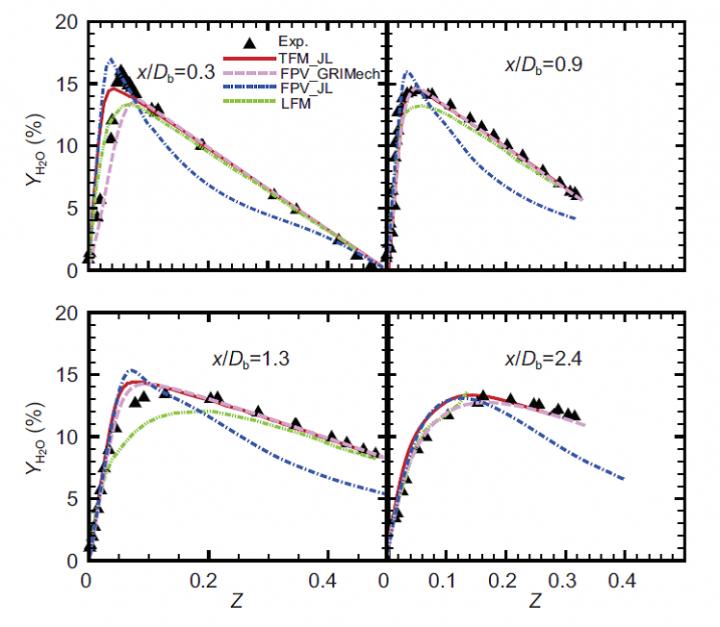
In the framework of large eddy simulation (LES), a new filtered flamelet equation was first derived, based on which a filtered flamelet model could be constructed directly from the filtered quantities. For instance, the scalar dissipation rate of the filtered progress variable, instead of the unfiltered one, is involved in the model construction. Therefore, the model uncertainty can be largely reduced. Figures 1 and 2 show the comparison between the simulation results of the Sydney bluff-body turbulent jet flame using different models, including the newly proposed filtered flamelet model with simplified mechanism (solid red lines), the flamelet/progress variable approach with detailed mechanism (dotted pink lines); the flamelet/progress variable approach with simplified mechanism (dotted blue lines), the laminar flamelet model with detailed mechanism (dotted green lines) and the experiment results (solid triangle marks). Overall, the new model results agree satisfactorily with the experimental data.

In summary, the promising performance of the present filtered flamelet model can be attributed to the new inspiration of model construction based on the filter flamelet equation. Further improvement and various case tests will be implemented in future’s work.

###

See the article:
J. Zhang, L. P.Wang, and Y. Q. Guo, Non-premixed turbulent combustion modeling based on the filtered turbulent flamelet equation, Sci. China-Phys. Mech. Astron. 63, 244711 (2020), https://doi.org/10.1007/s11433-019-1458-4

http://engine.scichina.com/publisher/scp/journal/SCPMA/63/4/10.1007/s11433-019-1458-4?slug=fulltext

Media Contact
Yan Bei
[email protected]

Related Journal Article

http://dx.doi.org/10.1007/s11433-019-1458-4

Tags: Chemistry/Physics/Materials Sciences
Share12Tweet8Share2ShareShareShare2

Related Posts

Innovative Gray Wolf-Optimized Hybrid Regression Technique Enhances State of Health Estimation for Bipolar Lead-Acid Batteries

Innovative Gray Wolf-Optimized Hybrid Regression Technique Enhances State of Health Estimation for Bipolar Lead-Acid Batteries

April 8, 2026
Harnessing Industrial Waste Heat: Innovative Dynamic Model Enhances “Carnot Batteries” for Sustainable Energy Storage

Harnessing Industrial Waste Heat: Innovative Dynamic Model Enhances “Carnot Batteries” for Sustainable Energy Storage

April 8, 2026

Precision-Engineered High-Performance Photodetector Delivers Exceptional Power Detection

April 8, 2026

Innovative Technique Enhances Stability in Quantum Operations

April 8, 2026
Please login to join discussion

POPULAR NEWS

  • blank

    Revolutionary AI Model Enhances Precision in Detecting Food Contamination

    98 shares
    Share 39 Tweet 25
  • Imagine a Social Media Feed That Challenges Your Views Instead of Reinforcing Them

    1010 shares
    Share 399 Tweet 250
  • Popular Anti-Aging Compound Linked to Damage in Corpus Callosum, Study Finds

    44 shares
    Share 18 Tweet 11
  • Promising Outcomes from First Clinical Trials of Gene Regulation in Epilepsy

    51 shares
    Share 20 Tweet 13

About

We bring you the latest biotechnology news from best research centers and universities around the world. Check our website.

Follow us

Recent News

Scalable Optical Vortex Arrays via LG Beam Decomposition

Palbociclib Plus Endocrine Therapy vs Chemotherapy: Trial

Saturation Editing of RNU4-2 Reveals Disorders

Subscribe to Blog via Email

Enter your email address to subscribe to this blog and receive notifications of new posts by email.

Join 78 other subscribers
  • Contact Us

Bioengineer.org © Copyright 2023 All Rights Reserved.

Welcome Back!

Login to your account below

Forgotten Password?

Retrieve your password

Please enter your username or email address to reset your password.

Log In
No Result
View All Result
  • Homepages
    • Home Page 1
    • Home Page 2
  • News
  • National
  • Business
  • Health
  • Lifestyle
  • Science

Bioengineer.org © Copyright 2023 All Rights Reserved.