• HOME
  • NEWS
  • EXPLORE
    • CAREER
      • Companies
      • Jobs
    • EVENTS
    • iGEM
      • News
      • Team
    • PHOTOS
    • VIDEO
    • WIKI
  • BLOG
  • COMMUNITY
    • FACEBOOK
    • INSTAGRAM
    • TWITTER
Saturday, February 7, 2026
BIOENGINEER.ORG
No Result
View All Result
  • Login
  • HOME
  • NEWS
  • EXPLORE
    • CAREER
      • Companies
      • Jobs
        • Lecturer
        • PhD Studentship
        • Postdoc
        • Research Assistant
    • EVENTS
    • iGEM
      • News
      • Team
    • PHOTOS
    • VIDEO
    • WIKI
  • BLOG
  • COMMUNITY
    • FACEBOOK
    • INSTAGRAM
    • TWITTER
  • HOME
  • NEWS
  • EXPLORE
    • CAREER
      • Companies
      • Jobs
        • Lecturer
        • PhD Studentship
        • Postdoc
        • Research Assistant
    • EVENTS
    • iGEM
      • News
      • Team
    • PHOTOS
    • VIDEO
    • WIKI
  • BLOG
  • COMMUNITY
    • FACEBOOK
    • INSTAGRAM
    • TWITTER
No Result
View All Result
Bioengineer.org
No Result
View All Result
Home NEWS Science News Chemistry

Scientists discover new non-sticky gels

Bioengineer by Bioengineer
February 3, 2020
in Chemistry
Reading Time: 2 mins read
0
IMAGE
Share on FacebookShare on TwitterShare on LinkedinShare on RedditShare on Telegram

IMAGE

Credit: University of Bristol


Scientists from the University of Bristol and Université Paris-Saclay have discovered a new class of material – non-sticky gels.

Until now gels have been made of particles that stick to one another to form a network.

The research team, whose findings are published in the journal Proceedings of the National Academy of Sciences, have now shown that networks and from and persist without the particles sticking to one another if the particles behave as liquid crystals.

Professor C Patrick-Royall, from the University of Bristol’s School of Chemistry, said: “Networks of micron — and sub-micron — sized colloidal particles, gels, are absolutely the stuff of everyday life.

“They are found from cosmetics to food and even in biological tissue. Yet our understanding of colloidal gels lags far behind their utility: Gels are out-of-equilibrium, so their properties change over time, often with significant consequences, such as failure or collapse.

“However, until now, we were confident of one thing: To aggregate into a network, the colloidal particles need to attract one another.”

Working with Dr Jeroen van Duijnevelt, also from Bristol, and Claudia Ferreiro-Cordova at Université Paris-Saclay, the team discovered that in fact the colloidal particles don’t need to stick together to form gels.

This new class of material “non-sticky gels”, forms when the colloids instead behave as a liquid crystal.

Liquid crystals, which are fundamental to display technology, are formed when the constituent molecules line up in one direction, while still remaining liquid.

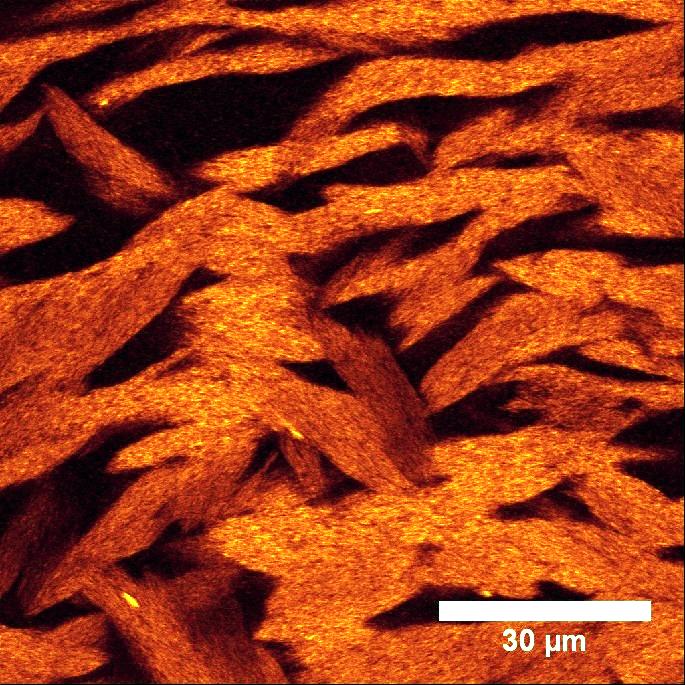
Here, instead of molecules, the colloidal particles, made of sepiolite clay line up preferentially in one direction and form a highly viscous network like conventional colloidal gels, but without needing attractions between the particles to hold them together.

The particles form a microscopic network with a structure a bit like a bird’s nest.

The researchers expect that their discovery will enable the development of new gel formulations with improved mechanical properties and longer shelf-life, which is a major limitation of many products today.

###

Media Contact
Paddy Royall
[email protected]

Related Journal Article

http://dx.doi.org/10.1073/pnas.1909357117

Tags: Chemistry/Physics/Materials Sciences
Share12Tweet8Share2ShareShareShare2

Related Posts

blank

Breakthrough in Environmental Cleanup: Scientists Develop Solar-Activated Biochar for Faster Remediation

February 7, 2026
blank

Cutting Costs: Making Hydrogen Fuel Cells More Affordable

February 6, 2026

Scientists Develop Hand-Held “Levitating” Time Crystals

February 6, 2026

Observing a Key Green-Energy Catalyst Dissolve Atom by Atom

February 6, 2026
Please login to join discussion

POPULAR NEWS

  • Robotic Ureteral Reconstruction: A Novel Approach

    Robotic Ureteral Reconstruction: A Novel Approach

    82 shares
    Share 33 Tweet 21
  • Digital Privacy: Health Data Control in Incarceration

    63 shares
    Share 25 Tweet 16
  • Study Reveals Lipid Accumulation in ME/CFS Cells

    57 shares
    Share 23 Tweet 14
  • Breakthrough in RNA Research Accelerates Medical Innovations Timeline

    53 shares
    Share 21 Tweet 13

About

We bring you the latest biotechnology news from best research centers and universities around the world. Check our website.

Follow us

Recent News

Phage-Antibiotic Combo Beats Resistant Peritoneal Infection

Boosting Remote Healthcare: Stepped-Wedge Trial Insights

Barriers and Boosters of Seniors’ Physical Activity in Karachi

Subscribe to Blog via Email

Enter your email address to subscribe to this blog and receive notifications of new posts by email.

Join 73 other subscribers
  • Contact Us

Bioengineer.org © Copyright 2023 All Rights Reserved.

Welcome Back!

Login to your account below

Forgotten Password?

Retrieve your password

Please enter your username or email address to reset your password.

Log In
No Result
View All Result
  • Homepages
    • Home Page 1
    • Home Page 2
  • News
  • National
  • Business
  • Health
  • Lifestyle
  • Science

Bioengineer.org © Copyright 2023 All Rights Reserved.