• HOME
  • NEWS
  • EXPLORE
    • CAREER
      • Companies
      • Jobs
    • EVENTS
    • iGEM
      • News
      • Team
    • PHOTOS
    • VIDEO
    • WIKI
  • BLOG
  • COMMUNITY
    • FACEBOOK
    • INSTAGRAM
    • TWITTER
Thursday, July 9, 2026
BIOENGINEER.ORG
No Result
View All Result
  • Login
  • HOME
  • NEWS
  • EXPLORE
    • CAREER
      • Companies
      • Jobs
        • Lecturer
        • PhD Studentship
        • Postdoc
        • Research Assistant
    • EVENTS
    • iGEM
      • News
      • Team
    • PHOTOS
    • VIDEO
    • WIKI
  • BLOG
  • COMMUNITY
    • FACEBOOK
    • INSTAGRAM
    • TWITTER
  • HOME
  • NEWS
  • EXPLORE
    • CAREER
      • Companies
      • Jobs
        • Lecturer
        • PhD Studentship
        • Postdoc
        • Research Assistant
    • EVENTS
    • iGEM
      • News
      • Team
    • PHOTOS
    • VIDEO
    • WIKI
  • BLOG
  • COMMUNITY
    • FACEBOOK
    • INSTAGRAM
    • TWITTER
No Result
View All Result
Bioengineer.org
No Result
View All Result
Home NEWS Science News Biology

New membranes for cellular recycling

Bioengineer by Bioengineer
February 3, 2020
in Biology
Reading Time: 2 mins read
0
IMAGE
Share on FacebookShare on TwitterShare on LinkedinShare on RedditShare on Telegram

Cells produce the shell of the autophagosomes on the spot
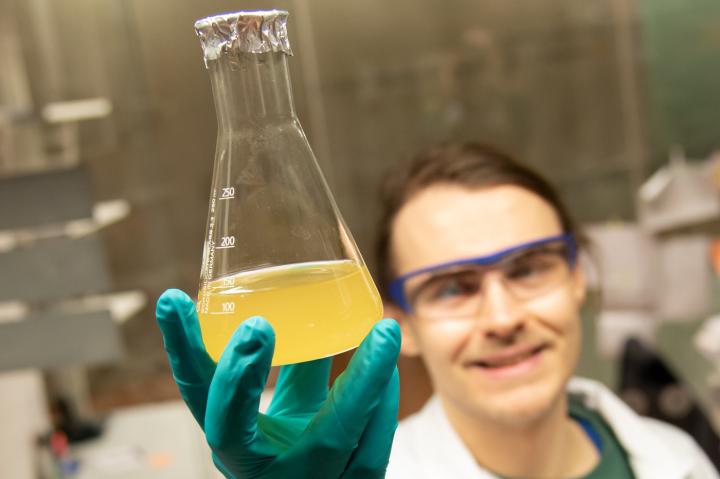
IMAGE

Credit: MPI for Biology of Ageing


There is a constant spring-cleaning in our cells: The cell’s own recycling system, so-called autophagy, fills garbage bags with cellular waste, transports them to the recycling yard and makes the decomposed material available again. Researchers from the Max Planck Institute for Biology of Ageing in Cologne, Germany, have now been able to show in the model organism yeast that the membrane of the garbage bags, known as autophagosomes, is newly produced on the spot around the garbage and not built of already existing components.

The self-renewal of cells through autophagy is a central process in the body. It also plays a role in ageing and many age-related diseases. The rule of thumb is: the more recycling, the longer you live. “If we manage to optimize the autophagy machinery, this could improve health in old age, but of course we first need to understand precisely how it works,” explains Martin Graef, research group leader at the Max Planck Institute.

Therefore, Maximilian Schütter, a doctoral student in Martin Graef’s research group, took a close look at how the garbage bags are made. These so-called autophagosomes consist of phospholipid membranes that form around the cellular waste and then transport it for recycling. Until now, it has always been assumed that membranes already present in the cell are assembled around the waste. However, the researchers have now been able to show that the membrane is instead newly formed on the spot. To do this, a protein located on the membrane of the autophagosomes activates free fatty acids and makes them available for the production of phospholipids, which are then incorporated into the expanding membrane.

“This discovery is so fundamental that not only our view of autophagy has changed, but many new research approaches are opening up,” explains Graef. It is known, for example, that recycling in the cells deteriorates when a diet is very rich in fat. “We may have found an explanation for this. Since free fatty acids are incorporated into the membrane, a change in the composition of the fats might have a direct effect on autophagy as a result of a different diet.”

###

Original publication

Maximilian Schütter, Patrick Giavalisco, Susanne Brodesser, Martin Graef

Local fatty acid channeling into phospholipid synthesis drives phagophore expansion during autophagy

Cell, Volume 180, Issue 1, 9 January 2020

Media Contact
Martin Graef
[email protected]
49-221-379-70470

Original Source

https://www.mpg.de/14397380/new-membranes-for-cellular-recycling

Related Journal Article

http://dx.doi.org/10.1016/j.cell.2019.12.005

Tags: BiologyCell Biology
Share12Tweet8Share2ShareShareShare2

Related Posts

Decades-Old Fossils Reveal Extinct Giant Salamander Species Rediscovered

Decades-Old Fossils Reveal Extinct Giant Salamander Species Rediscovered

July 9, 2026
Macrophages Key to Organ Transplant Rejection and New Treatments

Macrophages Key to Organ Transplant Rejection and New Treatments

July 9, 2026

Global study reveals key process controlling cellular fat energy use

July 9, 2026

Caddisfly Silk Gene Rapidly Evolves While Keeping Its Stickiness

July 9, 2026
Please login to join discussion

POPULAR NEWS

  • Detection of EDCs in Breast Milk and Infant Urine Up to Six Months Highlights Early Exposure Risks

    77 shares
    Share 31 Tweet 19
  • New Drug Candidate Developed at McMaster Shows Potential for Treating Brain Cancer

    58 shares
    Share 23 Tweet 15
  • KTU Researchers Explore Ultrasound’s Role in Enhancing Blood Flow Beyond Diagnostics

    53 shares
    Share 21 Tweet 13
  • 高齢者の骨粗鬆症治療の持続性比較

    51 shares
    Share 20 Tweet 13

About

We bring you the latest biotechnology news from best research centers and universities around the world. Check our website.

Follow us

Recent News

GBA1 Status and Sex Influence Depression Severity in Parkinson’s Disease

Study Explores AI-Powered Personal Training Effectiveness

Unraveling the Epigenome Behind Leukemia Diversity

Subscribe to Blog via Email

Enter your email address to subscribe to this blog and receive notifications of new posts by email.

Join 84 other subscribers
  • Contact Us

Bioengineer.org © Copyright 2023 All Rights Reserved.

Welcome Back!

Login to your account below

Forgotten Password?

Retrieve your password

Please enter your username or email address to reset your password.

Log In
No Result
View All Result
  • Homepages
    • Home Page 1
    • Home Page 2
  • News
  • National
  • Business
  • Health
  • Lifestyle
  • Science

Bioengineer.org © Copyright 2023 All Rights Reserved.