• HOME
  • NEWS
  • EXPLORE
    • CAREER
      • Companies
      • Jobs
    • EVENTS
    • iGEM
      • News
      • Team
    • PHOTOS
    • VIDEO
    • WIKI
  • BLOG
  • COMMUNITY
    • FACEBOOK
    • INSTAGRAM
    • TWITTER
Saturday, June 27, 2026
BIOENGINEER.ORG
No Result
View All Result
  • Login
  • HOME
  • NEWS
  • EXPLORE
    • CAREER
      • Companies
      • Jobs
        • Lecturer
        • PhD Studentship
        • Postdoc
        • Research Assistant
    • EVENTS
    • iGEM
      • News
      • Team
    • PHOTOS
    • VIDEO
    • WIKI
  • BLOG
  • COMMUNITY
    • FACEBOOK
    • INSTAGRAM
    • TWITTER
  • HOME
  • NEWS
  • EXPLORE
    • CAREER
      • Companies
      • Jobs
        • Lecturer
        • PhD Studentship
        • Postdoc
        • Research Assistant
    • EVENTS
    • iGEM
      • News
      • Team
    • PHOTOS
    • VIDEO
    • WIKI
  • BLOG
  • COMMUNITY
    • FACEBOOK
    • INSTAGRAM
    • TWITTER
No Result
View All Result
Bioengineer.org
No Result
View All Result
Home NEWS Science News Chemistry

Tiny magnetic structures enhance medical science

Bioengineer by Bioengineer
January 28, 2020
in Chemistry
Reading Time: 2 mins read
0
IMAGE
Share on FacebookShare on TwitterShare on LinkedinShare on RedditShare on Telegram

Researchers review promising new nanomaterials that can be used in cancer diagnosis and as MRI contrast agents
IMAGE

Credit: Celia Sousa

WASHINGTON, January 28, 2020 — Small magnetic objects, which have been used successfully in technological applications such as data storage, are showing promise in the biomedical field. Magnetic nanostructures have interesting properties that enhance novel applications in medical diagnosis and allow the exploration of new therapeutic techniques.

In this week’s Applied Physics Review, by AIP Publishing, researchers review the state of the art in this field. One especially interesting advance involves an exotic nanodisc configuration, known as a vortex state, where magnetic moments arrange into a curly geometry.

Isolating and separating cells from a blood or tissue sample is crucial for a variety of medical applications, such as gene therapy or cancer diagnosis and treatment. Standard procedures involve filtration and centrifugation, but cells of similar sizes or densities cannot be separated this way.

One approach to this problem has been to coat spherical iron oxide beads with antibodies that specifically bind the cells of interest. The desired cells are then separated with applied magnetic fields. However, this can require high magnetic field strengths, so a second approach using nanowires has been tried.

A third way involves nanodiscs, either in a vortex state or a synthetic antiferromagnetic configuration, consisting of two ferromagnetic layers separated by one nonmagnetic layer. The surface of the small structures can be treated with fluorescent probes, allowing the investigators to observe motion of the particles in response to an applied field.

Another biomedical application that can benefit from magnetic nanostructures is MRI. Because the basic technique has low sensitivity, contrast agents are usually needed. The most widely used agents are gadolinium complexes, but these have raised toxicity concerns. Both nanodiscs and nanowires coated with biocompatible substances have properties that would make them good MRI contrast agents.

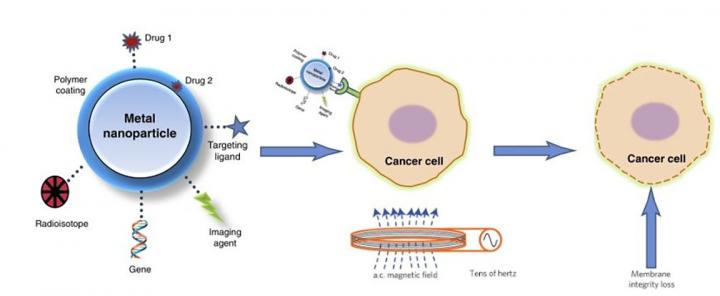
An innovative application area of magnetic nanostructures involves targeted cell annihilation for cancer treatment. Nanodiscs created in a spin vortex state or synthetic antiferromagnetic configuration show great promise for this use.

High tumor cell death rates, up to 90%, were observed when relatively weak magnetic fields were used with them. The mechanism leading to cell death is a strong mechanical force that results when a rotating magnetic field spins the nanodiscs, destroying tumor cells from the inside.

Most of these studies have been carried out in the lab, so some situations, such as retention or excretion by internal organs or transport through capillaries, could still be an issue. Further study is required to address these real-world effects.

###

The article, “Magnetic nanostructures for emerging biomedical applications,” is authored by L. Peixoto, R. Maglhäes, D. Navas, S. Moraes, C. Redondo, R. Morales, J. P. Araújo and C. T. Sousa. The article will appear in Applied Physics Reviews on Jan. 28, 2020 (DOI: 10.1063/1.5121702). After that date, it can be accessed at https://aip.scitation.org/doi/10.1063/1.5121702.

Media Contact
Larry Frum
[email protected]
301-209-3090

Related Journal Article

http://dx.doi.org/10.1063/1.5121702

Tags: Biomechanics/BiophysicscancerChemistry/Physics/Materials SciencesGene Therapy
Share12Tweet8Share2ShareShareShare2

Related Posts

AI and Physics Collaborate to Design Advanced Hydrogen Storage Materials

June 25, 2026

International Team Including Dresden Scientists Develops Novel Designer Proteins for Advanced Study of Living Tissue

June 25, 2026

New Study Uncovers Key Factors Driving Water Chemistry in Nanoscale Environments

June 25, 2026

Plasma Technology Extends Catalyst Lifespan in Hydrogen Production

June 24, 2026
Please login to join discussion

POPULAR NEWS

  • Saying Goodbye to PGY-6: Pediatric Fellowship Realities

    103 shares
    Share 41 Tweet 26
  • Multi-Hospital Study Reveals Long Covid Burden Is Twice as High as Current Estimates

    92 shares
    Share 36 Tweet 23
  • Detection of EDCs in Breast Milk and Infant Urine Up to Six Months Highlights Early Exposure Risks

    77 shares
    Share 31 Tweet 19
  • New Drug Candidate Developed at McMaster Shows Potential for Treating Brain Cancer

    58 shares
    Share 23 Tweet 15

About

We bring you the latest biotechnology news from best research centers and universities around the world. Check our website.

Follow us

Recent News

Tracking Lanthanide-Labeled Microplastics in Plants

POSTECH Researchers Slash Cost of Reconstituted Cell-Free Systems by 95%

AI and Physics Collaborate to Design Advanced Hydrogen Storage Materials

Subscribe to Blog via Email

Success! An email was just sent to confirm your subscription. Please find the email now and click 'Confirm' to start subscribing.

Join 82 other subscribers
  • Contact Us

Bioengineer.org © Copyright 2023 All Rights Reserved.

Welcome Back!

Login to your account below

Forgotten Password?

Retrieve your password

Please enter your username or email address to reset your password.

Log In
No Result
View All Result
  • Homepages
    • Home Page 1
    • Home Page 2
  • News
  • National
  • Business
  • Health
  • Lifestyle
  • Science

Bioengineer.org © Copyright 2023 All Rights Reserved.