• HOME
  • NEWS
  • EXPLORE
    • CAREER
      • Companies
      • Jobs
    • EVENTS
    • iGEM
      • News
      • Team
    • PHOTOS
    • VIDEO
    • WIKI
  • BLOG
  • COMMUNITY
    • FACEBOOK
    • INSTAGRAM
    • TWITTER
Saturday, February 7, 2026
BIOENGINEER.ORG
No Result
View All Result
  • Login
  • HOME
  • NEWS
  • EXPLORE
    • CAREER
      • Companies
      • Jobs
        • Lecturer
        • PhD Studentship
        • Postdoc
        • Research Assistant
    • EVENTS
    • iGEM
      • News
      • Team
    • PHOTOS
    • VIDEO
    • WIKI
  • BLOG
  • COMMUNITY
    • FACEBOOK
    • INSTAGRAM
    • TWITTER
  • HOME
  • NEWS
  • EXPLORE
    • CAREER
      • Companies
      • Jobs
        • Lecturer
        • PhD Studentship
        • Postdoc
        • Research Assistant
    • EVENTS
    • iGEM
      • News
      • Team
    • PHOTOS
    • VIDEO
    • WIKI
  • BLOG
  • COMMUNITY
    • FACEBOOK
    • INSTAGRAM
    • TWITTER
No Result
View All Result
Bioengineer.org
No Result
View All Result
Home NEWS Science News Biology

Kiss and run: How cells sort and recycle their components

Bioengineer by Bioengineer
January 27, 2020
in Biology
Reading Time: 2 mins read
0
IMAGE
Share on FacebookShare on TwitterShare on LinkedinShare on RedditShare on Telegram

IMAGE

Credit: Biozentrum, University of Basel


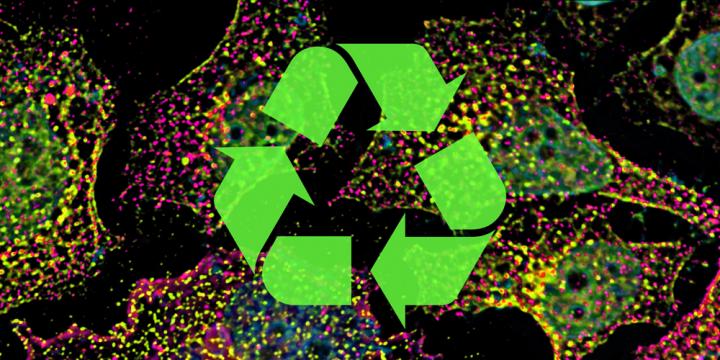
What can be reused and what can be disposed of? Cells also face this tricky task. Researchers from the Biozentrum of the University of Basel have now discovered a cellular machine, called FERARI, that sorts out usable proteins for recycling. In Nature Cell Biology, they explain how FERARI works and why it is so special.

Recycling, the reuse of material, saves energy and resources. No wonder that nature also recycles. In the cells, tiny organelles, so-called endosomes, separate the delivered cellular material into reusable material and waste.

However, how exactly the endosomes sort the material remains an enigma. A research team led by Professor Anne Spang at the Biozentrum, University of Basel, has now discovered that FERARI is a key player in this process. FERARI distributes the recyclable molecules, mainly transport proteins and receptors, and reintroduces them into the cellular cycle. In this way, valuable cell components do not have to be constantly produced anew, which not only saves energy but also time.

Recycling and disposal by endosomes

Endosomes are small membrane-bound vesicles inside animal and plant cells. During their maturation, endosomes pass through various stages in which they carry out different tasks. The early endosomes mainly absorb material, the more mature ones sort out the recyclable material and the late endosomes dispose of the non-reusable residual waste.

FERARI is a central distribution station

In the sorting endosomes, the researchers have now demonstrated that FERARI acts as a kind of distribution platform. “FERARI consists of different proteins and is responsible for ensuring that vesicles, used for recycling, dock onto the sorting endosomes and can be loaded with reusable material,” explains Spang.

The special feature of FERARI is that it coordinates both the fusion of the endosome with the recycling vesicle (kiss) as well as the pinching off of the recycling vesicle after it has been loaded with the cargo (run). The loaded vesicles then transport their cargo to the site of action, the cell membrane. “Our work contradicts the current thinking which assumes that all recycling vesicles are pinched off directly from the endosome,” says Spang. “We are the first to show this kind of ‘kiss-and-run’ mechanism.”

Disturbed recycling is associated with diseases

If FERARI does not work properly, recycling in the cell is impaired. Disorders in cellular transport and recycling processes can lead to a variety of diseases, including cancer, metabolic and neurodegenerative diseases.

###

Further information

Prof. Dr. Anne Spang, University of Basel, Biozentrum, phone +41 61 207 23 80, email: [email protected]

Media Contact
Katrin Buehler
[email protected]
0041-612-070-974

Related Journal Article

http://dx.doi.org/10.1038/s41556-019-0456-5

Tags: BiologyCell Biology
Share12Tweet8Share2ShareShareShare2

Related Posts

Florida Cane Toad: Complex Spread and Selective Evolution

Florida Cane Toad: Complex Spread and Selective Evolution

February 7, 2026
New Study Uncovers Mechanism Behind Burn Pit Particulate Matter–Induced Lung Inflammation

New Study Uncovers Mechanism Behind Burn Pit Particulate Matter–Induced Lung Inflammation

February 6, 2026

DeepBlastoid: Advancing Automated and Efficient Evaluation of Human Blastoids with Deep Learning

February 6, 2026

Navigating the Gut: The Role of Formic Acid in the Microbiome

February 6, 2026
Please login to join discussion

POPULAR NEWS

  • Robotic Ureteral Reconstruction: A Novel Approach

    Robotic Ureteral Reconstruction: A Novel Approach

    82 shares
    Share 33 Tweet 21
  • Digital Privacy: Health Data Control in Incarceration

    63 shares
    Share 25 Tweet 16
  • Study Reveals Lipid Accumulation in ME/CFS Cells

    57 shares
    Share 23 Tweet 14
  • Breakthrough in RNA Research Accelerates Medical Innovations Timeline

    53 shares
    Share 21 Tweet 13

About

We bring you the latest biotechnology news from best research centers and universities around the world. Check our website.

Follow us

Recent News

Digital Health Perspectives from Baltic Sea Experts

Florida Cane Toad: Complex Spread and Selective Evolution

Exploring Decision-Making in Dementia Caregivers’ Mobility

Subscribe to Blog via Email

Enter your email address to subscribe to this blog and receive notifications of new posts by email.

Join 73 other subscribers
  • Contact Us

Bioengineer.org © Copyright 2023 All Rights Reserved.

Welcome Back!

Login to your account below

Forgotten Password?

Retrieve your password

Please enter your username or email address to reset your password.

Log In
No Result
View All Result
  • Homepages
    • Home Page 1
    • Home Page 2
  • News
  • National
  • Business
  • Health
  • Lifestyle
  • Science

Bioengineer.org © Copyright 2023 All Rights Reserved.