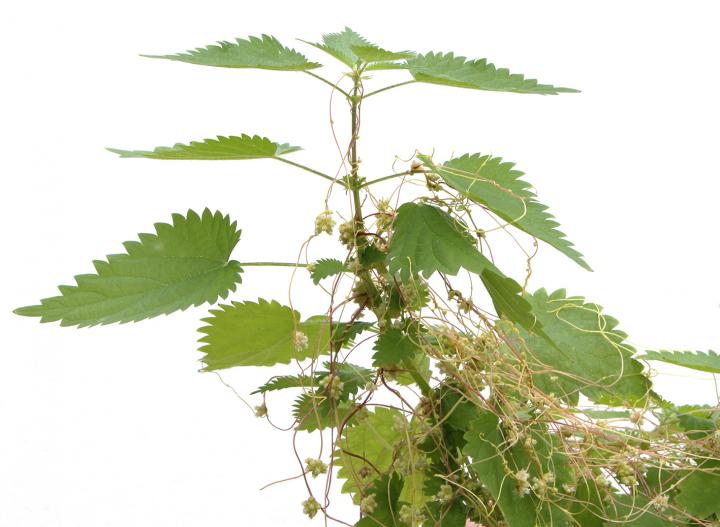
Credit: Jiri Macas
České Budějovice/Gatersleben, 27.01.2020 Whenever the European dodder, Cuscuta europaea, is under scientific scrutiny, it usually is due to its lack of chloroplasts and its concomitant parasitic lifestyle. However, since the beginning of this year its chromosomes became the new centre of attention, when researchers discovered a new type of centromere inherent to C. europaea. Whilst the positioning of the centromeres on the chromosome is normally determined by the locations of CENH3 histones, the centromeres of C. europaea were positioned in some chromosomal regions also independently from the plant’s occurrence of CENH3.
The European dodder Cuscuta europaea is mainly known as a parasitic plant – instead of doing photosynthesis, it grows on other plants and lives of their products. In some cases, it even lives as an epiparasite, living off related plant species. When looking into the plants’ cytogenetics, researchers from the Biology Centre of the Czech Academy of Sciences in Ceské Budejovice, in collaboration with researchers from the Leibniz Institute of Plant Genetics and Crop Plant Research (IPK), recently discovered that C. europaea showcases a unique kind of centromere.
The centromere is a region on a chromosome, at which the kinetochore assembles. This, in turn, guides the attachment of the microtubules of the spindle apparatus during the cellular processes mitosis and meiosis. In most eukaryotic species, the positioning of the centromere is determined by a centromere-specific histone H3 variant called CENH3, which also plays an essential role in the formation and function of kinetochores. Based on the distribution of centromeres on the chromosome, species are thought of as having either monocentric or holocentric centromere types. In monocentric species, CENH3 and thus centromere activity is confined to a single region per chromosome, whilst in holocentric species, both are found along the entire length of the chromosome.
In order to investigate traits associated with the transition from monocentric to holocentric chromosome organisation, researchers compare the phylogenetics of related species with differing centromere types. Especially species of the genus Cuscuta are already well documented. However, when investigating C. europaea as an additional representative holocentric species, the scientists came across unexpected discrepancies. Instead of creating the expected signals along the entire chromosome, in situ immunodetection patterns showed that CENH3 occurred in up to three distinct regions per chromosome. Later, super-resolution microscopy revealed that the centromeres still showed typical holocentric activity, apparently independent of the unusual CENH3 distribution, proving that a new type of centromere had been found.
To date, only few species showing no correlation between CENH3 and kinetochore functionality, mainly holocentric insects which are lacking CENH3 genes, have been found. But through the discovery of C. europaea‘s unique centromere type, this short list has now been extended by one already rather exceptional parasitic plant, which will continue to inspire further research.
###
Original publication: Oliveira et al. (2020) Mitotic spindle attachment to the holocentric chromosomes of Cuscuta europaea does not correlate with the distribution of CENH3 chromatin; Front. Plant Sci.
Media Contact
Dr. Andreas Houben
[email protected]
49-394-825-486
Related Journal Article
http://dx.