• HOME
  • NEWS
  • EXPLORE
    • CAREER
      • Companies
      • Jobs
    • EVENTS
    • iGEM
      • News
      • Team
    • PHOTOS
    • VIDEO
    • WIKI
  • BLOG
  • COMMUNITY
    • FACEBOOK
    • INSTAGRAM
    • TWITTER
Monday, August 31, 2026
BIOENGINEER.ORG
No Result
View All Result
  • Login
  • HOME
  • NEWS
  • EXPLORE
    • CAREER
      • Companies
      • Jobs
        • Lecturer
        • PhD Studentship
        • Postdoc
        • Research Assistant
    • EVENTS
    • iGEM
      • News
      • Team
    • PHOTOS
    • VIDEO
    • WIKI
  • BLOG
  • COMMUNITY
    • FACEBOOK
    • INSTAGRAM
    • TWITTER
  • HOME
  • NEWS
  • EXPLORE
    • CAREER
      • Companies
      • Jobs
        • Lecturer
        • PhD Studentship
        • Postdoc
        • Research Assistant
    • EVENTS
    • iGEM
      • News
      • Team
    • PHOTOS
    • VIDEO
    • WIKI
  • BLOG
  • COMMUNITY
    • FACEBOOK
    • INSTAGRAM
    • TWITTER
No Result
View All Result
Bioengineer.org
No Result
View All Result
Home NEWS Science News Health

Immune system cells contribute to the invading capacity of brain tumours

Bioengineer by Bioengineer
January 23, 2020
in Health
Reading Time: 2 mins read
0
IMAGE
Share on FacebookShare on TwitterShare on LinkedinShare on RedditShare on Telegram

IMAGE

Credit: INc-UAB


In a study published in Brain Communications, a new Open Access publication of the well-known journal Brain, the team led by Carlos Barcia, researcher at Institut de Neurociències of the Universitat Autònoma de Barcelona (INc), analysed the role of immune cells in the expansion of glioblastoma, the most aggressive brain tumour. The study is a collaborative effort with the General Hospital in Valencia, and part of Elena Saavedra’s doctoral thesis.

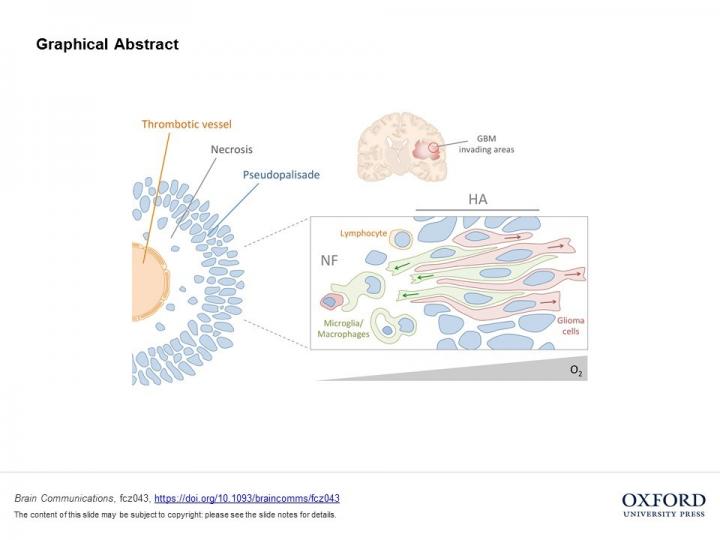
The research shows for the first time that microglia and macrophages, cells of the immune system, facilitate the invasive capacity of glioblastoma by clearing the necrotic areas of the tumour while ignoring tumour cells in its niche of invasion.

This invasive niche, which is the part of the tumour that comes into contact with the healthy tissue, is shaped like a pseudopalisade and is poorly irrigated by blood vessels. This results in a lack of oxygen -hypoxia-, which causes, on the one hand, that the tumour cells escape and invade healthy tissue, and on the other, the creation of a necrotic area inside the tumour. Researchers show, in this study, that microglia and macrophages travel to these hypoxic areas and only clean dying tumour cells, facilitating tumour growth and expansion.

“The importance of this work is that we observed for the first time the presence of immune system cells in these particular tumour’s invasive areas, and also that the phagocytic capacity of immune cells is not lost and could be trained to facilitate the removal of tumour instead of helping its growth” says Carlos Barcia.

The next step, then, is to study how microglia cells and macrophages could be trained, through immunotherapy or other strategies, to not play in favour of the tumour, but to contribute to its elimination.

###

Media Contact
María Jesús Delgado
[email protected]
34-935-814-049

Original Source

https://www.uab.cat/web/newsroom/news-detail/immune-system-cells-contribute-to-the-invading-capacity-of-brain-tumours-1345668003610.html?noticiaid=1345806090650

Related Journal Article

http://dx.doi.org/10.1093/braincomms/fcz043

Tags: BiologycancerCell Biologyneurobiology
Share12Tweet8Share2ShareShareShare2

Related Posts

Wearable monitor improves diagnosis of heart rhythm disorders after fainting

August 31, 2026

Visualisation of magnetic field-induced nanoparticle clusters and mechanical property changes in a breast phantom for inductive moderate hyperthermia

August 31, 2026

Multidisciplinary intervention in frail elderly patients with cardiovascular diseases: a multicentre, single-blinded, randomised controlled trial

August 31, 2026

Machine Learning Model Development and Evaluation for Non-contact Lower Limb Injury Risk Prediction in Elite Male Rugby Union: A Multi-team, Multi-season Analysis

August 31, 2026
Please login to join discussion

POPULAR NEWS

  • β-Sitosterol from Ipomoea carnea Jacq. As a promising anti-inflammatory agent: Evidence from in silico modeling and in vitro validation

    29 shares
    Share 12 Tweet 7
  • Design, fabrication and characterization of a wearable Fiber Bragg grating sensor for cardiorespiratory monitoring using finger plethysmography

    29 shares
    Share 12 Tweet 7
  • KAIST opens the era of industrial-scale microbial foods, proposing growth strategies for the next-generation protein market

    29 shares
    Share 12 Tweet 7
  • Virologist awarded $2 million NIH grant to investigate how virus-infected cells live and die

    29 shares
    Share 12 Tweet 7

About

We bring you the latest biotechnology news from best research centers and universities around the world. Check our website.

Follow us

Recent News

β-Sitosterol from Ipomoea carnea Jacq. As a promising anti-inflammatory agent: Evidence from in silico modeling and in vitro validation

Design, fabrication and characterization of a wearable Fiber Bragg grating sensor for cardiorespiratory monitoring using finger plethysmography

KAIST opens the era of industrial-scale microbial foods, proposing growth strategies for the next-generation protein market

Subscribe to Blog via Email

Enter your email address to subscribe to this blog and receive notifications of new posts by email.

Join 85 other subscribers
  • Contact Us

Bioengineer.org © Copyright 2023 All Rights Reserved.

Welcome Back!

Login to your account below

Forgotten Password?

Retrieve your password

Please enter your username or email address to reset your password.

Log In
No Result
View All Result
  • Homepages
    • Home Page 1
    • Home Page 2
  • News
  • National
  • Business
  • Health
  • Lifestyle
  • Science

Bioengineer.org © Copyright 2023 All Rights Reserved.