• HOME
  • NEWS
  • EXPLORE
    • CAREER
      • Companies
      • Jobs
    • EVENTS
    • iGEM
      • News
      • Team
    • PHOTOS
    • VIDEO
    • WIKI
  • BLOG
  • COMMUNITY
    • FACEBOOK
    • INSTAGRAM
    • TWITTER
Saturday, February 7, 2026
BIOENGINEER.ORG
No Result
View All Result
  • Login
  • HOME
  • NEWS
  • EXPLORE
    • CAREER
      • Companies
      • Jobs
        • Lecturer
        • PhD Studentship
        • Postdoc
        • Research Assistant
    • EVENTS
    • iGEM
      • News
      • Team
    • PHOTOS
    • VIDEO
    • WIKI
  • BLOG
  • COMMUNITY
    • FACEBOOK
    • INSTAGRAM
    • TWITTER
  • HOME
  • NEWS
  • EXPLORE
    • CAREER
      • Companies
      • Jobs
        • Lecturer
        • PhD Studentship
        • Postdoc
        • Research Assistant
    • EVENTS
    • iGEM
      • News
      • Team
    • PHOTOS
    • VIDEO
    • WIKI
  • BLOG
  • COMMUNITY
    • FACEBOOK
    • INSTAGRAM
    • TWITTER
No Result
View All Result
Bioengineer.org
No Result
View All Result
Home NEWS Science News Biology

The mysterious movement of water molecules

Bioengineer by Bioengineer
January 15, 2020
in Biology
Reading Time: 2 mins read
0
IMAGE
Share on FacebookShare on TwitterShare on LinkedinShare on RedditShare on Telegram

IMAGE

Credit: © Tamtögl

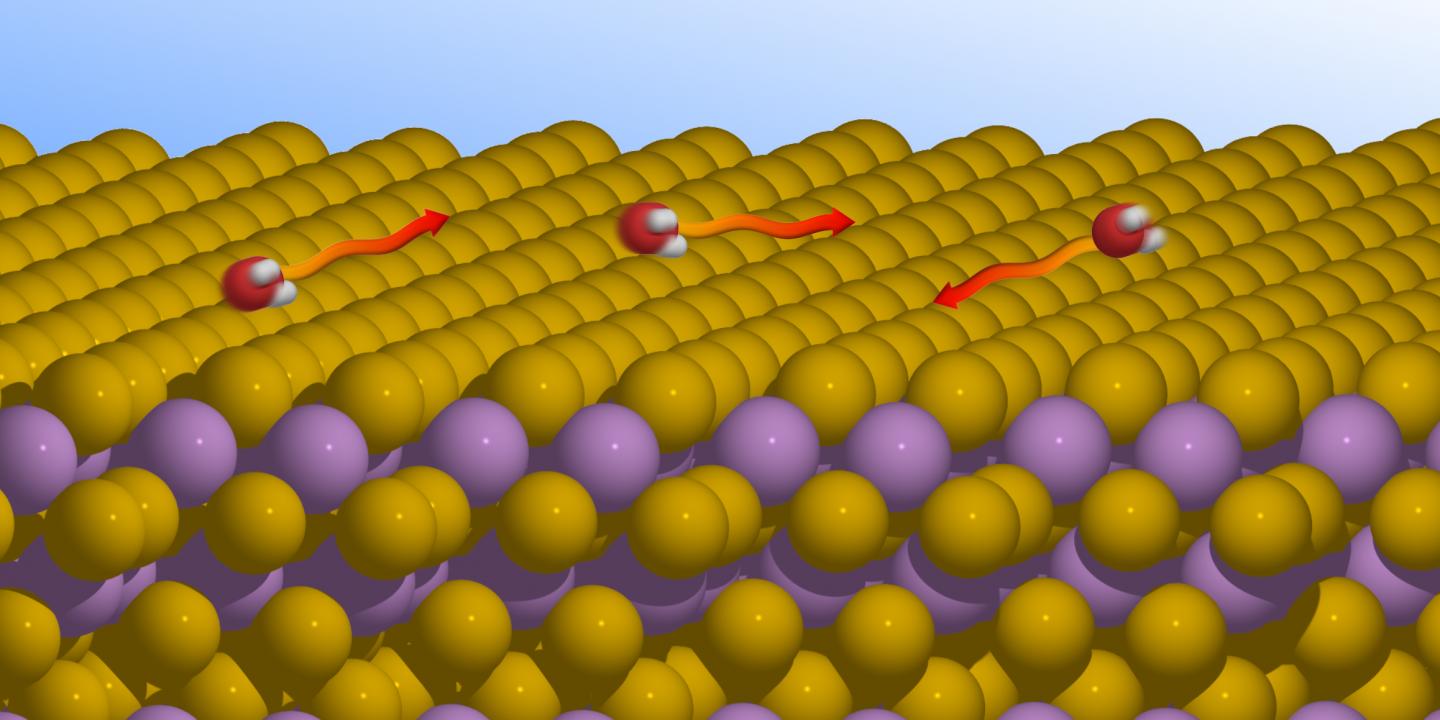
Water is a mysterious substance. Understanding how it behaves at the atomic level is still a challenge for experimental physicists, as light hydrogen and oxygen atoms are difficult to observe using conventional experimental methods. This is especially true for any researcher looking to study the microscopic movements of individual water molecules that run off a surface in a matter of picoseconds. As they report in their paper, entitled ‘Nanoscopic diffusion of water on a topological insulator’, researchers from the Exotic Surfaces working group at TU Graz’s Institute of Experimental Physics joined forces with counterparts from the Cavendish Laboratory at the University of Cambridge , the University of Surrey and Aarhus University. Together, they made significant advances, performing research into the behaviour of water on a material that is currently attracting particular interest: a topological insulator called bismuth telluride. This compound could be used to build quantum computers. Water vapour would be one of the environmental factors to which applications based on bismuth telluride might be exposed during operation.

In the course of their research, the team used a combination of a new experimental method called helium spin-echo spectroscopy and theoretical calculations. Helium spin-echo spectroscopy uses very low-energy helium atoms that allow isolated water molecules to be observed without influencing their motion in the process. The researchers discovered that water molecules behave completely differently on bismuth telluride compared with those on conventional metals. On such metals, attractive interactions between water molecules can be observed, leading to accumulations in the form of films. But the opposite is the case with topological insulators: the water molecules repel one another and remain isolated on the surface.

Bismuth telluride appears to be impervious to water, which is an advantage for applications exposed to typical environmental conditions. Plans are in place for further experiments on similarly structured surfaces, which are intended to clarify whether the movement of water molecules is attributable to specific features of the surface in question.

###

This area of research is part of TU Graz’s Advanced Materials Science Field of Expertise, one of the university’s five strategic research focuses.

Media Contact
Anton Tamtögl
[email protected]
43-316-873-8143

Related Journal Article

http://dx.doi.org/10.1038/s41467-019-14064-7

Tags: Atomic PhysicsAtomic/Molecular/Particle PhysicsBiochemistryChemistry/Physics/Materials SciencesMolecular Physics
Share12Tweet8Share2ShareShareShare2

Related Posts

Florida Cane Toad: Complex Spread and Selective Evolution

Florida Cane Toad: Complex Spread and Selective Evolution

February 7, 2026
New Study Uncovers Mechanism Behind Burn Pit Particulate Matter–Induced Lung Inflammation

New Study Uncovers Mechanism Behind Burn Pit Particulate Matter–Induced Lung Inflammation

February 6, 2026

DeepBlastoid: Advancing Automated and Efficient Evaluation of Human Blastoids with Deep Learning

February 6, 2026

Navigating the Gut: The Role of Formic Acid in the Microbiome

February 6, 2026
Please login to join discussion

POPULAR NEWS

  • Robotic Ureteral Reconstruction: A Novel Approach

    Robotic Ureteral Reconstruction: A Novel Approach

    82 shares
    Share 33 Tweet 21
  • Digital Privacy: Health Data Control in Incarceration

    63 shares
    Share 25 Tweet 16
  • Study Reveals Lipid Accumulation in ME/CFS Cells

    57 shares
    Share 23 Tweet 14
  • Breakthrough in RNA Research Accelerates Medical Innovations Timeline

    53 shares
    Share 21 Tweet 13

About

We bring you the latest biotechnology news from best research centers and universities around the world. Check our website.

Follow us

Recent News

Boosting Remote Healthcare: Stepped-Wedge Trial Insights

Barriers and Boosters of Seniors’ Physical Activity in Karachi

Evaluating Pediatric Emergency Care Quality in Ethiopia

Subscribe to Blog via Email

Enter your email address to subscribe to this blog and receive notifications of new posts by email.

Join 73 other subscribers
  • Contact Us

Bioengineer.org © Copyright 2023 All Rights Reserved.

Welcome Back!

Login to your account below

Forgotten Password?

Retrieve your password

Please enter your username or email address to reset your password.

Log In
No Result
View All Result
  • Homepages
    • Home Page 1
    • Home Page 2
  • News
  • National
  • Business
  • Health
  • Lifestyle
  • Science

Bioengineer.org © Copyright 2023 All Rights Reserved.