• HOME
  • NEWS
  • EXPLORE
    • CAREER
      • Companies
      • Jobs
    • EVENTS
    • iGEM
      • News
      • Team
    • PHOTOS
    • VIDEO
    • WIKI
  • BLOG
  • COMMUNITY
    • FACEBOOK
    • INSTAGRAM
    • TWITTER
Saturday, February 7, 2026
BIOENGINEER.ORG
No Result
View All Result
  • Login
  • HOME
  • NEWS
  • EXPLORE
    • CAREER
      • Companies
      • Jobs
        • Lecturer
        • PhD Studentship
        • Postdoc
        • Research Assistant
    • EVENTS
    • iGEM
      • News
      • Team
    • PHOTOS
    • VIDEO
    • WIKI
  • BLOG
  • COMMUNITY
    • FACEBOOK
    • INSTAGRAM
    • TWITTER
  • HOME
  • NEWS
  • EXPLORE
    • CAREER
      • Companies
      • Jobs
        • Lecturer
        • PhD Studentship
        • Postdoc
        • Research Assistant
    • EVENTS
    • iGEM
      • News
      • Team
    • PHOTOS
    • VIDEO
    • WIKI
  • BLOG
  • COMMUNITY
    • FACEBOOK
    • INSTAGRAM
    • TWITTER
No Result
View All Result
Bioengineer.org
No Result
View All Result
Home NEWS Science News Biology

Scientists hope to defeat infections after discovering bacterial espionage

Bioengineer by Bioengineer
January 14, 2020
in Biology
Reading Time: 3 mins read
0
IMAGE
Share on FacebookShare on TwitterShare on LinkedinShare on RedditShare on Telegram

IMAGE

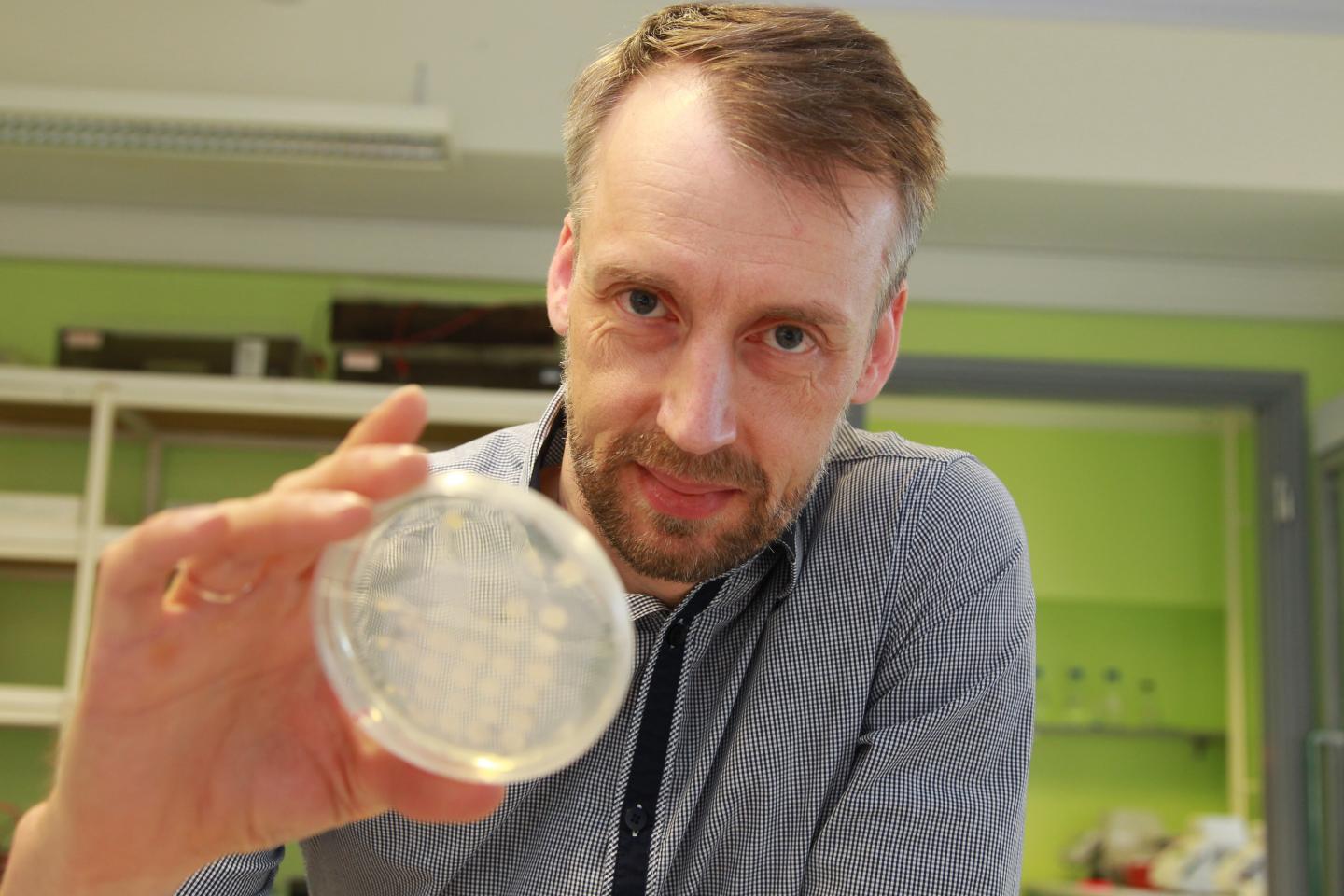
Credit: Copyright: Kristjan Teedema/Postimees/Scanpix


University of Tartu scientists hope create a solution for chronic infections that do not respond to antibiotic treatment after having discovered mechanisms for listening in on sleeping bacteria.

Having recently published a research article on the topic in Scientific Reports with his team, Senior Research Fellow in Molecular Microbiology Arvi Jõers writes about the ability of bacteria to listen in on one other and what this discovery means for medicine.

The life of bacteria is not easy. If there is sufficient food, they multiply rapidly, but they do not tend to store it. Once bacteria are out of food, it is over for them: their metabolism slows down and they enter a sleep-like state. In such a state, bacteria are quite resilient to environmental conditions and can even live through difficult times. In this, they are similar to a bear in hibernation – minimal energy is spent while waiting for better times ahead.

These arrive with new food.

Once there is enough food again, all bacteria wake up and start multiplying rapidly. However, bacteria can be more hesitant if there is little food and it is not of the best quality. Is it even worth leaving a secure state for such a lousy meal? Perhaps it is not even real food, but some sort of trick? Naturally, bacteria do not follow this line of thought. Instead, they have developed mechanisms in the course of evolution that offer solutions to such dilemmas.

One particular sign of the environment being sufficiently good for bacteria to grow and multiply is the growth of other bacteria. University of Tartu scientists discovered that sleeping bacteria can learn about the growth of other bacteria by spying on them.

Namely, as bacteria grow, they expel material from their cell walls into the environment. The cell wall is quite a rigid structure that surrounds each bacterial cell and protects it from the external environment. For a bacterium to grow bigger, the cell wall must become softer and give in to a certain degree. As a result of changes like this, part of the cell wall material enters the environment, sending sleeping bacteria a message that conditions have improved and others have enough food to grow.

Once sleeping bacteria identify material originating from the cell walls of other bacteria in the environment, they wake up quickly and in great numbers in order to get their share of the newly arrived nutrients.

Sleeping bacteria unwilling to wake up pose a serious problem in medicine. Antibiotics are, above all, known to kill actively growing bacteria and they do not often work on sleeping bacterial cells. Thus, sleeping bacteria can survive a course of antibiotics in the human body and start to grow again later when the person has finished the treatment. These cells are called persister cells and they can cause long-term chronic infections that do not respond to antibiotic treatment.

If scientists could now use this new knowledge to trick sleeping bacteria and lure them into waking up with some substance similar to a cell wall, there would be hope of killing them with antibiotics on the first try. This would allow bacterial infections to be treated with one course of treatment.

###

Media Contact
Arvi Jõers
[email protected]
372-737-5041

Related Journal Article

http://dx.doi.org/10.1038/s41598-019-54646-5

Tags: Biology
Share12Tweet8Share2ShareShareShare2

Related Posts

New Study Uncovers Mechanism Behind Burn Pit Particulate Matter–Induced Lung Inflammation

New Study Uncovers Mechanism Behind Burn Pit Particulate Matter–Induced Lung Inflammation

February 6, 2026

DeepBlastoid: Advancing Automated and Efficient Evaluation of Human Blastoids with Deep Learning

February 6, 2026

Navigating the Gut: The Role of Formic Acid in the Microbiome

February 6, 2026

AI-Enhanced Optical Coherence Photoacoustic Microscopy Revolutionizes 3D Cancer Model Imaging

February 6, 2026
Please login to join discussion

POPULAR NEWS

  • Robotic Ureteral Reconstruction: A Novel Approach

    Robotic Ureteral Reconstruction: A Novel Approach

    82 shares
    Share 33 Tweet 21
  • Digital Privacy: Health Data Control in Incarceration

    63 shares
    Share 25 Tweet 16
  • Study Reveals Lipid Accumulation in ME/CFS Cells

    57 shares
    Share 23 Tweet 14
  • Breakthrough in RNA Research Accelerates Medical Innovations Timeline

    53 shares
    Share 21 Tweet 13

About

We bring you the latest biotechnology news from best research centers and universities around the world. Check our website.

Follow us

Recent News

Scientists Identify SARS-CoV-2 PLpro and RIPK1 Inhibitors Showing Potent Synergistic Antiviral Effects in Mouse COVID-19 Model

Neg-Entropy: The Key Therapeutic Target for Chronic Diseases

Multidisciplinary Evidence-Based Guidelines for Therapeutic Drug Monitoring of Biologics in Inflammatory Bowel Disease

Subscribe to Blog via Email

Enter your email address to subscribe to this blog and receive notifications of new posts by email.

Join 73 other subscribers
  • Contact Us

Bioengineer.org © Copyright 2023 All Rights Reserved.

Welcome Back!

Login to your account below

Forgotten Password?

Retrieve your password

Please enter your username or email address to reset your password.

Log In
No Result
View All Result
  • Homepages
    • Home Page 1
    • Home Page 2
  • News
  • National
  • Business
  • Health
  • Lifestyle
  • Science

Bioengineer.org © Copyright 2023 All Rights Reserved.