• HOME
  • NEWS
  • EXPLORE
    • CAREER
      • Companies
      • Jobs
    • EVENTS
    • iGEM
      • News
      • Team
    • PHOTOS
    • VIDEO
    • WIKI
  • BLOG
  • COMMUNITY
    • FACEBOOK
    • INSTAGRAM
    • TWITTER
Saturday, February 7, 2026
BIOENGINEER.ORG
No Result
View All Result
  • Login
  • HOME
  • NEWS
  • EXPLORE
    • CAREER
      • Companies
      • Jobs
        • Lecturer
        • PhD Studentship
        • Postdoc
        • Research Assistant
    • EVENTS
    • iGEM
      • News
      • Team
    • PHOTOS
    • VIDEO
    • WIKI
  • BLOG
  • COMMUNITY
    • FACEBOOK
    • INSTAGRAM
    • TWITTER
  • HOME
  • NEWS
  • EXPLORE
    • CAREER
      • Companies
      • Jobs
        • Lecturer
        • PhD Studentship
        • Postdoc
        • Research Assistant
    • EVENTS
    • iGEM
      • News
      • Team
    • PHOTOS
    • VIDEO
    • WIKI
  • BLOG
  • COMMUNITY
    • FACEBOOK
    • INSTAGRAM
    • TWITTER
No Result
View All Result
Bioengineer.org
No Result
View All Result
Home NEWS Science News Chemistry

Researchers solve a scientific mystery about evaporation

Bioengineer by Bioengineer
January 13, 2020
in Chemistry
Reading Time: 2 mins read
0
IMAGE
Share on FacebookShare on TwitterShare on LinkedinShare on RedditShare on Telegram

Work has implications for power generation, desalination, electronics
IMAGE

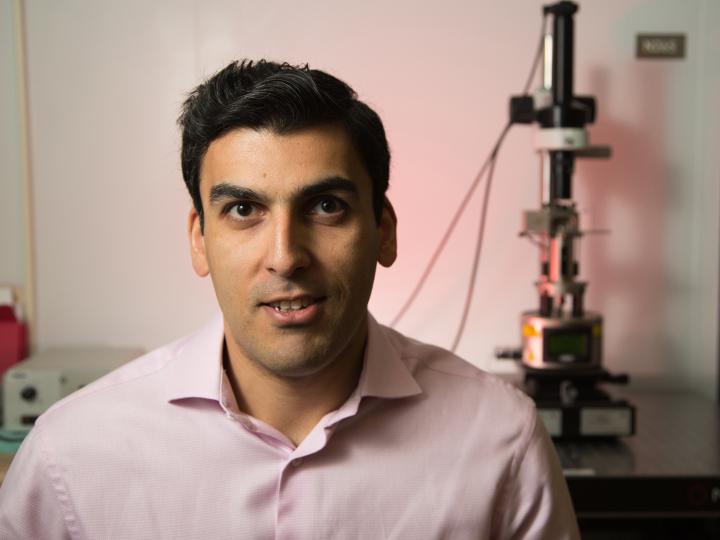
Credit: University of Houston


Evaporation can explain why water levels drop in a full swimming pool, but it also plays an important role in industrial processes ranging from cooling electronics to power generation. Much of the global electricity supply is generated by steam plants, which are driven by evaporation.

But determining when and how quickly a liquid will convert to a vapor has been stymied by questions about how – and how much – the temperature changes at the point where the liquid meets the vapor, a concept known as temperature discontinuity. Those questions have made it more difficult to create more efficient processes using evaporation, but now researchers from the University of Houston have reported answers to what happens at that interface, addressing 20 years of conflicting findings. The work was reported in the Journal of Physical Chemistry.

The temperature discontinuity was first reported in 1999 by Canadian researchers G. Fang and C.A. Ward, who noted that they were unable to explain the phenomenon through classical mechanics. The new work solves that mystery.

Hadi Ghasemi, Cullen Associate Professor of Mechanical Engineering at UH, said the new understanding eliminates the “bottleneck” that has complicated predictions and simulations of processes involving evaporation.

“We demonstrated the physics of what happens within the space of a few molecules at the interface and accurately developed a theory on the evaporation rate,” Ghasemi said. “That allowed us to explain all of the conflicting findings that have been reported in the last 20 years and solve this mystery.”

In addition to Ghasemi, co-authors for the paper included first author Parham Jafari, a PhD student at UH, and Amit Amritkar, a research assistant professor at UH.

The researchers first approached the question in the lab, but Ghasemi said they were unable to get the needed spatial resolution for a definitive answer. They used a computational approach in order to find the properties of liquid and vapor within the length of a few molecules.

The explanation – developed using the Direct Simulation Monte Carlo method – will allow scientists to more accurate simulate the performance of all systems based on the theory of evaporation.

“With this understanding, we can more accurately develop simulations of performance and efficiency, as well as design and predict the behavior of advanced systems,” Ghasemi said.

That would have applications for energy, electronics, photonics and other fields.

As just one example of the importance of evaporation, Ghasemi noted that 80% of electric power globally is generated through steam plants, which work based on evaporation phenomena.

###

Media Contact
Jeannie Kever
[email protected]
713-743-0778

Original Source

https://uh.edu/news-events/stories/january-2020/01132020-ghasemi-evaporation.php

Related Journal Article

http://dx.doi.org/10.1021/acs.jpcc.9b10838

Tags: Chemistry/Physics/Materials SciencesMechanical EngineeringTechnology/Engineering/Computer Science
Share12Tweet8Share2ShareShareShare2

Related Posts

blank

Breakthrough in Environmental Cleanup: Scientists Develop Solar-Activated Biochar for Faster Remediation

February 7, 2026
blank

Cutting Costs: Making Hydrogen Fuel Cells More Affordable

February 6, 2026

Scientists Develop Hand-Held “Levitating” Time Crystals

February 6, 2026

Observing a Key Green-Energy Catalyst Dissolve Atom by Atom

February 6, 2026
Please login to join discussion

POPULAR NEWS

  • Robotic Ureteral Reconstruction: A Novel Approach

    Robotic Ureteral Reconstruction: A Novel Approach

    82 shares
    Share 33 Tweet 21
  • Digital Privacy: Health Data Control in Incarceration

    63 shares
    Share 25 Tweet 16
  • Study Reveals Lipid Accumulation in ME/CFS Cells

    57 shares
    Share 23 Tweet 14
  • Breakthrough in RNA Research Accelerates Medical Innovations Timeline

    53 shares
    Share 21 Tweet 13

About

We bring you the latest biotechnology news from best research centers and universities around the world. Check our website.

Follow us

Recent News

Decoding Prostate Cancer Origins via snFLARE-seq, mxFRIZNGRND

Digital Health Perspectives from Baltic Sea Experts

Florida Cane Toad: Complex Spread and Selective Evolution

Subscribe to Blog via Email

Enter your email address to subscribe to this blog and receive notifications of new posts by email.

Join 73 other subscribers
  • Contact Us

Bioengineer.org © Copyright 2023 All Rights Reserved.

Welcome Back!

Login to your account below

Forgotten Password?

Retrieve your password

Please enter your username or email address to reset your password.

Log In
No Result
View All Result
  • Homepages
    • Home Page 1
    • Home Page 2
  • News
  • National
  • Business
  • Health
  • Lifestyle
  • Science

Bioengineer.org © Copyright 2023 All Rights Reserved.