Credit: Ann Ross/North Carolina State University
GAINESVILLE, Fla. — Christopher Columbus’ accounts of the Caribbean include harrowing descriptions of fierce raiders who abducted women and cannibalized men – stories long dismissed as myths.
But a new study suggests Columbus may have been telling the truth.
Using the equivalent of facial recognition technology, researchers analyzed the skulls of early Caribbean inhabitants, uncovering relationships between people groups and upending longstanding hypotheses about how the islands were first colonized.
One surprising finding was that the Caribs, marauders from South America and rumored cannibals, invaded Jamaica, Hispaniola and the Bahamas, overturning half a century of assumptions that they never made it farther north than Guadeloupe.
“I’ve spent years trying to prove Columbus wrong when he was right: There were Caribs in the northern Caribbean when he arrived,” said William Keegan, Florida Museum of Natural History curator of Caribbean archaeology. “We’re going to have to reinterpret everything we thought we knew.”
Columbus had recounted how peaceful Arawaks in modern-day Bahamas were terrorized by pillagers he mistakenly described as “Caniba,” the Asiatic subjects of the Grand Khan. His Spanish successors corrected the name to “Caribe” a few decades later, but the similar-sounding names led most archaeologists to chalk up the references to a mix-up: How could Caribs have been in the Bahamas when their closest outpost was nearly 1,000 miles to the south?
But skulls reveal the Carib presence in the Caribbean was far more prominent than previously thought, giving credence to Columbus’ claims.
Face to face with the Caribbean’s earliest inhabitants
Previous studies relied on artifacts such as tools and pottery to trace the geographical origin and movement of people through the Caribbean over time. Adding a biological component brings the region’s history into sharper focus, said Ann Ross, a professor of biological sciences at North Carolina State University and the study’s lead author.
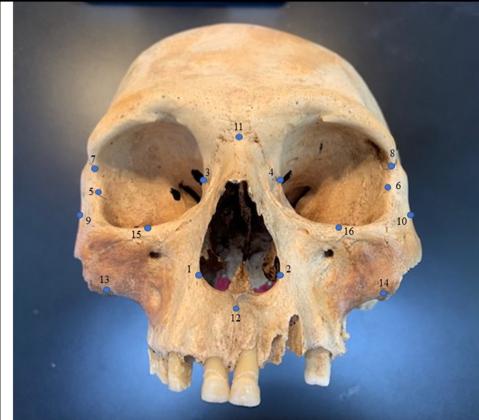
Ross used 3D facial “landmarks,” such as the size of an eye socket or length of a nose, to analyze more than 100 skulls dating from about A.D. 800 to 1542. These landmarks can act as a genetic proxy for determining how closely people are related to one another.
The analysis not only revealed three distinct Caribbean people groups, but also their migration routes, which was “really stunning,” Ross said.
Looking at ancient faces shows the Caribbean’s earliest settlers came from the Yucatan, moving into Cuba and the Northern Antilles, which supports a previous hypothesis based on similarities in stone tools. Arawak speakers from coastal Colombia and Venezuela migrated to Puerto Rico between 800 and 200 B.C., a journey also documented in pottery.
The earliest inhabitants of the Bahamas and Hispaniola, however, were not from Cuba as commonly thought, but the Northwest Amazon – the Caribs. Around A.D. 800, they pushed north into Hispaniola and Jamaica and then the Bahamas where they were well established by the time Columbus arrived.
“I had been stumped for years because I didn’t have this Bahamian component,” Ross said. “Those remains were so key. This will change the perspective on the people and peopling of the Caribbean.”
For Keegan, the discovery lays to rest a puzzle that pestered him for years: why a type of pottery known as Meillacoid appears in Hispaniola by A.D. 800, Jamaica around 900 and the Bahamas around 1000.
“Why was this pottery so different from everything else we see? That had bothered me,” he said. “It makes sense that Meillacoid pottery is associated with the Carib expansion.”
The sudden appearance of Meillacoid pottery also corresponds with a general reshuffling of people in the Caribbean after a 1,000-year period of tranquility, further evidence that “Carib invaders were on the move,” Keegan said.
Raiders of the lost Arawaks
So, was there any substance to the tales of cannibalism?
Possibly, Keegan said.
Arawaks and Caribs were enemies, but they often lived side by side with occasional intermarriage before blood feuds erupted, he said.
“It’s almost a ‘Hatfields and McCoys’ kind of situation,” Keegan said. “Maybe there was some cannibalism involved. If you need to frighten your enemies, that’s a really good way to do it.”
Whether or not it was accurate, the European perception that Caribs were cannibals had a tremendous impact on the region’s history, he said. The Spanish monarchy initially insisted that indigenous people be paid for work and treated with respect, but reversed its position after receiving reports that they refused to convert to Christianity and ate human flesh.
“The crown said, ‘Well, if they’re going to behave that way, they can be enslaved,'” Keegan said. “All of a sudden, every native person in the entire Caribbean became a Carib as far as the colonists were concerned.”
###
Michael Pateman of the Turks and Caicos National Museum and Colleen Young of the University of Missouri also co-authored the study.
Media Contact
Natalie van Hoose
[email protected]
352-273-1922
Related Journal Article
http://dx.