• HOME
  • NEWS
  • EXPLORE
    • CAREER
      • Companies
      • Jobs
    • EVENTS
    • iGEM
      • News
      • Team
    • PHOTOS
    • VIDEO
    • WIKI
  • BLOG
  • COMMUNITY
    • FACEBOOK
    • INSTAGRAM
    • TWITTER
Saturday, February 7, 2026
BIOENGINEER.ORG
No Result
View All Result
  • Login
  • HOME
  • NEWS
  • EXPLORE
    • CAREER
      • Companies
      • Jobs
        • Lecturer
        • PhD Studentship
        • Postdoc
        • Research Assistant
    • EVENTS
    • iGEM
      • News
      • Team
    • PHOTOS
    • VIDEO
    • WIKI
  • BLOG
  • COMMUNITY
    • FACEBOOK
    • INSTAGRAM
    • TWITTER
  • HOME
  • NEWS
  • EXPLORE
    • CAREER
      • Companies
      • Jobs
        • Lecturer
        • PhD Studentship
        • Postdoc
        • Research Assistant
    • EVENTS
    • iGEM
      • News
      • Team
    • PHOTOS
    • VIDEO
    • WIKI
  • BLOG
  • COMMUNITY
    • FACEBOOK
    • INSTAGRAM
    • TWITTER
No Result
View All Result
Bioengineer.org
No Result
View All Result
Home NEWS Science News Biology

Unlimited potential: Researchers found new ways to generate totipotent-like cells

Bioengineer by Bioengineer
January 9, 2020
in Biology
Reading Time: 2 mins read
0
IMAGE
Share on FacebookShare on TwitterShare on LinkedinShare on RedditShare on Telegram

IMAGE

Credit: ©Helmholtz Zentrum München


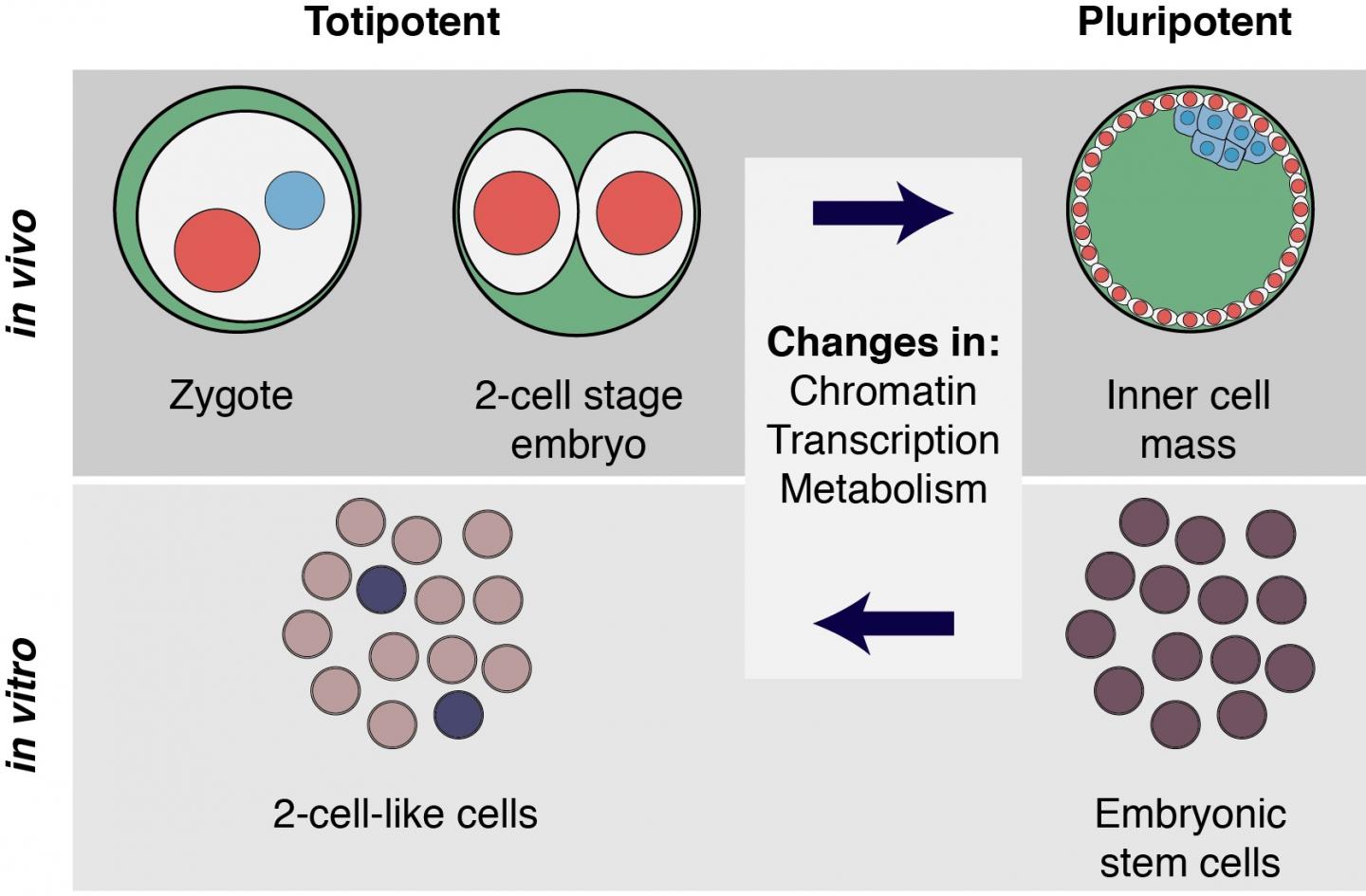
Totipotent cells own the highest differentiation potential of all cells. They can only be found shortly after fertilization in an early embryonic state and are capable of producing all cell types. Pluripotent cells, also called embryonic stem cells, on the contrary have lost some of this potential as they have already further developed. In order to be able re-program their initial totipotency, it is crucial to have a broad knowledge about the differences between pluripotent and totipotent cells as the elimination of these differences might lead to totipotency. One of the possible differences, which so far has not been investigated, is whether totipotent and pluripotent cells have different metabolic needs and activities.

Adding metabolites for more potential

To find an answer to this question, the researchers in a first step compared the gene expression of pluripotent and totipotent-like cells, which are also referred to as “2-cell-like cells”, in culture. They discovered differences in metabolic enzymes and regulators involved in glycolysis, TCA-cycle, electron transport and glutamine metabolism. To dig deeper into these differences, Diego Rodriguez-Terrones from the Institute of Epigenetics and Stem Cells and Götz Hartleben from the Institute for Diabetes and Cancer teamed up to be able to measure oxygen consumption in 2-cell like cells, which was thus far not possible. They found that totipotent-like cells consume different amounts of oxygen compared to pluripotent cells. In addition, they observed differences in mitochondria morphology and reactive oxygen species (ROS) levels between pluripotent and totipotent-like cells. These findings led to the hypothesis that by adding specific metabolites pluripotent cells could re-programmed in a way to induce totipotent-like cells. Indeed, after analyzing 20 different metabolites, the group successfully identified 3 metabolites which are shown for the first time to induce totipotent-like cells in culture.

“Totipotent-like cells are invaluable to gain more knowledge about cellular plasticity. With these manipulated cells, we might be able to study and recreate the molecular features of totipotency in vitro.

Also, they open up the possibility for us to study very early developmental events during mammalian embryogenesis,” says Rodriguez-Terrones. “In future, totipotent-like cells could be very important for cell replacement therapies. The ability to generate them efficiently with metabolites paves the way for further research and innovation.”

Multi-disciplinary collaboration fundamental for scientific success

The study joined forces and expertise of the Institute of Epigenetics and Stem Cells and the Institute for Diabetes and Cancer at Helmholt Zentrum München. The hybrid collaboration made it possible to analyze the emergence of 2-cell-like cells in culture from another perspective. The work was partly funded by the Helmholtz Association and the German Research Council (CRC 1064)

###

Original publication

D. Rodriguez-Terrones et al., 2019: A distinct metabolic state arises during the emergence of 2-cell-like cells. EMBO Reports, DOI: 10.15252/embr.201948354

Media Contact
Diego Rodriguez-Terrones
[email protected]

Related Journal Article

http://dx.doi.org/10.15252/embr.201948354

Tags: Biology
Share12Tweet8Share2ShareShareShare2

Related Posts

Florida Cane Toad: Complex Spread and Selective Evolution

Florida Cane Toad: Complex Spread and Selective Evolution

February 7, 2026
New Study Uncovers Mechanism Behind Burn Pit Particulate Matter–Induced Lung Inflammation

New Study Uncovers Mechanism Behind Burn Pit Particulate Matter–Induced Lung Inflammation

February 6, 2026

DeepBlastoid: Advancing Automated and Efficient Evaluation of Human Blastoids with Deep Learning

February 6, 2026

Navigating the Gut: The Role of Formic Acid in the Microbiome

February 6, 2026
Please login to join discussion

POPULAR NEWS

  • Robotic Ureteral Reconstruction: A Novel Approach

    Robotic Ureteral Reconstruction: A Novel Approach

    82 shares
    Share 33 Tweet 21
  • Digital Privacy: Health Data Control in Incarceration

    63 shares
    Share 25 Tweet 16
  • Study Reveals Lipid Accumulation in ME/CFS Cells

    57 shares
    Share 23 Tweet 14
  • Breakthrough in RNA Research Accelerates Medical Innovations Timeline

    53 shares
    Share 21 Tweet 13

About

We bring you the latest biotechnology news from best research centers and universities around the world. Check our website.

Follow us

Recent News

Menopause Care: Insights from Workforce Review and Consultation

LRRK2R1627P Mutation Boosts Gut Inflammation, α-Synuclein

3D Gut-Brain-Vascular Model Reveals Disease Links

Subscribe to Blog via Email

Enter your email address to subscribe to this blog and receive notifications of new posts by email.

Join 73 other subscribers
  • Contact Us

Bioengineer.org © Copyright 2023 All Rights Reserved.

Welcome Back!

Login to your account below

Forgotten Password?

Retrieve your password

Please enter your username or email address to reset your password.

Log In
No Result
View All Result
  • Homepages
    • Home Page 1
    • Home Page 2
  • News
  • National
  • Business
  • Health
  • Lifestyle
  • Science

Bioengineer.org © Copyright 2023 All Rights Reserved.