• HOME
  • NEWS
  • EXPLORE
    • CAREER
      • Companies
      • Jobs
    • EVENTS
    • iGEM
      • News
      • Team
    • PHOTOS
    • VIDEO
    • WIKI
  • BLOG
  • COMMUNITY
    • FACEBOOK
    • INSTAGRAM
    • TWITTER
Monday, May 11, 2026
BIOENGINEER.ORG
No Result
View All Result
  • Login
  • HOME
  • NEWS
  • EXPLORE
    • CAREER
      • Companies
      • Jobs
        • Lecturer
        • PhD Studentship
        • Postdoc
        • Research Assistant
    • EVENTS
    • iGEM
      • News
      • Team
    • PHOTOS
    • VIDEO
    • WIKI
  • BLOG
  • COMMUNITY
    • FACEBOOK
    • INSTAGRAM
    • TWITTER
  • HOME
  • NEWS
  • EXPLORE
    • CAREER
      • Companies
      • Jobs
        • Lecturer
        • PhD Studentship
        • Postdoc
        • Research Assistant
    • EVENTS
    • iGEM
      • News
      • Team
    • PHOTOS
    • VIDEO
    • WIKI
  • BLOG
  • COMMUNITY
    • FACEBOOK
    • INSTAGRAM
    • TWITTER
No Result
View All Result
Bioengineer.org
No Result
View All Result
Home NEWS Science News Chemistry

NASA’s Hubble surveys gigantic galaxy

Bioengineer by Bioengineer
January 6, 2020
in Chemistry
Reading Time: 3 mins read
0
IMAGE
Share on FacebookShare on TwitterShare on LinkedinShare on RedditShare on Telegram

IMAGE

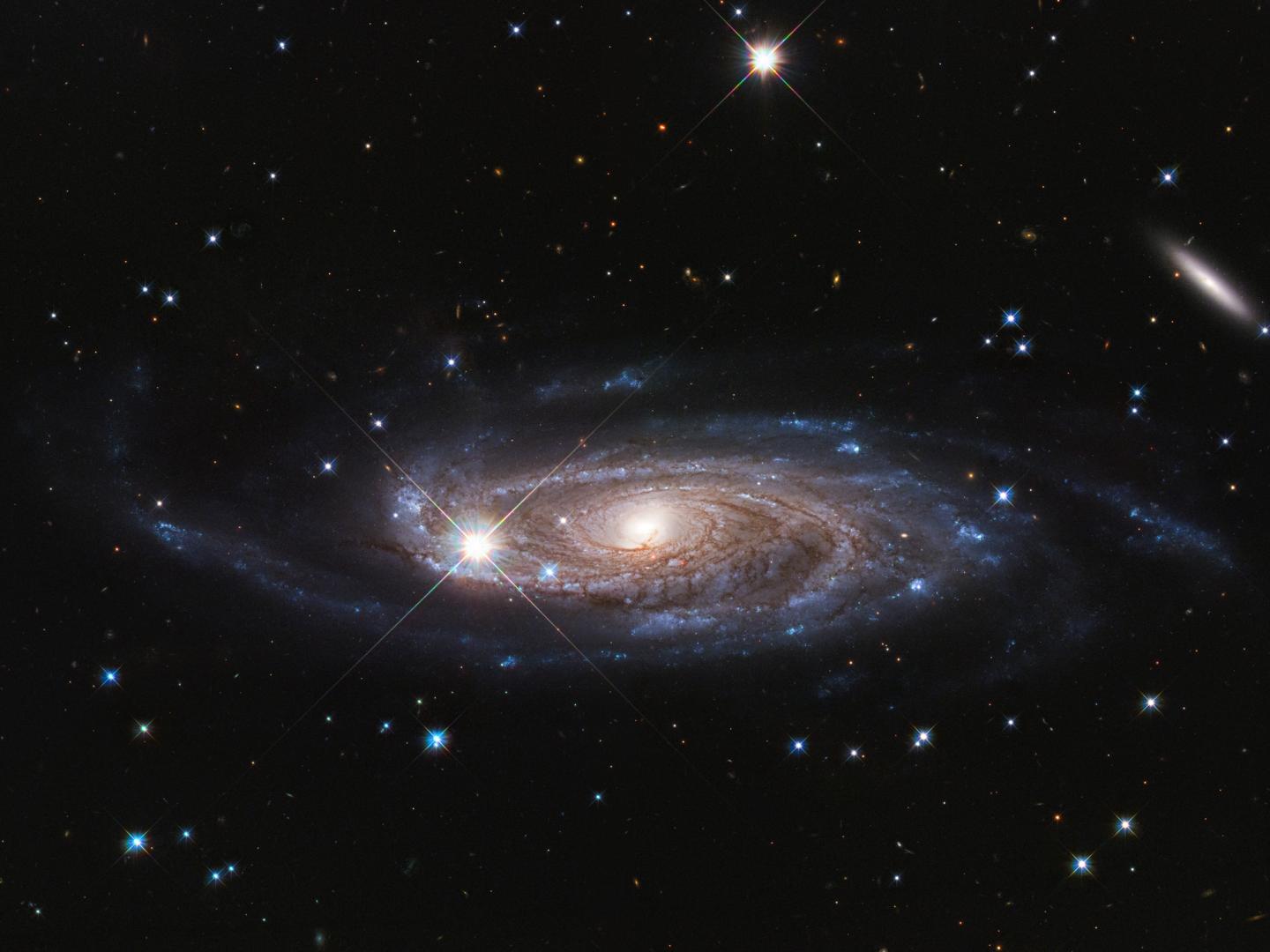
Credit: Credits: NASA, ESA and B. Holwerda (University of Louisville)

This majestic spiral galaxy might earn the nickname the “Godzilla galaxy” because it may be the largest known in the local universe. The galaxy, UGC 2885, is 2.5 times wider than our Milky Way and contains 10 times as many stars.

But it is a “gentle giant,” say researchers, because it looks like it has been sitting quietly over billions of years, possibly sipping hydrogen from the filamentary structure of intergalactic space. This fuels modest ongoing star birth at half the rate of our Milky Way. In fact, its supermassive central black hole is a sleeping giant, too. Because the galaxy does not appear to be feeding on much smaller satellite galaxies, it is starved of infalling gas.

The galaxy has been nicknamed “Rubin’s galaxy,” after astronomer Vera Rubin (1928 – 2016), by Benne Holwerda of the University of Louisville, Kentucky, who observed the galaxy with NASA’s Hubble Space Telescope.

“My research was in a large part inspired by Vera Rubin’s work in 1980 on the size of this galaxy,” said Holwerda. Rubin measured the galaxy’s rotation, which provides evidence for dark matter, which makes up most of the galaxy’s mass as measured by the rotation rate. “We consider this a commemorative image. This goal to cite Dr. Rubin in our observation was very much part of our original Hubble proposal.”

In results being presented at the winter American Astronomical Society meeting in Honolulu, Hawaii, Holwerda is seeking to understand what led to the galaxy’s monstrous size. “How it got so big is something we don’t quite know yet,” said Holwerda. “It’s as big as you can make a disk galaxy without hitting anything else in space.”

One clue is that the galaxy is fairly isolated in space and doesn’t have any nearby galaxies to crash into and disrupt the shape of its disk.

Did the monster galaxy gobble up much smaller satellite galaxies over time? Or did it just slowly accrete gas for new stars? “It seems like it’s been puttering along, slowly growing,” Holwerda said. Using Hubble’s exceptional resolution, his team is counting the number of globular star clusters in the galaxy’s halo — a vast shell of faint stars surrounding the galaxy. An excess of clusters would yield evidence that they were captured from smaller infalling galaxies over many billions of years.

NASA’s upcoming James Webb Space Telescope could be used to explore the center of this galaxy as well as the globular cluster population. NASA’s planned Wide Field Infrared Survey Telescope (WFIRST) would give an even more complete census of this galaxy’s cluster population, especially that of the whole halo. “The infrared capability of both space telescopes would give us a more unimpeded view of the underlying stellar populations,” said Holwerda. This complements Hubble’s visible-light ability to track wispy star formation throughout the galaxy.

A number of foreground stars in our Milky Way can be seen in the image, identified by their diffraction spikes. The brightest appears to sit on top of the galaxy’s disk, though UGC 2885 is really 232 million light-years farther away. The giant galaxy is located in the northern constellation Perseus.

###

Media Contact
Claire Andreoli
[email protected]
301-286-1940

Original Source

https://www.nasa.gov/feature/goddard/2020/nasas-hubble-surveys-gigantic-galaxy

Tags: AstronomyAstrophysicsSatellite Missions/ShuttlesSpace/Planetary ScienceTechnology/Engineering/Computer Science
Share12Tweet8Share2ShareShareShare2

Related Posts

Miniature Sensor Uses Light to Detect Touch — Chemistry

Miniature Sensor Uses Light to Detect Touch

May 8, 2026
Iron Minerals Determine Whether Dissolved Organic Matter Fuels Microbes or Becomes Long-Term Carbon Storage — Chemistry

Iron Minerals Determine Whether Dissolved Organic Matter Fuels Microbes or Becomes Long-Term Carbon Storage

May 8, 2026

Kate Evans Appointed Associate Lab Director for Biological and Environmental Systems Science at ORNL

May 8, 2026

Advancing Multiscale Modeling and Overcoming Operational Challenges in Autothermal COâ‚‚-to-Methanol Reactors

May 8, 2026
Please login to join discussion

POPULAR NEWS

  • Research Indicates Potential Connection Between Prenatal Medication Exposure and Elevated Autism Risk

    840 shares
    Share 336 Tweet 210
  • New Study Reveals Plants Can Detect the Sound of Rain

    728 shares
    Share 290 Tweet 182
  • Salmonella Haem Blocks Macrophages, Boosts Infection

    61 shares
    Share 24 Tweet 15
  • Breastmilk Balances E. coli and Beneficial Bacteria in Infant Gut Microbiomes

    57 shares
    Share 23 Tweet 14

About

We bring you the latest biotechnology news from best research centers and universities around the world. Check our website.

Follow us

Recent News

Tinengotinib Alone or with Atezolizumab in Tumors

Fear of Falling and Activity Affect Elderly Life Quality

Transforming Jellyfish Bycatch into a Valuable Collagen Source for Cosmetics and Biotechnology

Subscribe to Blog via Email

Enter your email address to subscribe to this blog and receive notifications of new posts by email.

Join 82 other subscribers
  • Contact Us

Bioengineer.org © Copyright 2023 All Rights Reserved.

Welcome Back!

Login to your account below

Forgotten Password?

Retrieve your password

Please enter your username or email address to reset your password.

Log In
No Result
View All Result
  • Homepages
    • Home Page 1
    • Home Page 2
  • News
  • National
  • Business
  • Health
  • Lifestyle
  • Science

Bioengineer.org © Copyright 2023 All Rights Reserved.