• HOME
  • NEWS
  • EXPLORE
    • CAREER
      • Companies
      • Jobs
    • EVENTS
    • iGEM
      • News
      • Team
    • PHOTOS
    • VIDEO
    • WIKI
  • BLOG
  • COMMUNITY
    • FACEBOOK
    • INSTAGRAM
    • TWITTER
Thursday, January 1, 2026
BIOENGINEER.ORG
No Result
View All Result
  • Login
  • HOME
  • NEWS
  • EXPLORE
    • CAREER
      • Companies
      • Jobs
        • Lecturer
        • PhD Studentship
        • Postdoc
        • Research Assistant
    • EVENTS
    • iGEM
      • News
      • Team
    • PHOTOS
    • VIDEO
    • WIKI
  • BLOG
  • COMMUNITY
    • FACEBOOK
    • INSTAGRAM
    • TWITTER
  • HOME
  • NEWS
  • EXPLORE
    • CAREER
      • Companies
      • Jobs
        • Lecturer
        • PhD Studentship
        • Postdoc
        • Research Assistant
    • EVENTS
    • iGEM
      • News
      • Team
    • PHOTOS
    • VIDEO
    • WIKI
  • BLOG
  • COMMUNITY
    • FACEBOOK
    • INSTAGRAM
    • TWITTER
No Result
View All Result
Bioengineer.org
No Result
View All Result
Home NEWS Science News Health

Hearing through lip-reading

Bioengineer by Bioengineer
January 2, 2020
in Health
Reading Time: 2 mins read
0
IMAGE
Share on FacebookShare on TwitterShare on LinkedinShare on RedditShare on Telegram

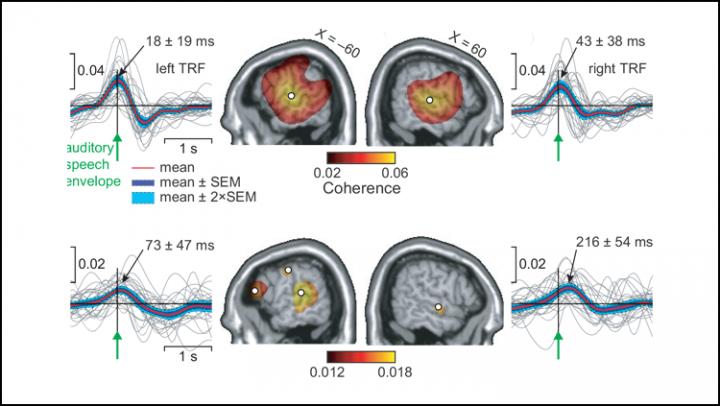
How the brain can create sound information via lip-reading
IMAGE

Credit: Bourguignon et al., JNeurosci 2019

Brain activity synchronizes with sound waves, even without audible sound, through lip-reading, according to new research published in JNeurosci.

Listening to speech activates our auditory cortex to synchronize with the rhythm of incoming sound waves. Lip-reading is a useful aid to comprehend unintelligible speech, but we still don’t know how lip-reading helps the brain process sound.

Bourguignon et al. used magnetoencephalography to measure brain activity in healthy adults while they listened to a story or watched a silent video of a woman speaking. The participants’ auditory cortices synchronized with sound waves produced by the woman in the video, even though they could not hear it. The synchronization resembled that in those who actually did listen to the story, indicating the brain can glean auditory information from the visual information available to them through lip-reading. The researchers suggest this ability arises from activity in the visual cortex synchronizing with lip movement. This signal is sent to other brain areas that translate the movement information into sound information, creating the sound wave synchronization.

###

Manuscript title: Lip-Reading Enables the Brain to Synthesize Auditory Features of Unknown Silent Speech

Please contact [email protected] for full-text PDF and to join SfN’s journals media list.

About JNeurosci

JNeurosci, the Society for Neuroscience’s first journal, was launched in 1981 as a means to communicate the findings of the highest quality neuroscience research to the growing field. Today, the journal remains committed to publishing cutting-edge neuroscience that will have an immediate and lasting scientific impact, while responding to authors’ changing publishing needs, representing breadth of the field and diversity in authorship.

About The Society for Neuroscience

The Society for Neuroscience is the world’s largest organization of scientists and physicians devoted to understanding the brain and nervous system. The nonprofit organization, founded in 1969, now has nearly 37,000 members in more than 90 countries and over 130 chapters worldwide.

Media Contact
Calli McMurray
[email protected]
202-962-4000

Related Journal Article

http://dx.doi.org/10.1523/JNEUROSCI.1101-19.2019

Tags: Hearing/SpeechLanguage/Linguistics/SpeechLearning/Literacy/ReadingneurobiologySocial/Behavioral Science
Share12Tweet8Share2ShareShareShare2

Related Posts

Preterm Birth’s Impact on Childhood Psychomotor Skills

January 1, 2026

Bioavailable Testosterone Lowers Lung Squamous Cell Carcinoma Risk

January 1, 2026

Case Report: Thrombocytopenia After PD-1 Therapy in SCLC

January 1, 2026

Enhancing Manual Wheelchair Training for Chronic Conditions

January 1, 2026
Please login to join discussion

POPULAR NEWS

  • blank

    PTSD, Depression, Anxiety in Childhood Cancer Survivors, Parents

    107 shares
    Share 43 Tweet 27
  • NSF funds machine-learning research at UNO and UNL to study energy requirements of walking in older adults

    71 shares
    Share 28 Tweet 18
  • Exploring Audiology Accessibility in Johannesburg, South Africa

    52 shares
    Share 21 Tweet 13
  • SARS-CoV-2 Subvariants Affect Outcomes in Elderly Hip Fractures

    44 shares
    Share 18 Tweet 11

About

We bring you the latest biotechnology news from best research centers and universities around the world. Check our website.

Follow us

Recent News

Model-Free Optical Processors Learn via Proximal Policy Optimization

Preterm Birth’s Impact on Childhood Psychomotor Skills

Bioavailable Testosterone Lowers Lung Squamous Cell Carcinoma Risk

Subscribe to Blog via Email

Enter your email address to subscribe to this blog and receive notifications of new posts by email.

Join 71 other subscribers
  • Contact Us

Bioengineer.org © Copyright 2023 All Rights Reserved.

Welcome Back!

Login to your account below

Forgotten Password?

Retrieve your password

Please enter your username or email address to reset your password.

Log In
No Result
View All Result
  • Homepages
    • Home Page 1
    • Home Page 2
  • News
  • National
  • Business
  • Health
  • Lifestyle
  • Science

Bioengineer.org © Copyright 2023 All Rights Reserved.