• HOME
  • NEWS
  • EXPLORE
    • CAREER
      • Companies
      • Jobs
    • EVENTS
    • iGEM
      • News
      • Team
    • PHOTOS
    • VIDEO
    • WIKI
  • BLOG
  • COMMUNITY
    • FACEBOOK
    • INSTAGRAM
    • TWITTER
Saturday, February 7, 2026
BIOENGINEER.ORG
No Result
View All Result
  • Login
  • HOME
  • NEWS
  • EXPLORE
    • CAREER
      • Companies
      • Jobs
        • Lecturer
        • PhD Studentship
        • Postdoc
        • Research Assistant
    • EVENTS
    • iGEM
      • News
      • Team
    • PHOTOS
    • VIDEO
    • WIKI
  • BLOG
  • COMMUNITY
    • FACEBOOK
    • INSTAGRAM
    • TWITTER
  • HOME
  • NEWS
  • EXPLORE
    • CAREER
      • Companies
      • Jobs
        • Lecturer
        • PhD Studentship
        • Postdoc
        • Research Assistant
    • EVENTS
    • iGEM
      • News
      • Team
    • PHOTOS
    • VIDEO
    • WIKI
  • BLOG
  • COMMUNITY
    • FACEBOOK
    • INSTAGRAM
    • TWITTER
No Result
View All Result
Bioengineer.org
No Result
View All Result
Home NEWS Science News Chemistry

MIPT physicists find ways to overcome signal loss in magnonic circuits

Bioengineer by Bioengineer
January 2, 2020
in Chemistry
Reading Time: 2 mins read
0
IMAGE
Share on FacebookShare on TwitterShare on LinkedinShare on RedditShare on Telegram

IMAGE

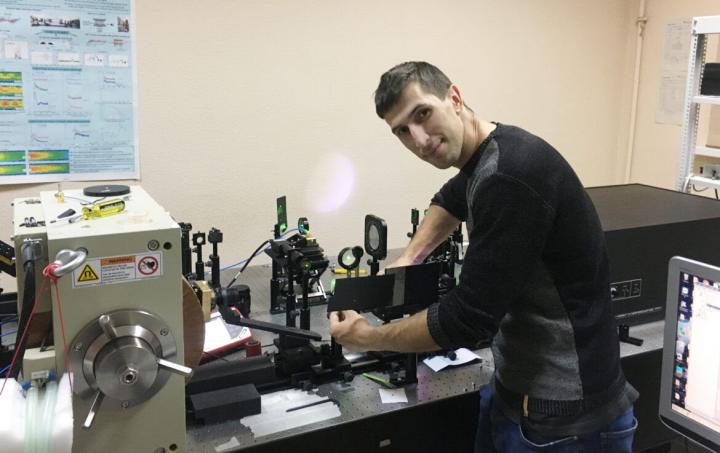
Credit: Image courtesy of Dmitry Kalyabin

Researchers from the Moscow Institute of Physics and Technology, Kotelnikov Institute of Radio Engineering and Electronics, and N.G. Chernyshevsky Saratov State University have demonstrated that the coupling elements in magnonic logic circuits are so crucial that a poorly selected waveguide can lead to signal loss. The physicists developed a parametric model for predicting the waveguide configuration that avoids signal loss, built a prototype waveguide, and tested the model in an experiment. Their paper was published in the Journal of Applied Physics.

The underlying goal of the research on magnonic logic is creating alternative circuit elements compatible with the existing electronics. This means developing completely new elements, including faster signal processors with low power consumption, that could be incorporated into present-day electronics.

In designing new devices, various components are integrated with each other. However, magnonic circuits rely on magnetic waveguides rather than wires for this. Researchers previously conjectured that waveguides could have an adverse effect on signal intensity in transmission from one component to another.

The recent study by the Russian physicists has shown the waveguides to have a greater effect than anticipated. In fact, it turns out that a poorly chosen waveguide geometry can result in complete signal loss. The reason for this is spin wave interference. Waveguides are extremely miniature components, measuring hundredths of a micrometer, and on this scale, the lateral quantization of the signal needs to be accounted for.

The researchers worked on an optimization problem: How does one design a waveguide for magnonic circuits to ensure maximum efficiency? The team developed a theory and a mathematical model to describe wave propagation in nanosized waveguides. To this end, senior researcher Dmitry Kalyabin of MIPT’s Terahertz Spintronics Lab, adapted the team’s previous results developed for acoustic systems to spin waves.

His colleagues in Saratov then created a prototype device and verified Kalyabin’s calculations using a method known as Brillouin spectroscopy. This technique involves making a “snapshot” of the magnetization distribution in a sample following its exposure to laser light. The distribution observed in this way can then be compared with theoretical predictions.

“We initially aimed to build a model that enables calculating the throughput characteristics of a waveguide before it was actually made. Our expectation was that optimizing the shape of the waveguide would maximize signal transmission efficiency. But our research revealed the effects of interference to be greater than anticipated, with suboptimal parameters sometimes rendering the signal completely lost,” said Sergey Nikitov, the head of the Terahertz Spintronics Lab and a corresponding member of the Russian Academy of Sciences.

Although the authors of the paper used the example of a tapering narrow ferromagnetic waveguide to demonstrate how their model works, it is applicable to the entire range of currently used waveguide types.

###

Media Contact
Varvara Bogomolova
[email protected]
7-916-147-4496

Related Journal Article

http://dx.doi.org/10.1063/1.5099358

Tags: Electrical Engineering/ElectronicsNanotechnology/MicromachinesResearch/DevelopmentTechnology/Engineering/Computer Science
Share12Tweet8Share2ShareShareShare2

Related Posts

blank

Breakthrough in Environmental Cleanup: Scientists Develop Solar-Activated Biochar for Faster Remediation

February 7, 2026
blank

Cutting Costs: Making Hydrogen Fuel Cells More Affordable

February 6, 2026

Scientists Develop Hand-Held “Levitating” Time Crystals

February 6, 2026

Observing a Key Green-Energy Catalyst Dissolve Atom by Atom

February 6, 2026
Please login to join discussion

POPULAR NEWS

  • Robotic Ureteral Reconstruction: A Novel Approach

    Robotic Ureteral Reconstruction: A Novel Approach

    82 shares
    Share 33 Tweet 21
  • Digital Privacy: Health Data Control in Incarceration

    63 shares
    Share 25 Tweet 16
  • Study Reveals Lipid Accumulation in ME/CFS Cells

    57 shares
    Share 23 Tweet 14
  • Breakthrough in RNA Research Accelerates Medical Innovations Timeline

    53 shares
    Share 21 Tweet 13

About

We bring you the latest biotechnology news from best research centers and universities around the world. Check our website.

Follow us

Recent News

Boosting Remote Healthcare: Stepped-Wedge Trial Insights

Barriers and Boosters of Seniors’ Physical Activity in Karachi

Evaluating Pediatric Emergency Care Quality in Ethiopia

Subscribe to Blog via Email

Enter your email address to subscribe to this blog and receive notifications of new posts by email.

Join 73 other subscribers
  • Contact Us

Bioengineer.org © Copyright 2023 All Rights Reserved.

Welcome Back!

Login to your account below

Forgotten Password?

Retrieve your password

Please enter your username or email address to reset your password.

Log In
No Result
View All Result
  • Homepages
    • Home Page 1
    • Home Page 2
  • News
  • National
  • Business
  • Health
  • Lifestyle
  • Science

Bioengineer.org © Copyright 2023 All Rights Reserved.