• HOME
  • NEWS
  • EXPLORE
    • CAREER
      • Companies
      • Jobs
    • EVENTS
    • iGEM
      • News
      • Team
    • PHOTOS
    • VIDEO
    • WIKI
  • BLOG
  • COMMUNITY
    • FACEBOOK
    • INSTAGRAM
    • TWITTER
Sunday, August 16, 2026
BIOENGINEER.ORG
No Result
View All Result
  • Login
  • HOME
  • NEWS
  • EXPLORE
    • CAREER
      • Companies
      • Jobs
        • Lecturer
        • PhD Studentship
        • Postdoc
        • Research Assistant
    • EVENTS
    • iGEM
      • News
      • Team
    • PHOTOS
    • VIDEO
    • WIKI
  • BLOG
  • COMMUNITY
    • FACEBOOK
    • INSTAGRAM
    • TWITTER
  • HOME
  • NEWS
  • EXPLORE
    • CAREER
      • Companies
      • Jobs
        • Lecturer
        • PhD Studentship
        • Postdoc
        • Research Assistant
    • EVENTS
    • iGEM
      • News
      • Team
    • PHOTOS
    • VIDEO
    • WIKI
  • BLOG
  • COMMUNITY
    • FACEBOOK
    • INSTAGRAM
    • TWITTER
No Result
View All Result
Bioengineer.org
No Result
View All Result
Home NEWS Science News Biology

How bacteria control their cell cycle

Bioengineer by Bioengineer
December 30, 2019
in Biology
Reading Time: 3 mins read
0
IMAGE
Share on FacebookShare on TwitterShare on LinkedinShare on RedditShare on Telegram

IMAGE

Credit: Biozentrum, University of Basel


Researchers at the Biozentrum of the University have demonstrated how bacteria coordinate cell division with the replication of their genetic material. In an interdisciplinary study they explain why the current concept of the bacterial cell cycle has to be rewritten. The results were published in eLife.

Each living cell grows and divides, thus generating new offspring. This process is also known as the cell cycle. Strictly speaking, it describes a periodic repetition of two coordinated cycles: the duplication of a cell’s genetic information on the one hand and cell division on the other. Although the cell cycle in plant and animal cells has been elucidated quite precisely in the past decades, it has remained unclear how these two processes are coordinated in bacteria.

DNA replication controls the cell cycle timing

Although it is natural to think that the cell cycle begins with the birth of the cell and ends with the next cell division, the new research argues for a major shift in this concept. Their findings show that, in bacteria, the cell cycle starts and ends with the initiation of DNA replication, with the cell division event occurring between two DNA replication events.

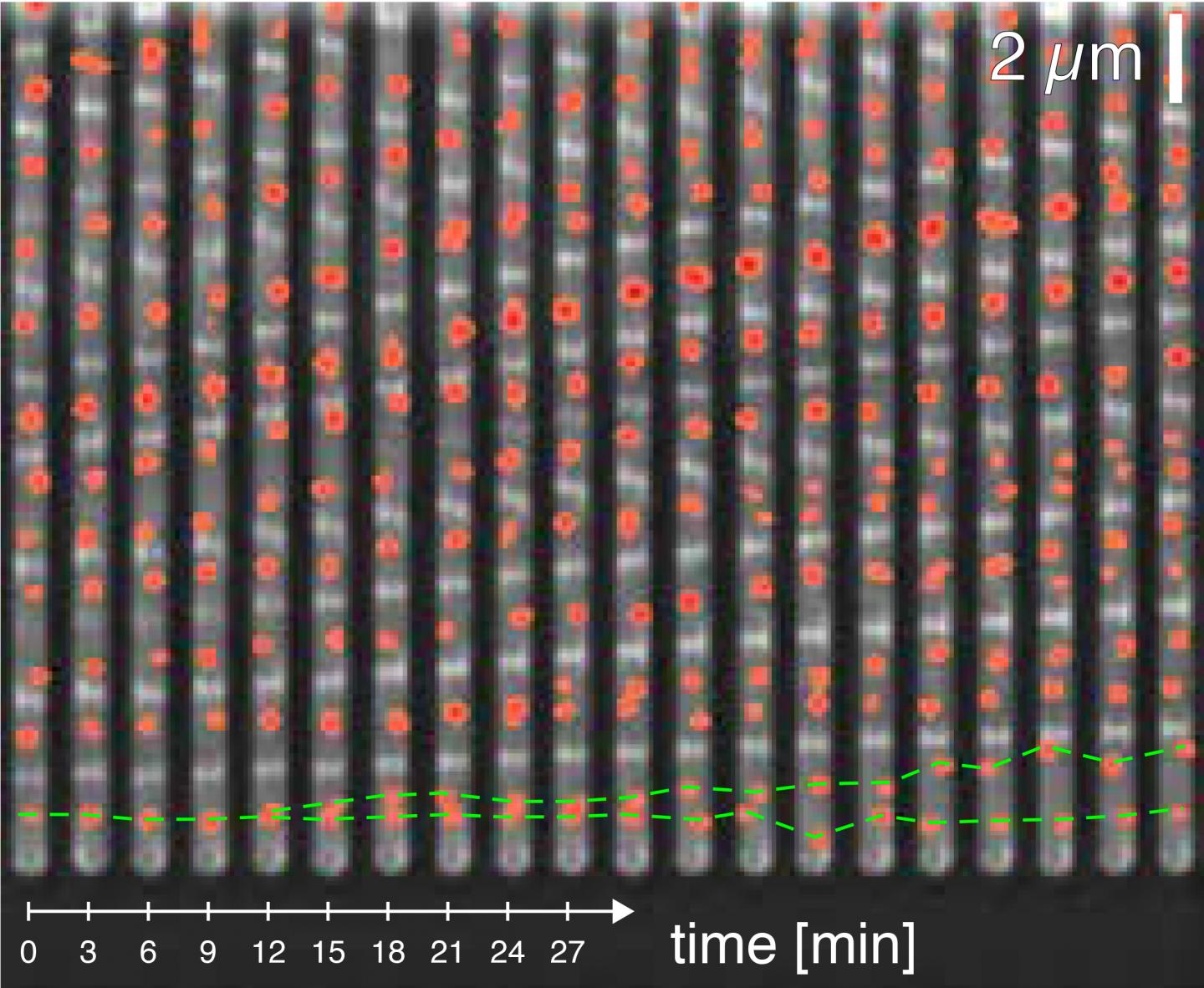
The researchers, led by Prof. Erik van Nimwegen at the Biozentrum of the University of Basel, used a highly interdisciplinary approach combining microfluidics, automated time-lapse microscopy, sophisticated image analysis, and computational modeling. They observed the behavior of individual E. coli cells over long periods of time and systematically quantified multiple variables describing growth, cell division and DNA replication for thousands of cell cycles in several growth conditions. Computational modelling was then applied to this data to uncover the control mechanisms of the cell cycle.

“Our model indicates that the cell cycle in E. coli starts with the initiation of DNA replication, at which point two different counters start running; one determining when the next cell division should occur, and the other determining when the next initiation of DNA replication should occur,” explains Thomas Julou, head of the study. “Even though we have not yet identified the molecular basis of these two counters, the biomass produced since the last counter reset appears to be the variable controlling when the next division and replication events take place”.

Studying fluctuations to reveal control mechanisms

In contrast to classical molecular biology approaches where the effects of mutations are analyzed, the current study uses a new approach in which analysis of the subtle fluctuations that normally growing cells exhibit is used to infer how the underlying process is controlled.

“A major challenge was to develop statistical methods to analyze the structure of the correlations in the fluctuations of cell cycle parameters such as cell size at birth,” says Erik van Nimwegen. “A key new idea that we developed is that, instead of looking for correlations between variables, it is more informative to identify which variables appear to fluctuate independently of each other.” This approach enabled the scientists to reveal the control mechanism of the bacterial cell cycle, but this method will be generally applicable to studying other biological processes and organisms.

###

Further information

Prof. Dr. Erik van Nimwegen, University of Basel, Biozentrum, Tel. +41 61 207 15 76, E-Mail: [email protected]

Media Contact
Dr. Katrin Bühler
[email protected]
0041-612-070-974

Related Journal Article

http://dx.doi.org/10.7554/eLife.48063

Tags: BacteriologyBiologyCell Biology
Share12Tweet8Share2ShareShareShare2

Related Posts

Strubbelig–NHL3 Receptor Complex Helps Arabidopsis Respond to Cellulose Deficiency

Strubbelig–NHL3 Receptor Complex Helps Arabidopsis Respond to Cellulose Deficiency

August 15, 2026
Bombyx mori Satellitome Analysis Reveals Evolutionary Stability, Dispersed Chromosomal Organization, Transposon Origins

Bombyx mori Satellitome Analysis Reveals Evolutionary Stability, Dispersed Chromosomal Organization, Transposon Origins

August 15, 2026

Synthetic pyrenoid reconstruction reveals EPYC1-driven carbon concentration mechanisms and evolution

August 15, 2026

Endophytic Flavobacterium boosts root hairs and drought tolerance through ERF–CEP5 signaling

August 15, 2026
Please login to join discussion

POPULAR NEWS

  • KAIST develops semiconductor neuron that harnesses noise to selectively process signals

    29 shares
    Share 12 Tweet 7
  • Imagining natural and extra robotic thumbs together strengthens kinesthetic sensorimotor networks

    29 shares
    Share 12 Tweet 7
  • PARP1 Drives Neuropathic Pain Through GPX4-Dependent Ferroptosis in Injured Mice’s Sensory Neurons

    29 shares
    Share 12 Tweet 7
  • Strubbelig–NHL3 Receptor Complex Helps Arabidopsis Respond to Cellulose Deficiency

    29 shares
    Share 12 Tweet 7

About

We bring you the latest biotechnology news from best research centers and universities around the world. Check our website.

Follow us

Recent News

KAIST develops semiconductor neuron that harnesses noise to selectively process signals

Imagining natural and extra robotic thumbs together strengthens kinesthetic sensorimotor networks

PARP1 Drives Neuropathic Pain Through GPX4-Dependent Ferroptosis in Injured Mice’s Sensory Neurons

Subscribe to Blog via Email

Enter your email address to subscribe to this blog and receive notifications of new posts by email.

Join 85 other subscribers
  • Contact Us

Bioengineer.org © Copyright 2023 All Rights Reserved.

Welcome Back!

Login to your account below

Forgotten Password?

Retrieve your password

Please enter your username or email address to reset your password.

Log In
No Result
View All Result
  • Homepages
    • Home Page 1
    • Home Page 2
  • News
  • National
  • Business
  • Health
  • Lifestyle
  • Science

Bioengineer.org © Copyright 2023 All Rights Reserved.