Credit: Osaka University
A group of researchers at Osaka University revealed that ESAM (Endothelial cell-selective adhesion molecule), a surface marker for hematopoietic stem cells (HSCs) and vascular endothelial cells (ECs), played an important role in the ontogeny of hematopoiesis in mice, particularly in the development of adult-type erythropoiesis. Their research results were published in Stem Cell Reports.
In hematopoiesis, a process essential for growth and life maintenance for mammals, HSCs give rise to other blood cells for the organism’s entire life. Hemangioblasts, the multipotent precursor cells, differentiate into hematopoietic and vascular endothelial cells. The microenvironment in bone marrow provides signals that regulate and support the production of blood cells necessary to maintain homeostasis of HSCs.
Functions of various types of known HSC surface markers, especially the role of hematopoietic cells in ontogeny and proliferation, were not well understood. In 2016, this group identified ESAM as an HSC surface marker, revealing that ESAM marked hematopoietic stem cells in humans as well as in mice. In the same year, this group also clarified that ESAM-deficient mice treated with an anti-tumor drug died before hematopoietic recovery. (Normally, red and white blood cells temporarily decrease after the administration of the anti-tumor drug and recover later.) They were aware that ESAM had an important function, but could not identify the role of ESAM during fetal life.
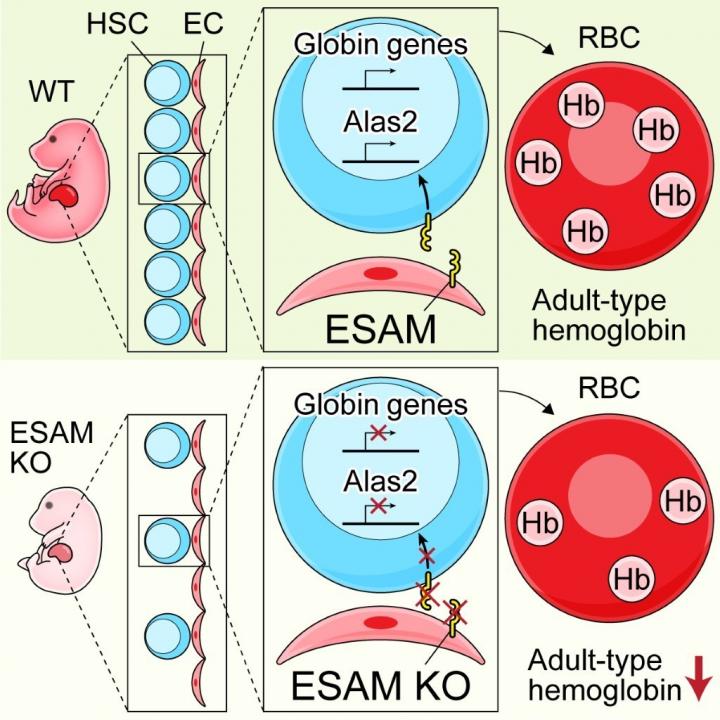
In this study, the group found that the adult-type hemoglobin synthesis ability of ESAM-null fetal livers was lower than that of wild-type mice and that expression of adult-type hemoglobin-related genes markedly decreased in ESAM-null HSCs. From these findings, they elucidated that ESAM played an important role in the development of definitive hematopoiesis, particularly of adult-type erythropoiesis.
In HSCs co-cultured with a murine stromal cell line, ESAM-null HSCs exhibited functional disruption of differentiation into adult-type blood cells. In fetuses from conditional ESAM-knockout mice, in which ESAM was deficient specifically in HSCs or ECs, the hematopoiesis-supporting ability was also impaired in ECs derived from ESAM-null mice. These results show that ESAM expressed on ECs as well as HSCs contribute to adult-type hematopoiesis. That is, both ESAM expressed on HSCs and ESAM expressed on ECs play an important role in developing definitive hematopoiesis. (Figure)
Lead author UEDA Tomoaki says, “Properties of HSCs and hematopoiesis mechanisms are not well understood because it is difficult to study hematopoiesis, especially in human fetal life. We’d like to continue our research so that our achievements will elucidate the mechanisms of hematopoiesis and lead to the identification of the cause of congenital disorders of the hematopoietic system, especially the cause of genetic anemia, and the development of treatment methods.”
###
The article, “Endothelial cell-selective adhesion molecule contributes to the development of definitive hematopoiesis in the fetal liver,” was published in Stem Cell Reports at DOI: https:/
About Osaka University
Osaka University was founded in 1931 as one of the seven imperial universities of Japan and now has expanded to one of Japan’s leading comprehensive universities. The University has now embarked on open research revolution from a position as Japan’s most innovative university and among the most innovative institutions in the world according to Reuters 2015 Top 100 Innovative Universities and the Nature Index Innovation 2017. The university’s ability to innovate from the stage of fundamental research through the creation of useful technology with economic impact stems from its broad disciplinary spectrum.
Website: https:/
Media Contact
Saori Obayashi
[email protected]
81-661-055-886
Original Source
https:/
Related Journal Article
http://dx.