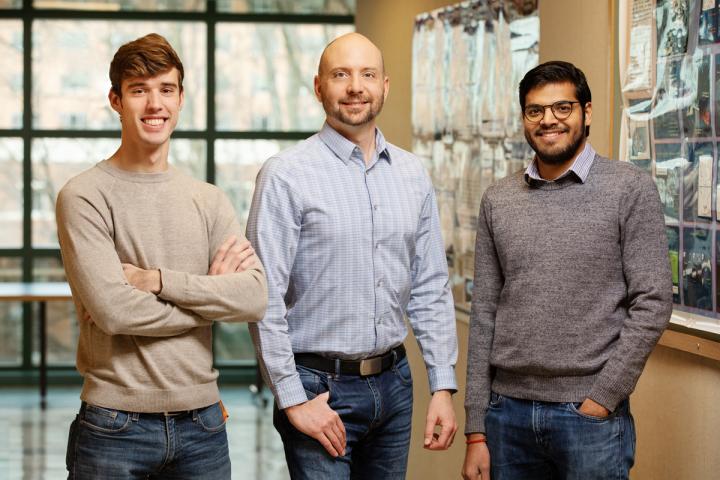
Credit: Photo by L. Brian Stauffer
CHAMPAIGN, Ill. — Handling very soft, delicate items without damaging them is hard enough with human hands, let alone doing it at the microscopic scale with laboratory instruments. Three new studies show how scientists have honed a technique for handling tiny, soft particles using precisely controlled fluid flows that act as gentle microscopic hands. The technique allows researchers to test the physical limits of these soft particles and the things made from them – ranging from biological tissues to fabric softeners.
The three studies, led by the University of Illinois’ Charles Schroeder, the Ray and Beverly Mentzer Faculty Scholar of chemical and biomolecular engineering, detail the technology and application of the Stokes trap – a method for manipulating small particles using only fluid flow. In the newest study, published in the journal Soft Matter, the team used the Stokes trap to study the dynamics of vesicles – squishy fluid-filled particles that are stripped-down versions of cells and have direct relevance to biological systems, the researchers said. This follows up on two recent studies in the journals Physical Review Fluids and Physical Review Applied that expanded the power of the trapping method.
“There are several other techniques available for manipulating small particles, such as the widely used and Nobel Prize-winning optical trap method that uses carefully aligned lasers to capture particles, ” said Dinesh Kumar, a chemical and biomolecular engineering graduate student and lead author of two of the studies. “The Stokes trap offers several advantages over other methods, including the ease of scaling up to study multiple particles and the ability to control the orientiation and trajectories of different shape particles such as rods or spheres.”
Armed with the improved Stokes trap technology, the team set out to understand the dynamics of lipid vesicles when they are far from their normal equilibrium state.
“We wanted to understand what happens to these particles when they are pulled on in a strong flow,” Schroeder said. “In real-world applications, these materials are stretched when they interact with each other; they are processed, injected and constantly undergoing stresses that lead to deformation. How they act when they deform has important implications on their use, long-term stability and processability.”
“We found that when vesicles are deformed in a strong flow, they stretch into one of three distinct shapes – symmetric dumbbell, asymmetric dumbbell or ellipsoid shape,” Kumar said. “We observed that these shape transitions are independent of the viscosity difference of the fluids between vesicle interior and exterior. This demonstrates that the Stokes trap is an effective way to measure stretching dynamics of soft materials in solution and far from equilibrium.”
With their new data, the team was able to produce a phase diagram that can be used by researchers to determine how certain types of fluid flow will influence deformation and, ultimately, the physical properties of soft particles when pulled on from different flow directions.
“For example, products like fabric softeners – which are composed of vesicle suspensions – do not work correctly when they clump together,” Kumar said. “Using the Stokes trap, we can figure out what types of particle interactions cause the vesicles to aggregate and then design a better-performing material.”
The technique is currently limited by the size of particles that the Stokes trap can catch and handle, the researchers said. They are working with particles that generally are larger than 100 nanometers in diameter, but in order for this technology to apply more directly to biological systems, they will need to be able to grab particles that are 10 to 20 nanometers in diameter – or even down to a single protein.
The team is currently working to capture smaller particles and collaborating with colleagues at Stanford University to apply the Stokes trap to study membrane proteins.
###
Schroeder also is affiliated with the Beckman Institute for Advanced Science and Technology, the department of chemistry and the department of materials science and engineering at the U. of I.
Former U. of I. graduate student Anish Shenoy is a co-author of the Physical Review Applied and the Physical Review Fluids studies, and U. of I. undergraduate student Channing Richter is a co-author of the publication in Soft Matter.
The National Science Foundation supported this work under the CBET Particulate and Multiphase Processes Program, Award 1704668.
Media Contact
Lois Yoksoulian
[email protected]
217-244-2788
Original Source
https:/
Related Journal Article
http://dx.