• HOME
  • NEWS
  • EXPLORE
    • CAREER
      • Companies
      • Jobs
    • EVENTS
    • iGEM
      • News
      • Team
    • PHOTOS
    • VIDEO
    • WIKI
  • BLOG
  • COMMUNITY
    • FACEBOOK
    • INSTAGRAM
    • TWITTER
Saturday, February 7, 2026
BIOENGINEER.ORG
No Result
View All Result
  • Login
  • HOME
  • NEWS
  • EXPLORE
    • CAREER
      • Companies
      • Jobs
        • Lecturer
        • PhD Studentship
        • Postdoc
        • Research Assistant
    • EVENTS
    • iGEM
      • News
      • Team
    • PHOTOS
    • VIDEO
    • WIKI
  • BLOG
  • COMMUNITY
    • FACEBOOK
    • INSTAGRAM
    • TWITTER
  • HOME
  • NEWS
  • EXPLORE
    • CAREER
      • Companies
      • Jobs
        • Lecturer
        • PhD Studentship
        • Postdoc
        • Research Assistant
    • EVENTS
    • iGEM
      • News
      • Team
    • PHOTOS
    • VIDEO
    • WIKI
  • BLOG
  • COMMUNITY
    • FACEBOOK
    • INSTAGRAM
    • TWITTER
No Result
View All Result
Bioengineer.org
No Result
View All Result
Home NEWS Science News Biology

Evolutionary changes in brain potentially make us more prone to anxiety

Bioengineer by Bioengineer
December 23, 2019
in Biology
Reading Time: 2 mins read
0
IMAGE
Share on FacebookShare on TwitterShare on LinkedinShare on RedditShare on Telegram

IMAGE

Credit: Daiki Sato


Neurochemicals such as serotonin and dopamine play crucial roles in cognitive and emotional functions of our brain. Vesicular monoamine transporter 1 (VMAT1) is one of the genes responsible for transporting neurotransmitters and regulating neuronal signaling. A research team led by Tohoku University has reconstructed ancestral VMAT1 proteins, revealing the functional changes in neurotransmitter uptake of VMAT1 throughout the course of human evolution.

Human bodies are made up of millions of cells. Each individual contains a specific set of instruction of codes that make up all of a living thing’s genetic material. These instructions are known as genomes. PhD candidate Daiki Sato and Professor Masakado Kawata of the Graduate School of Life Sciences at Tohoku University, and two of the authors involved in the current study, previously discovered VMAT1 to be one of the genes that had evolved throughout human lineage.

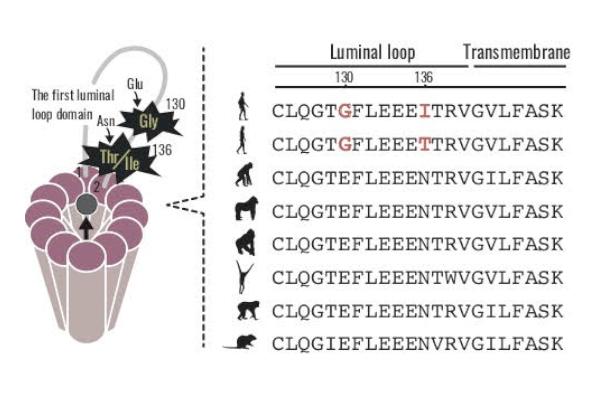
VMAT 1 contains two human-specific mutations, or where the genomes changed, with the change being represented as 130Glu to 130Gly and from 136Asn to 136Thr. Previous studies have shown that having the new 130Gly/136Thr variant decreases the uptake of neurotransmitters and is associated with higher depression and/or anxiety.

In this study, Sato, Kawata and their colleagues revealed the evolutionary changes in neurotransmitter uptake of VMAT1 by reconstructing ancestral VMAT1 proteins. First they applied a fluorescent substrate to visualize and quantify the neurotransmitter uptake of each genotype. The ancestral (130Glu/136Asn) VMAT1 protein exhibited an increased uptake of neurotransmitters compared to a derived (130Gly/136Thr) genotype. Given that the derived (130Gly/136Thr) genotype is shown to be associated with depression and/or anxiety in modern human populations. “This results of our study reveal that our ancestors may have been able to withstand higher levels of anxiety or depression,” noted the authors.

The researcher’s next step is to identify the neurological and behavioral consequences of the mutations in mice to clarify how the variants contributed to our brain evolution. “This would be the striking evidence that links evolution of our genome and brain,” said the authors. The researchers hope that this finding provides insights into our diverse psychological traits including psychiatric disorders.

###

Media Contact
Masakado Kawata
[email protected]
81-227-956-688

Original Source

https://www.tohoku.ac.jp/en/press/vmat1_human_evolution.html

Related Journal Article

http://dx.doi.org/10.1186/s12862-019-1543-8

Tags: Biology
Share12Tweet8Share2ShareShareShare2

Related Posts

Florida Cane Toad: Complex Spread and Selective Evolution

Florida Cane Toad: Complex Spread and Selective Evolution

February 7, 2026
New Study Uncovers Mechanism Behind Burn Pit Particulate Matter–Induced Lung Inflammation

New Study Uncovers Mechanism Behind Burn Pit Particulate Matter–Induced Lung Inflammation

February 6, 2026

DeepBlastoid: Advancing Automated and Efficient Evaluation of Human Blastoids with Deep Learning

February 6, 2026

Navigating the Gut: The Role of Formic Acid in the Microbiome

February 6, 2026
Please login to join discussion

POPULAR NEWS

  • Robotic Ureteral Reconstruction: A Novel Approach

    Robotic Ureteral Reconstruction: A Novel Approach

    82 shares
    Share 33 Tweet 21
  • Digital Privacy: Health Data Control in Incarceration

    63 shares
    Share 25 Tweet 16
  • Study Reveals Lipid Accumulation in ME/CFS Cells

    57 shares
    Share 23 Tweet 14
  • Breakthrough in RNA Research Accelerates Medical Innovations Timeline

    53 shares
    Share 21 Tweet 13

About

We bring you the latest biotechnology news from best research centers and universities around the world. Check our website.

Follow us

Recent News

Evaluating Pediatric Emergency Care Quality in Ethiopia

TPMT Expression Predictions Linked to Azathioprine Side Effects

Improving Dementia Care with Enhanced Activity Kits

Subscribe to Blog via Email

Success! An email was just sent to confirm your subscription. Please find the email now and click 'Confirm' to start subscribing.

Join 73 other subscribers
  • Contact Us

Bioengineer.org © Copyright 2023 All Rights Reserved.

Welcome Back!

Login to your account below

Forgotten Password?

Retrieve your password

Please enter your username or email address to reset your password.

Log In
No Result
View All Result
  • Homepages
    • Home Page 1
    • Home Page 2
  • News
  • National
  • Business
  • Health
  • Lifestyle
  • Science

Bioengineer.org © Copyright 2023 All Rights Reserved.