• HOME
  • NEWS
  • EXPLORE
    • CAREER
      • Companies
      • Jobs
    • EVENTS
    • iGEM
      • News
      • Team
    • PHOTOS
    • VIDEO
    • WIKI
  • BLOG
  • COMMUNITY
    • FACEBOOK
    • INSTAGRAM
    • TWITTER
Saturday, February 7, 2026
BIOENGINEER.ORG
No Result
View All Result
  • Login
  • HOME
  • NEWS
  • EXPLORE
    • CAREER
      • Companies
      • Jobs
        • Lecturer
        • PhD Studentship
        • Postdoc
        • Research Assistant
    • EVENTS
    • iGEM
      • News
      • Team
    • PHOTOS
    • VIDEO
    • WIKI
  • BLOG
  • COMMUNITY
    • FACEBOOK
    • INSTAGRAM
    • TWITTER
  • HOME
  • NEWS
  • EXPLORE
    • CAREER
      • Companies
      • Jobs
        • Lecturer
        • PhD Studentship
        • Postdoc
        • Research Assistant
    • EVENTS
    • iGEM
      • News
      • Team
    • PHOTOS
    • VIDEO
    • WIKI
  • BLOG
  • COMMUNITY
    • FACEBOOK
    • INSTAGRAM
    • TWITTER
No Result
View All Result
Bioengineer.org
No Result
View All Result
Home NEWS Science News Biology

Light pollution can suppress melatonin production in humans and animals

Bioengineer by Bioengineer
December 19, 2019
in Biology
Reading Time: 2 mins read
0
IMAGE
Share on FacebookShare on TwitterShare on LinkedinShare on RedditShare on Telegram

IMAGE

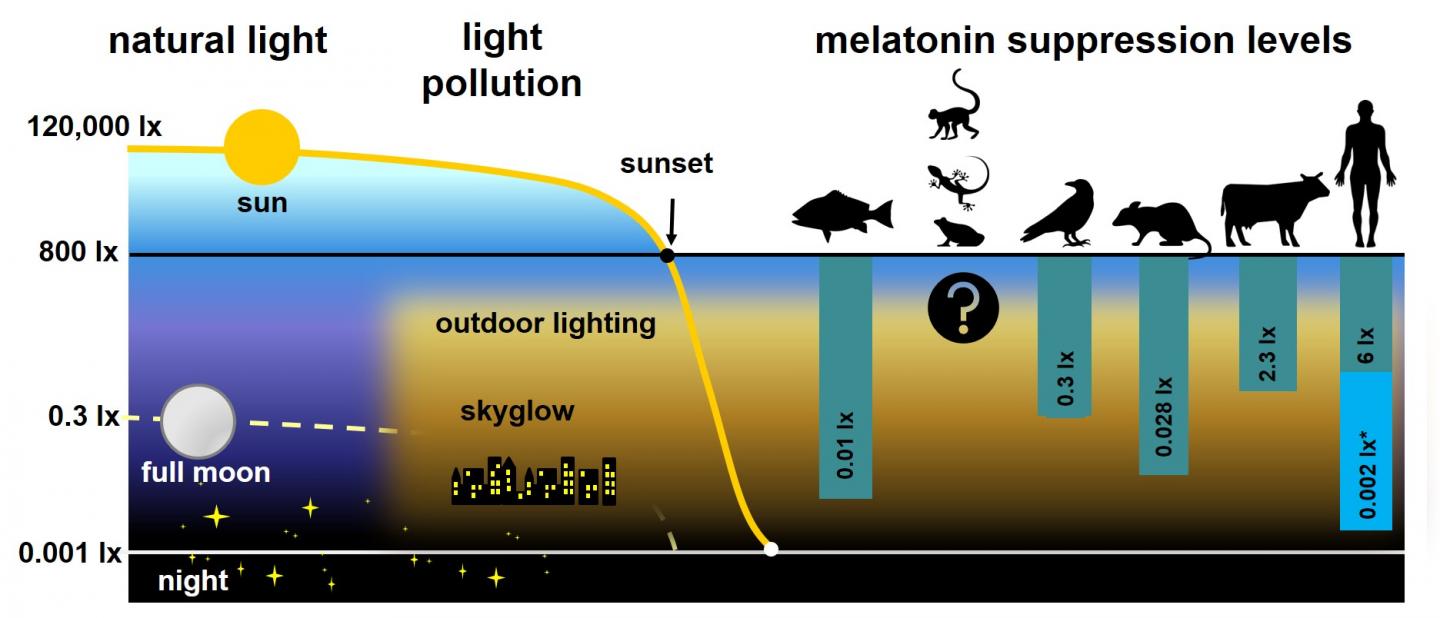
Credit: Andreas Jechow, Icons made by Freepik

Melatonin sets the internal clock. Researchers from Leibniz-Institute of Freshwater Ecology and Inland Fisheries (IGB) in an international team have analyzed data on the impact of light pollution on melatonin formation in humans and vertebrates. They found that even the low light intensities of urban skyglow can suppress melatonin production.

Melatonin synchronizes the day-night-rhythm in animals and humans. It adjusts the circadian clocks of cells, tissues and organs, and regulates other seasonal processes like reproduction. In vertebrates, differences in light levels are detected by photoreceptors for example in the retina. At high light levels, melatonin production is suppressed. In darkness, melatonin is produced.

The sensitivity threshold for humans is 6 lux – street lighting is typically higher

Artificial light at night can disturb the nocturnal melatonin production. Within a literature review of 1900 studies, the researchers identified 72 relevant works that fulfilled their criteria for light pollution. Based on the data, they showed that even very low illuminance levels can suppress melatonin production for some vertebrate classes: in fish the threshold is 0.01 lux, in rodents 0.03 lux and in sensitive humans 6 lux; pure blue light showed much lower thresholds.

For comparison, the illuminance levels at night: On a starry night, the illuminance is 0.001 lux. On a full-moon night it reaches a maximum of 0.3 lux. The skyglow of a city, a form of light pollution, can reach illuminances of up to 0.1 lux, and outdoor lighting on the order of 150 lux.

“Surprisingly, the low light levels of skyglow are sufficient to suppress melatonin production in several vertebrate classes”, says first author Dr. Maja Grubisic from IGB Berlin. “Skyglow affects large areas on a world-wide scale, as we know from satellite data”, adds her colleague Dr. Andreas Jechow. The light from artificial lighting shines into the night sky, brighter with rain and snow, and is reflected by clouds and particles, which is called skyglow. The scientists unraveled several knowledge gaps: “There are no studies on melatonin and light pollution in reptiles and amphibians and no long term-studies at all. Particularly, the impacts on human health are not fully understood”, says IGB researcher Dr. Franz Hoelker, head of the study.

###

Media Contact
Dr. Maja Grubisic
[email protected]

Original Source

https://www.fv-berlin.de/en/info-for/the-media-and-public/news/news/lichtverschmutzung-unterdrueckt-dunkelhormon-melatonin/

Related Journal Article

http://dx.doi.org/10.3390/su11226400

Tags: BiologyEcology/EnvironmentPollution/Remediation
Share13Tweet8Share2ShareShareShare2

Related Posts

New Study Uncovers Mechanism Behind Burn Pit Particulate Matter–Induced Lung Inflammation

New Study Uncovers Mechanism Behind Burn Pit Particulate Matter–Induced Lung Inflammation

February 6, 2026

DeepBlastoid: Advancing Automated and Efficient Evaluation of Human Blastoids with Deep Learning

February 6, 2026

Navigating the Gut: The Role of Formic Acid in the Microbiome

February 6, 2026

AI-Enhanced Optical Coherence Photoacoustic Microscopy Revolutionizes 3D Cancer Model Imaging

February 6, 2026
Please login to join discussion

POPULAR NEWS

  • Robotic Ureteral Reconstruction: A Novel Approach

    Robotic Ureteral Reconstruction: A Novel Approach

    82 shares
    Share 33 Tweet 21
  • Digital Privacy: Health Data Control in Incarceration

    63 shares
    Share 25 Tweet 16
  • Study Reveals Lipid Accumulation in ME/CFS Cells

    57 shares
    Share 23 Tweet 14
  • Breakthrough in RNA Research Accelerates Medical Innovations Timeline

    53 shares
    Share 21 Tweet 13

About

We bring you the latest biotechnology news from best research centers and universities around the world. Check our website.

Follow us

Recent News

Neg-Entropy: The Key Therapeutic Target for Chronic Diseases

Multidisciplinary Evidence-Based Guidelines for Therapeutic Drug Monitoring of Biologics in Inflammatory Bowel Disease

Early Tuberculosis Treatment Lowers Sepsis Mortality in People with HIV

Subscribe to Blog via Email

Enter your email address to subscribe to this blog and receive notifications of new posts by email.

Join 73 other subscribers
  • Contact Us

Bioengineer.org © Copyright 2023 All Rights Reserved.

Welcome Back!

Login to your account below

Forgotten Password?

Retrieve your password

Please enter your username or email address to reset your password.

Log In
No Result
View All Result
  • Homepages
    • Home Page 1
    • Home Page 2
  • News
  • National
  • Business
  • Health
  • Lifestyle
  • Science

Bioengineer.org © Copyright 2023 All Rights Reserved.