• HOME
  • NEWS
  • EXPLORE
    • CAREER
      • Companies
      • Jobs
    • EVENTS
    • iGEM
      • News
      • Team
    • PHOTOS
    • VIDEO
    • WIKI
  • BLOG
  • COMMUNITY
    • FACEBOOK
    • INSTAGRAM
    • TWITTER
Monday, May 11, 2026
BIOENGINEER.ORG
No Result
View All Result
  • Login
  • HOME
  • NEWS
  • EXPLORE
    • CAREER
      • Companies
      • Jobs
        • Lecturer
        • PhD Studentship
        • Postdoc
        • Research Assistant
    • EVENTS
    • iGEM
      • News
      • Team
    • PHOTOS
    • VIDEO
    • WIKI
  • BLOG
  • COMMUNITY
    • FACEBOOK
    • INSTAGRAM
    • TWITTER
  • HOME
  • NEWS
  • EXPLORE
    • CAREER
      • Companies
      • Jobs
        • Lecturer
        • PhD Studentship
        • Postdoc
        • Research Assistant
    • EVENTS
    • iGEM
      • News
      • Team
    • PHOTOS
    • VIDEO
    • WIKI
  • BLOG
  • COMMUNITY
    • FACEBOOK
    • INSTAGRAM
    • TWITTER
No Result
View All Result
Bioengineer.org
No Result
View All Result
Home NEWS Science News Chemistry

Researchers discover how ant species uses abdomen for extra power during jumps

Bioengineer by Bioengineer
December 18, 2019
in Chemistry
Reading Time: 3 mins read
0
IMAGE
Share on FacebookShare on TwitterShare on LinkedinShare on RedditShare on Telegram

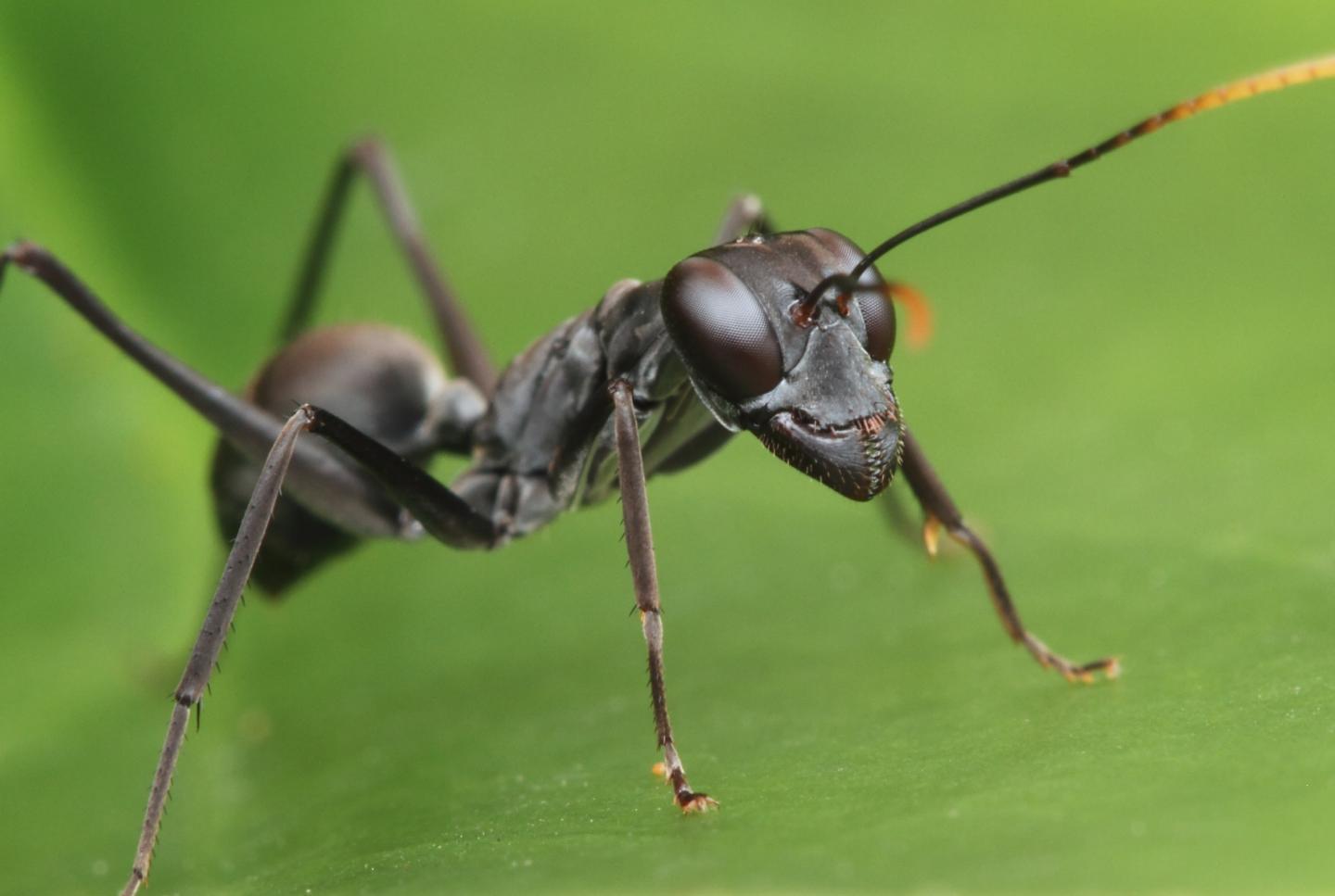
Researchers in the department of entomology at the University of Illinois have shown how a species of ant uses its abdomen to add speed to its jump, in a recent study published in Integrative Organismal Biology
IMAGE

Credit: Alex Wild: https://www.alexanderwild.com/

Researchers in the department of entomology at the University of Illinois have shown how a species of ant uses its abdomen to add speed to its jump, in a recent study published in Integrative Organismal Biology. With a name like Gigantiops destructor, one might expect this ant species to be large or aggressive, but these relatively shy ants common to South America are anything but. Compared to other notable Amazonian ants such as bullet, army and leafcutter ants, Gigantiops are smaller, less confrontational, and often overlooked as one walks through the rainforest. However, these ants are capable of a rather unique behavior – they travel through their leaf litter habitats by jumping – and rotating their abdomens to power part of that process.

Gigantiops destructor is one of only four types of ants that are known to use their legs to jump as a form of locomotion. The ants use their legs to make precise directional jumps, aided by how they move their abdomens, as the new study shows. “It had been previously thought that these ants were swinging their abdomen above their body during takeoff to help power their jumps,” said study co-author Josh Gibson, a graduate student in entomology. “Until now, no one had actually tested it, so that’s what we set out to do in this paper.” Gibson co-authored the study with Dr. Andrew Suarez (entomology; evolution, ecology and behavior) and Dajia Ye (alumna and current graduate student at the University of Pennsylvania).

Using high speed cameras to study the ants in slow motion, the authors compared the jumps of unencumbered ants to the jumps of ants who had been sedated and had their abdomens glued in place, as well as to ants who had been sedated and sham-treated as a control. By limiting their ability to move, the researchers hoped to understand how the ants utilized this body movement for jumping.

The results indicate that moving their abdomens aids the ants to jump further, higher, and faster overall. This is particularly helpful to the ants as they try to navigate the detritus on a forest floor. “These ants forage in leaf litter, and it can be quite difficult if the ants have to walk up and down each leaf,” said Gibson. “Jumping improves their ability to travel much more quickly through the litter, and their abdominal rotation powers those jumps, at least in part.”

Interestingly, the abdomen rotation does not seem to be involved as much in stabilizing the body of the ant during the jump – which is where the legs come in. “Looking at future work, we could look at the center of body mass on the ants and see how they use their legs to stabilize themselves after they jump,” added Gibson. “Learning more about how these ants move and how their bodies to accomplish that can help us gain a better understanding of how this could apply to other species, or provide insight into bio-inspired design concepts.”

###

A video presenting these findings and the jumping ants in-action, for embedding in articles, is here: https://youtu.be/o01WIFXnrSw

Media Contact
Rosemary Keane
[email protected]
217-300-5893

Related Journal Article

http://dx.doi.org/10.1093/iob/obz033

Tags: BiodiversityBiologyBiomechanics/BiophysicsEcology/EnvironmentEntomology
Share12Tweet8Share2ShareShareShare2

Related Posts

Miniature Sensor Uses Light to Detect Touch — Chemistry

Miniature Sensor Uses Light to Detect Touch

May 8, 2026
Iron Minerals Determine Whether Dissolved Organic Matter Fuels Microbes or Becomes Long-Term Carbon Storage — Chemistry

Iron Minerals Determine Whether Dissolved Organic Matter Fuels Microbes or Becomes Long-Term Carbon Storage

May 8, 2026

Kate Evans Appointed Associate Lab Director for Biological and Environmental Systems Science at ORNL

May 8, 2026

Advancing Multiscale Modeling and Overcoming Operational Challenges in Autothermal COâ‚‚-to-Methanol Reactors

May 8, 2026
Please login to join discussion

POPULAR NEWS

  • Research Indicates Potential Connection Between Prenatal Medication Exposure and Elevated Autism Risk

    840 shares
    Share 336 Tweet 210
  • New Study Reveals Plants Can Detect the Sound of Rain

    728 shares
    Share 290 Tweet 182
  • Salmonella Haem Blocks Macrophages, Boosts Infection

    62 shares
    Share 25 Tweet 16
  • Breastmilk Balances E. coli and Beneficial Bacteria in Infant Gut Microbiomes

    57 shares
    Share 23 Tweet 14

About

We bring you the latest biotechnology news from best research centers and universities around the world. Check our website.

Follow us

Recent News

Medicaid’s Role in Combating Climate Change Impacts

Mapping Skin Lesions in Lupus Types Explored

Umbilical IL-6 Levels Reveal Preterm Brain Injury Risk

Subscribe to Blog via Email

Enter your email address to subscribe to this blog and receive notifications of new posts by email.

Join 82 other subscribers
  • Contact Us

Bioengineer.org © Copyright 2023 All Rights Reserved.

Welcome Back!

Login to your account below

Forgotten Password?

Retrieve your password

Please enter your username or email address to reset your password.

Log In
No Result
View All Result
  • Homepages
    • Home Page 1
    • Home Page 2
  • News
  • National
  • Business
  • Health
  • Lifestyle
  • Science

Bioengineer.org © Copyright 2023 All Rights Reserved.