Credit: ©Science China Press
In the paper, a C6v-symmetric structure is thoroughly studied in which the valley Hall effect plays an important role when the Dirac cone at the corner point of the Brillouin region is opened, accompanied by a new band gap, by changing the symmetry of the structure from C6v into C3v. Further, the researchers analyze the acoustic wave propagation in two types of topological states in the range of this new band gap. The first type appears at the top or bottom boundary of the single structure, whereas the second type is confined to the interface between two structures exhibiting different topological properties.
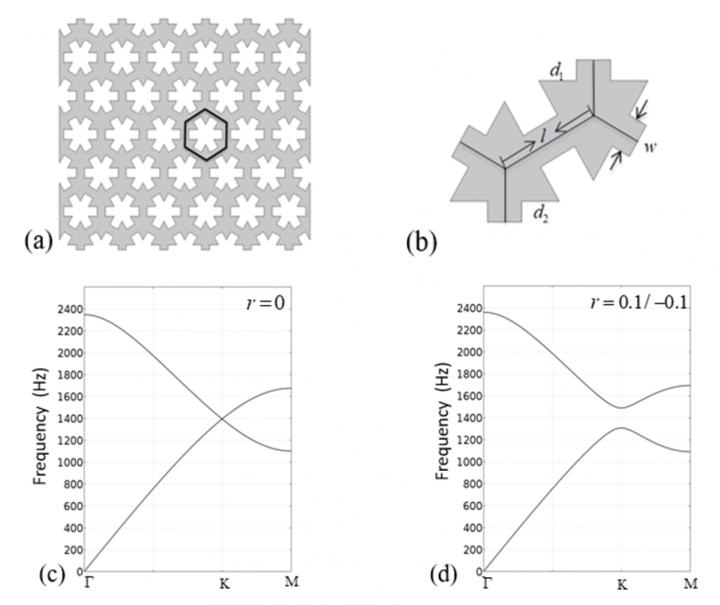
As depicted in Figures 1(a) and 1(b), the sonic crystal is composed of a triangular-lattice array. The side lengths of two adjacent regular triangles connected by rectangular waveguides are d1 and d2, respectively and d1/d2=(1-r)/(1+r). Figures 1(c) and 1(d) provide the dispersion relations of the sonic crystal along the typical boundaries of the Brillouin zone when r=0 and r=0.1/-0.1, respectively. In Figure 1(c), double degeneracy occurs, which is located at the K-point due to the C6v symmetry of the structure. In constrast to Figure 1(c), a band gap appears in Figure 1(d) by breaking the C6v symmetry into the C3v symmetry. Therefore, an acoustic topological insulator based on the mechanism of valley Hall effect is constructed. Both the two types of topological states in the range of this new band gap can propagate in both the directions (i.e., dual-channel propagation).
In Figure 2(a), the three boundaries are all selected to be Type 8 (please refer to the paper for the classification of the boundaries), and the researchers apply a point source at the middle point of the top boundary. Then the acoustic wave propagates in both the directions along the boundaries as shown in the figure. Although the edge state has the characteristic of dual-channel propagation, one-way propagation can be achieved by tailoring the boundaries as shown in Figure2(b). Further, the output position can be adjusted arbitrarily via changing the types of the boundaries as shown in Figures 2(c) and 2(d). In Figure 3, combining the edge and interface states together, the acoustic wave propagation path can be programmed in various ways.
In Figures 3(c)-(e), the researchers only change the selections of the two parts of the top boundary to control the propagation behavior of acoustic waves. The acoustic wave first propagates from bulk to the boundary of the composite structure, and then propagates on the top boundary to the right, to the left or in both the directions, according to the boundary types in Figures 3(c)-(e). The structure in Figure 3(f) is the same as that in Figure 3(e), but the point source is set at the left side of the top boundary. The acoustic wave first propagates along the top boundary of the structure with r=-0.1. When the wave meets the interface between r=0.1 and r=-0.1, there yields a bifurcation in the wave propagation. In the superposed composite structure, the boundary types only affect the existence of the edge state and have no influence on the interface state.
By combining the edge state and the interface state together, the acoustic wave propagation path in the band gap can be tailored in more flexible, diverse, and intriguing ways. It provides a new idea for the design of tunable acoustic devices.
###
This research was funded by the National Natural Science Foundation of China (Grant Nos. 11532001, 11621062, and 11872329), the Fundamental Research Funds for the Central Universities (Grant No. 2016XZZX001-05), and the Shenzhen Scientific and Technological Fund for R & D (Grant No. JCYJ20170816172316775).
See the article:
Jiao Wang, Yang Huang, WeiQiu Chen. Tailoring edge and interface states in topological metastructures exhibiting the acoustic valley Hall effect, Sci. China-Phys. Mech. Astron. 63(2): 224611 (2020). https:/
Media Contact
Weiqiu Chen
[email protected]
Related Journal Article
http://dx.