Credit: Virginia Tech
Construction is literally a hands-on business where profit-loss margins are squeaky-tight. The training of new workers requires time and labor, and materials like wood, cement, and rebar are too expensive for the “play” essential for learning new skills. Unfortunately, the consequences of mistakes on a construction worksite might be measured in the loss of limbs, if not lives.
So how do universities and the construction industry produce workers, designers, and managers who can apply real knowledge gained by using the latest technologies? Can they make “smart” worksites that mitigate danger and risk, especially where cost savings are difficult to achieve, but frequently required for success?
Abiola Akanmu, an assistant professor in the Myers-Lawson School of Construction, may have an answer. Her research creates teachable virtual construction scenarios that engage students’ hands and minds using augmented reality and holograms.
“Educators and commercial firms are both looking for ways to solve the hands-on problem,” said Akanmu. “And whatever you can do in the physical world, we’ll be able to do in the virtual world.”
Akanmu and an interdisciplinary team of researchers at Virginia Tech recently received a National Science Foundation grant to expand educators’ understanding of how trainees learn the transferable skills necessary to thrive in expensive – and dangerous – concrete and steel environments. Akanmu’s collaborators on the grant include Doug Bowman, a professor in the Department of Computer Science; Diana Bairaktarova, an assistant professor in the Department of Engineering Education; and Farrokh Jazizadeh Kari, an assistant professor in the Department of Civil and Environmental Engineering.
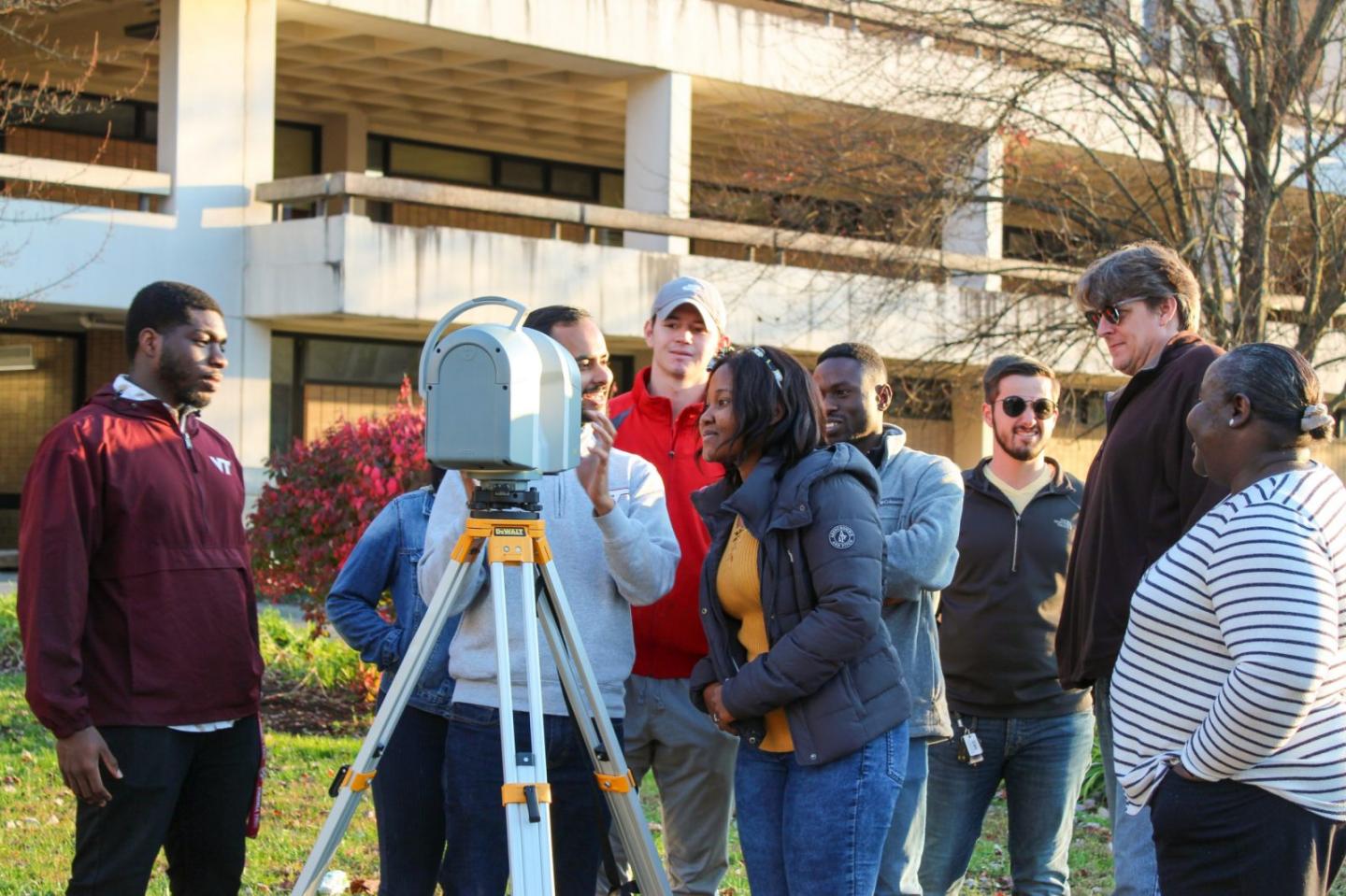
The project aims to prepare construction engineering and management students to use modern sensor technologies at construction sites. Awarded through a program for improving undergraduate STEM education, the grant will fund professors and students learning to use specialized laser sensors that optically map these locations and the physical structures within them.
The scanning process resembles how survey crews map roads prior to work. Specialized equipment using small sensors will survey an environment and report back a picture from the scanned data. In unsafe environments, site exploration can occur using robots or drones.
Akanmu’s students are working on developing a taxonomy, or a systematic understanding, of how to convert that data into representative scenes using computer programs. Students will then be able to physically experience these scenarios using Microsoft HoloLens, ensuring that profits and people won’t be put at risk by experiments or errors.
The scanning and mapping sensors should enable construction managers to master and juggle multiple issues on a “smart” jobsite. Through simulation, managers will also be able to evaluate health risks caused by repetitive motion or unergonomic conditions where worker injuries are likely to occur. This process will improve worksite safety, another area of cost risk for construction firms.
In addition, the research will help educators tailor student experiences that will meet the needs of industry partners through the advice of focus groups and experienced contractors. Construction industry feedback will be essential in evaluating the usefulness of the technology.
Bolanle Ogunseiju, a doctoral student in the environmental design and planning program, is working with Akanmu to make these virtual environments both realistic and accessible for students. She combines the technological expertise she is learning on the project with the real-world knowledge she gained as a former estimator in the construction industry.
Ogunseiju links the project’s relevance to one of the most difficult problems construction firms face: reliably predicting the amounts of expensive materials — such as dirt fill, gravel, and cement — that usually can’t be confirmed until actual work begins at a site.
She notes that estimating the volume of expensive items is particularly difficult. Mistakes can cost firms contracts during competitions and cause financial losses on worksites, risking successful project completion. “Students will learn not just the technical skills, but also the decision-making skills that firms seek in their employees to make them more effective,” said Ogunseiju.
Another benefit will be the ability for students to see beneath a structure’s finished façade and realistically experience — even though the setting is simulated and virtual — how complicated processes mesh materials together. Akanmu describes the technology’s ability to peel back layers of finished structures to show what materials are used to make a large supporting column, for example, and how they are blended together step by step.
“With this program, it will be very easy to form a mental view of what students must see to learn,” said Ogunseiju. “It provides practical experience, not just mere projecting, which will increase their value to future employers.”
###
Media Contact
Emily Roediger
[email protected]
540-231-2108
Original Source
https:/