• HOME
  • NEWS
  • EXPLORE
    • CAREER
      • Companies
      • Jobs
    • EVENTS
    • iGEM
      • News
      • Team
    • PHOTOS
    • VIDEO
    • WIKI
  • BLOG
  • COMMUNITY
    • FACEBOOK
    • INSTAGRAM
    • TWITTER
Saturday, February 7, 2026
BIOENGINEER.ORG
No Result
View All Result
  • Login
  • HOME
  • NEWS
  • EXPLORE
    • CAREER
      • Companies
      • Jobs
        • Lecturer
        • PhD Studentship
        • Postdoc
        • Research Assistant
    • EVENTS
    • iGEM
      • News
      • Team
    • PHOTOS
    • VIDEO
    • WIKI
  • BLOG
  • COMMUNITY
    • FACEBOOK
    • INSTAGRAM
    • TWITTER
  • HOME
  • NEWS
  • EXPLORE
    • CAREER
      • Companies
      • Jobs
        • Lecturer
        • PhD Studentship
        • Postdoc
        • Research Assistant
    • EVENTS
    • iGEM
      • News
      • Team
    • PHOTOS
    • VIDEO
    • WIKI
  • BLOG
  • COMMUNITY
    • FACEBOOK
    • INSTAGRAM
    • TWITTER
No Result
View All Result
Bioengineer.org
No Result
View All Result
Home NEWS Science News Chemistry

Breakthrough made in detecting carbon impurities in gallium nitride crystals via light

Bioengineer by Bioengineer
December 9, 2019
in Chemistry
Reading Time: 2 mins read
0
IMAGE
Share on FacebookShare on TwitterShare on LinkedinShare on RedditShare on Telegram

IMAGE

Credit: Kazunobu Kojima


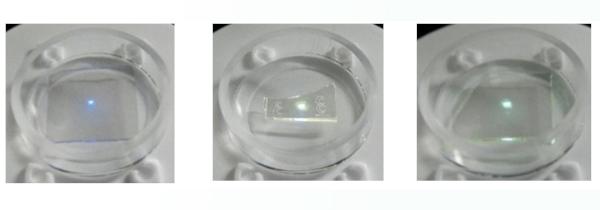
Carbon impurity has long hindered efficiency in nitride-based electronic and optical devices. But Researchers at Tohoku University, have discovered a method that can quickly detect carbon impurity using light.

The use of blue and white light-emitting diodes (LEDs) that use nitride semiconductors- specifically indium gallium nitride (InGaN) and gallium nitride (GaN) – has led to a steep increase in energy efficiency. Naturally, researchers have tried to replicate this in optical and electronic applications by using nitride semiconductors. However, a common issue arises due to carbon impurity, which significantly degrades performance.

Carbon impurity leads to deep-traps, an undesirable electronic defect by which performance is substantially reduced. However, detecting carbon impurity in semiconductor crystals is a time-consuming and costly process. Some methods necessitate creating additional electrodes onto the crystal. Thus, raising costs and inhibiting the inspection speed. Other methods result in the breakage of nitride crystals; therefore, rendering the crystals useless.

Nevertheless, Associate Professor for the Institute of Multidisciplinary Research for Advanced Materials at Tohoku University, Kazunobu Kojima and his team solved this problem by creating a way to identify carbon impurity using a probing technique utilizing light that makes no physical contact with the crystals. The technique is named omnidirectional photoluminescence (ODPL) spectroscopy.

The process of ODPL firstly involves illuminating a crystal, such as GaN, via external light. The external light is absorbed by the crystal, thereby stimulating it. In order to return to its initial state, therefore, the crystal creates a light to dissipate excess energy.

Utilizing the ODPL allows for the quick evaluation of photoluminescence efficiency with high accuracy. Since carbon impurity reduces the photoluminescence efficiency, researchers can also determine the carbon concentration by assessing the PL efficiency.

Professor Kojima explained the benefits of such a system. “Optical probing technologies are immensely beneficial due to their nondestructive nature. By using light, we can therefore, help detect carbon impurity which is ultimately such a hindrance for GaN devices, such as LEDs and power transistors.”

An added benefit of the ODPL spectroscopy is that is not only limited to nitride-semiconductor-based application. It can check any light-emitting materials that contain optical and electronic properties. An example would be perovskites, which is currently used in the manufacturing of high-efficiency solar cells.

###

Media Contact
Kazunobu Kojima
[email protected]
81-222-175-363

Original Source

https://www.tohoku.ac.jp/en/press/detecting_carbon_impurities.html

Related Journal Article

http://dx.doi.org/10.7567/1882-0786/ab5adc

Tags: Chemistry/Physics/Materials Sciences
Share12Tweet8Share2ShareShareShare2

Related Posts

blank

Breakthrough in Environmental Cleanup: Scientists Develop Solar-Activated Biochar for Faster Remediation

February 7, 2026
blank

Cutting Costs: Making Hydrogen Fuel Cells More Affordable

February 6, 2026

Scientists Develop Hand-Held “Levitating” Time Crystals

February 6, 2026

Observing a Key Green-Energy Catalyst Dissolve Atom by Atom

February 6, 2026
Please login to join discussion

POPULAR NEWS

  • Robotic Ureteral Reconstruction: A Novel Approach

    Robotic Ureteral Reconstruction: A Novel Approach

    82 shares
    Share 33 Tweet 21
  • Digital Privacy: Health Data Control in Incarceration

    63 shares
    Share 25 Tweet 16
  • Study Reveals Lipid Accumulation in ME/CFS Cells

    57 shares
    Share 23 Tweet 14
  • Breakthrough in RNA Research Accelerates Medical Innovations Timeline

    53 shares
    Share 21 Tweet 13

About

We bring you the latest biotechnology news from best research centers and universities around the world. Check our website.

Follow us

Recent News

Decoding Prostate Cancer Origins via snFLARE-seq, mxFRIZNGRND

Digital Health Perspectives from Baltic Sea Experts

Florida Cane Toad: Complex Spread and Selective Evolution

Subscribe to Blog via Email

Enter your email address to subscribe to this blog and receive notifications of new posts by email.

Join 73 other subscribers
  • Contact Us

Bioengineer.org © Copyright 2023 All Rights Reserved.

Welcome Back!

Login to your account below

Forgotten Password?

Retrieve your password

Please enter your username or email address to reset your password.

Log In
No Result
View All Result
  • Homepages
    • Home Page 1
    • Home Page 2
  • News
  • National
  • Business
  • Health
  • Lifestyle
  • Science

Bioengineer.org © Copyright 2023 All Rights Reserved.