• HOME
  • NEWS
  • EXPLORE
    • CAREER
      • Companies
      • Jobs
    • EVENTS
    • iGEM
      • News
      • Team
    • PHOTOS
    • VIDEO
    • WIKI
  • BLOG
  • COMMUNITY
    • FACEBOOK
    • INSTAGRAM
    • TWITTER
Saturday, February 7, 2026
BIOENGINEER.ORG
No Result
View All Result
  • Login
  • HOME
  • NEWS
  • EXPLORE
    • CAREER
      • Companies
      • Jobs
        • Lecturer
        • PhD Studentship
        • Postdoc
        • Research Assistant
    • EVENTS
    • iGEM
      • News
      • Team
    • PHOTOS
    • VIDEO
    • WIKI
  • BLOG
  • COMMUNITY
    • FACEBOOK
    • INSTAGRAM
    • TWITTER
  • HOME
  • NEWS
  • EXPLORE
    • CAREER
      • Companies
      • Jobs
        • Lecturer
        • PhD Studentship
        • Postdoc
        • Research Assistant
    • EVENTS
    • iGEM
      • News
      • Team
    • PHOTOS
    • VIDEO
    • WIKI
  • BLOG
  • COMMUNITY
    • FACEBOOK
    • INSTAGRAM
    • TWITTER
No Result
View All Result
Bioengineer.org
No Result
View All Result
Home NEWS Science News Chemistry

Speedy and precise multicolor imaging of biomolecules now possible

Bioengineer by Bioengineer
December 9, 2019
in Chemistry
Reading Time: 2 mins read
0
IMAGE
Share on FacebookShare on TwitterShare on LinkedinShare on RedditShare on Telegram

IMAGE

Credit: Ryota Iino, Institute for Molecular Science, National Institutes of Natural Sciences, Japan.


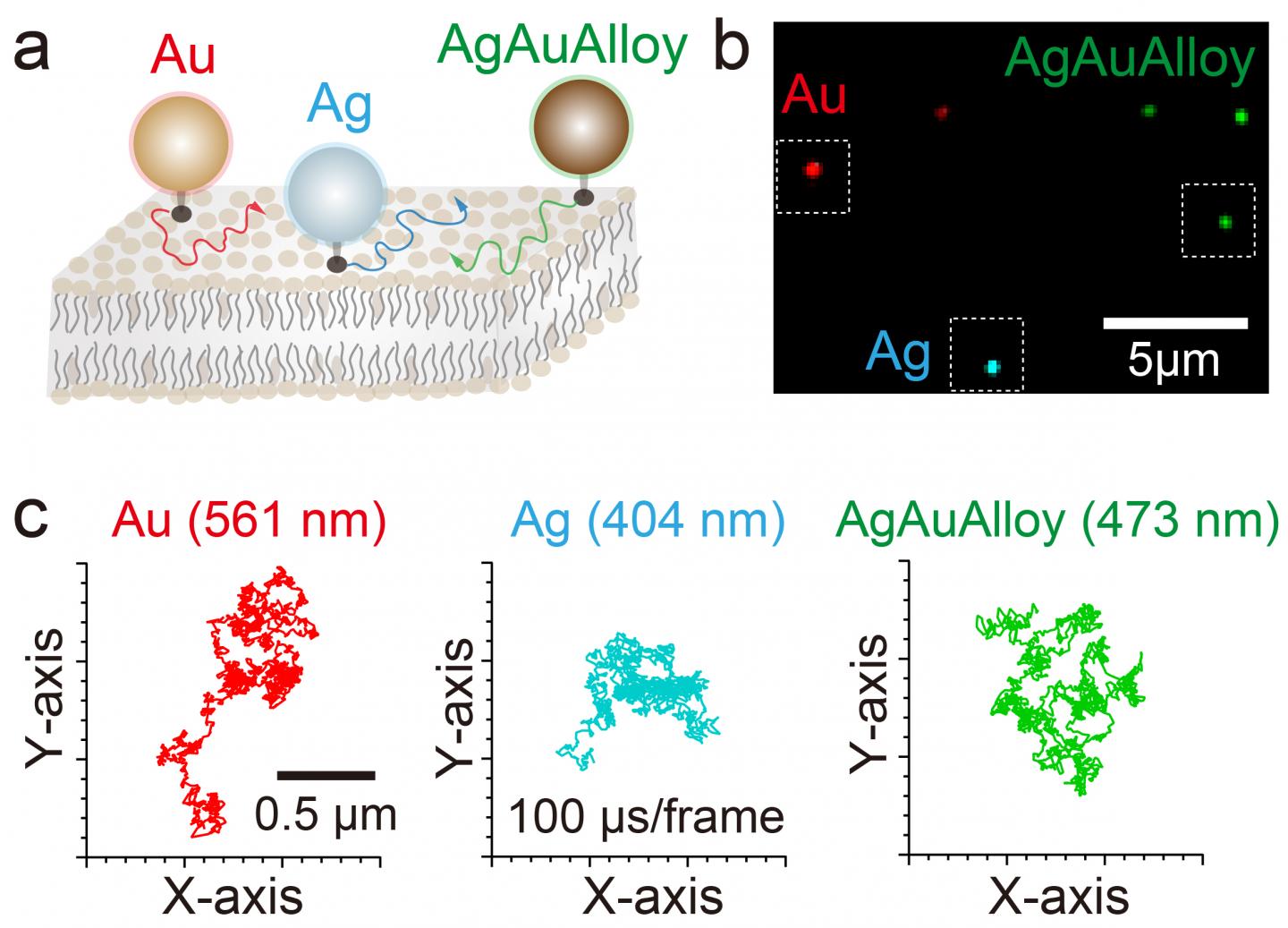
For the first time, researchers can track biological molecules with unprecedented speed and precision thanks to the use of multi-metallic nanoparticles.

The researchers published their results on October 17 in ACS Photonics, a journal of the American Chemical Society.

Nanoparticles are used to track the movements of biological molecules isolated from cells and also in living cells, such as the mechanisms related to intracelluar transport, cell signaling, and other processes. Researchers have traditionally used gold nanoparticles to track these movements, but, in imaging, they could only show one color: green. Now, scientists can see more than green through the use of gold, silver and gold-silver alloy nanoparticles.

“Gold nanoparticles are very powerful tools used to precisely track the fast motion of biomolecules,” said Ryota Iino, paper author and professor at the Institute for Molecular Science in the National Institutes of Natural Sciences. “However, the imaging was previously limited to monochromatic green. In this study, by using gold, silver and silver-gold nanoparticles, we have succeeded in extending the color palette–between purple and green–of high-speed and high-precision imaging of biomolecules.”

Other tagging techniques, such as organic fluorescent dyes, can extend the color palette to include reds, but they tend to display as weaker colors than the sharp and strong showing that metallic nanoparticles give off. Metallic nanoparticles are also more stable than organic dyes, meaning they remain visible as they move with the tagged biomolecule for a long period.

“Nanoparticles show much stronger signals, and they don’t blink in the same way organic dyes can,” Iino said. “Different nanoparticles also strongly scatter the light at different wavelengths, meaning they show up as visibly different colors when imaged.”

The team is now working on extending the imaging color palette even further with newly engineered nanoparticles. They also hope to use even much smaller nanoparticles to have a better understanding of all molecular mechanisms in functioning cells.

###

This work was supported, in part, by the Grants-in-Aid for Scientific Research on Innovative Areas “Molecular Engine”, by Grants-in-Aid for Scientific Research from the Ministry of Education, Culture, Sports, Science, and Technology of Japan and by the Imaging Science Project of the Center of Novel Science Initiatives of the National Institutes of Natural Sciences.

Other contributors include Jun Ando, Akihiko Nakamura and Mayuko Yamamoto, all of the Institute for Molecular Science in the National Institutes of Natural Sciences. Ando and Nakamura are also affiliated with the Graduate University for Advanced Studies. Chihong Song and Kazuyoshi Murata, both of the National Institute for Physiological Sciences in the National Institutes of Natural Sciences, also contributed.

Media Contact
Ryota Iino
[email protected]
81-564-595-230

Related Journal Article

http://dx.doi.org/10.1021/acsphotonics.9b00953

Tags: BiochemistryBiomechanics/BiophysicsChemistry/Physics/Materials SciencesNanotechnology/MicromachinesOptics
Share12Tweet8Share2ShareShareShare2

Related Posts

blank

Breakthrough in Environmental Cleanup: Scientists Develop Solar-Activated Biochar for Faster Remediation

February 7, 2026
blank

Cutting Costs: Making Hydrogen Fuel Cells More Affordable

February 6, 2026

Scientists Develop Hand-Held “Levitating” Time Crystals

February 6, 2026

Observing a Key Green-Energy Catalyst Dissolve Atom by Atom

February 6, 2026
Please login to join discussion

POPULAR NEWS

  • Robotic Ureteral Reconstruction: A Novel Approach

    Robotic Ureteral Reconstruction: A Novel Approach

    82 shares
    Share 33 Tweet 21
  • Digital Privacy: Health Data Control in Incarceration

    63 shares
    Share 25 Tweet 16
  • Study Reveals Lipid Accumulation in ME/CFS Cells

    57 shares
    Share 23 Tweet 14
  • Breakthrough in RNA Research Accelerates Medical Innovations Timeline

    53 shares
    Share 21 Tweet 13

About

We bring you the latest biotechnology news from best research centers and universities around the world. Check our website.

Follow us

Recent News

Succinate Receptor 1 Limits Blood Cell Formation, Leukemia

Palmitoylation of Tfr1 Drives Platelet Ferroptosis and Exacerbates Liver Damage in Heat Stroke

Oxygen-Enhanced Dual-Section Microneedle Patch Improves Drug Delivery and Boosts Photodynamic and Anti-Inflammatory Treatment for Psoriasis

Subscribe to Blog via Email

Enter your email address to subscribe to this blog and receive notifications of new posts by email.

Join 73 other subscribers
  • Contact Us

Bioengineer.org © Copyright 2023 All Rights Reserved.

Welcome Back!

Login to your account below

Forgotten Password?

Retrieve your password

Please enter your username or email address to reset your password.

Log In
No Result
View All Result
  • Homepages
    • Home Page 1
    • Home Page 2
  • News
  • National
  • Business
  • Health
  • Lifestyle
  • Science

Bioengineer.org © Copyright 2023 All Rights Reserved.