• HOME
  • NEWS
  • EXPLORE
    • CAREER
      • Companies
      • Jobs
    • EVENTS
    • iGEM
      • News
      • Team
    • PHOTOS
    • VIDEO
    • WIKI
  • BLOG
  • COMMUNITY
    • FACEBOOK
    • INSTAGRAM
    • TWITTER
Monday, May 11, 2026
BIOENGINEER.ORG
No Result
View All Result
  • Login
  • HOME
  • NEWS
  • EXPLORE
    • CAREER
      • Companies
      • Jobs
        • Lecturer
        • PhD Studentship
        • Postdoc
        • Research Assistant
    • EVENTS
    • iGEM
      • News
      • Team
    • PHOTOS
    • VIDEO
    • WIKI
  • BLOG
  • COMMUNITY
    • FACEBOOK
    • INSTAGRAM
    • TWITTER
  • HOME
  • NEWS
  • EXPLORE
    • CAREER
      • Companies
      • Jobs
        • Lecturer
        • PhD Studentship
        • Postdoc
        • Research Assistant
    • EVENTS
    • iGEM
      • News
      • Team
    • PHOTOS
    • VIDEO
    • WIKI
  • BLOG
  • COMMUNITY
    • FACEBOOK
    • INSTAGRAM
    • TWITTER
No Result
View All Result
Bioengineer.org
No Result
View All Result
Home NEWS Science News Chemistry

Atomic-scale manufacturing method could enable ultra-efficient computers

Bioengineer by Bioengineer
November 27, 2019
in Chemistry
Reading Time: 3 mins read
0
IMAGE
Share on FacebookShare on TwitterShare on LinkedinShare on RedditShare on Telegram

IMAGE

Credit: Adapted from ACS Nano 2019, DOI: 10.1021/acsnano.9b07637


As computers continue to infiltrate almost every aspect of modern life, their negative impact on the environment grows. According to recent estimates, the electricity required to power today’s computers releases a total of more than 1 gigatonne of carbon emissions to the atmosphere each year. Now, researchers reporting in ACS Nano have developed a new manufacturing process that could enable ultra-efficient atomic computers that store more data and consume 100 times less power.

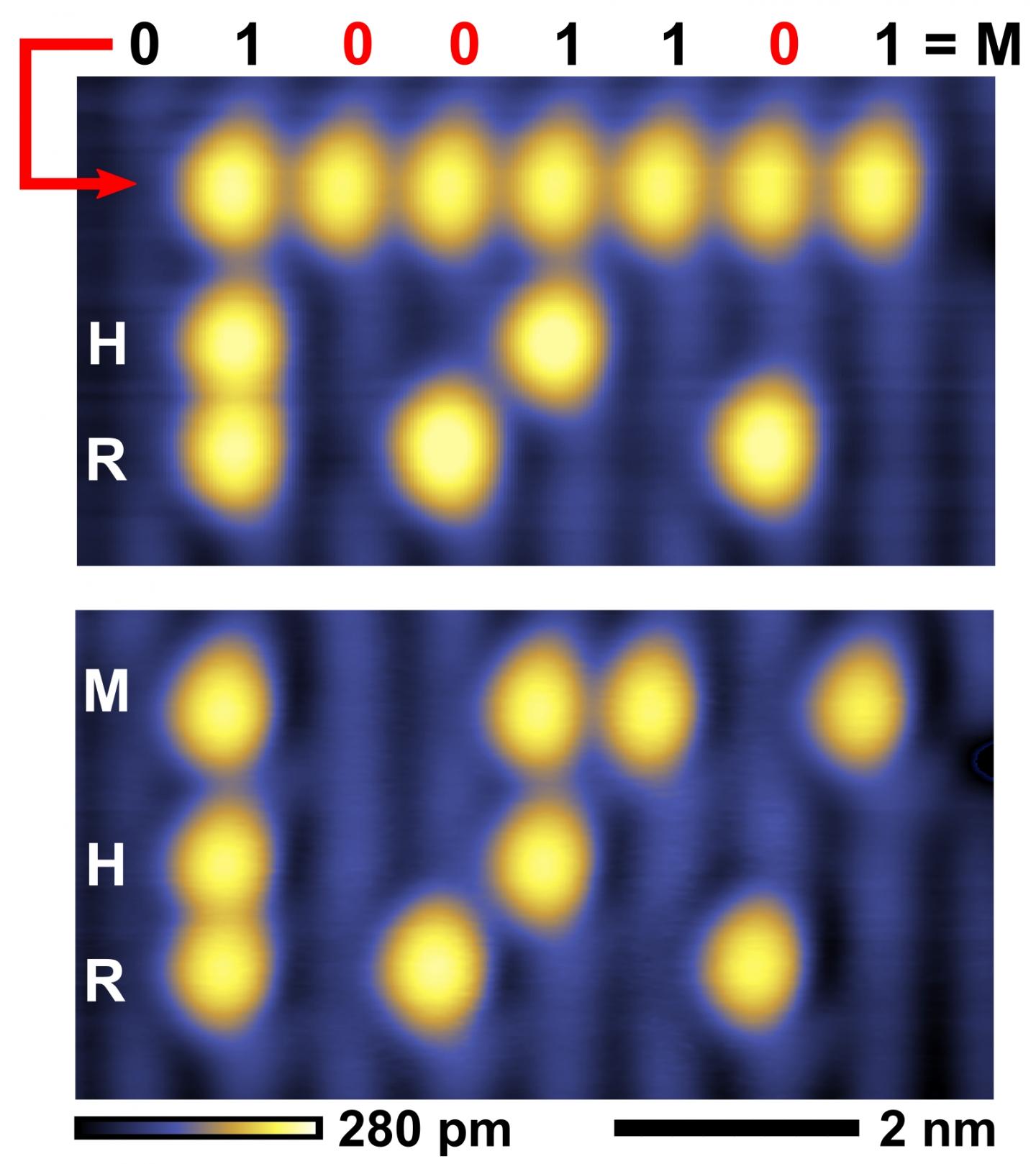
Scientists have previously manipulated single atoms to make ultra-dense memory arrays for computers, which store more data in a much smaller space than conventional hard drives and consume much less power. In a technique known as hydrogen lithography, researchers use the tip of a scanning tunneling microscope (STM) to remove single atoms of hydrogen bonded to a silicon surface. The pattern of silicon atoms bound to or lacking a hydrogen atom forms a binary code that stores the data. However, there is a bottleneck when rewriting the data because the STM tip must pick up and deposit hydrogen atoms at precise locations. Roshan Achal, Robert Wolkow and colleagues wanted to develop a more efficient method to rewrite atomic memory arrays.

The researchers prepared silicon surfaces covered with hydrogen atoms. With hydrogen lithography, they removed certain atoms to write data. The scientists found that by taking away an extra hydrogen atom next to a bit they wanted to rewrite, they could create a reactive site that attracted hydrogen gas that was infused into the chamber. Binding of a single hydrogen gas (H2) molecule to the two adjacent sites erased the sites so that a new binary code could be written. Using hydrogen gas as a molecular eraser to rewrite the data was much faster and easier than bringing in individual hydrogen atoms on an STM tip. The researchers demonstrated the technique’s ability to rewrite a small 24-bit memory array. The new method allows 1,000-times-faster fabrication of atomic-scale computers, making them ready for real-world manufacture, the researchers say.

###

The authors acknowledge funding from the National Sciences and Engineering Research Council of Canada, Alberta Innovates-Technology Futures, National Research Council Canada and Quantum Silicon.

The paper’s abstract will be available on November 27 at 8 a.m. Eastern time here: http://pubs.acs.org/doi/abs/10.1021/acsnano.9b07637

The researchers have created a video about their work, which can be viewed here.

The American Chemical Society, the world’s largest scientific society, is a nonprofit organization chartered by the U.S. Congress. ACS is a global leader in providing access to chemistry-related information and research through its multiple databases, peer-reviewed journals and scientific conferences. ACS does not conduct research, but publishes and publicizes peer-reviewed scientific studies. Its main offices are in Washington, D.C., and Columbus, Ohio.

To automatically receive news releases from the American Chemical Society, contact [email protected].

Follow us: Twitter | Facebook

Media Contact
Katie Cottingham
[email protected]
301-775-8455

Related Journal Article

http://dx.doi.org/10.1021/acsnano.9b07637

Tags: Atomic PhysicsAtomic/Molecular/Particle PhysicsChemistry/Physics/Materials SciencesElectrical Engineering/ElectronicsHardwareMaterialsNanotechnology/MicromachinesTheory/Design
Share12Tweet8Share2ShareShareShare2

Related Posts

Miniature Sensor Uses Light to Detect Touch — Chemistry

Miniature Sensor Uses Light to Detect Touch

May 8, 2026
Iron Minerals Determine Whether Dissolved Organic Matter Fuels Microbes or Becomes Long-Term Carbon Storage — Chemistry

Iron Minerals Determine Whether Dissolved Organic Matter Fuels Microbes or Becomes Long-Term Carbon Storage

May 8, 2026

Kate Evans Appointed Associate Lab Director for Biological and Environmental Systems Science at ORNL

May 8, 2026

Advancing Multiscale Modeling and Overcoming Operational Challenges in Autothermal COâ‚‚-to-Methanol Reactors

May 8, 2026
Please login to join discussion

POPULAR NEWS

  • Research Indicates Potential Connection Between Prenatal Medication Exposure and Elevated Autism Risk

    840 shares
    Share 336 Tweet 210
  • New Study Reveals Plants Can Detect the Sound of Rain

    728 shares
    Share 290 Tweet 182
  • Salmonella Haem Blocks Macrophages, Boosts Infection

    62 shares
    Share 25 Tweet 16
  • Breastmilk Balances E. coli and Beneficial Bacteria in Infant Gut Microbiomes

    57 shares
    Share 23 Tweet 14

About

We bring you the latest biotechnology news from best research centers and universities around the world. Check our website.

Follow us

Recent News

Medicaid’s Role in Combating Climate Change Impacts

Mapping Skin Lesions in Lupus Types Explored

Umbilical IL-6 Levels Reveal Preterm Brain Injury Risk

Subscribe to Blog via Email

Enter your email address to subscribe to this blog and receive notifications of new posts by email.

Join 82 other subscribers
  • Contact Us

Bioengineer.org © Copyright 2023 All Rights Reserved.

Welcome Back!

Login to your account below

Forgotten Password?

Retrieve your password

Please enter your username or email address to reset your password.

Log In
No Result
View All Result
  • Homepages
    • Home Page 1
    • Home Page 2
  • News
  • National
  • Business
  • Health
  • Lifestyle
  • Science

Bioengineer.org © Copyright 2023 All Rights Reserved.