Chemical herders, which are used to concentrate oil spills for cleanup via burning, are shown to have effect on wave breaking.
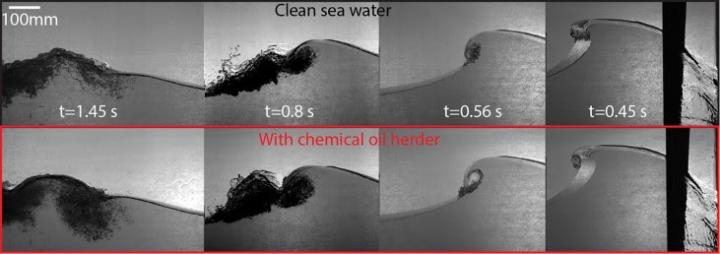
Credit: Lakshmana Chandrala, Franz O’Meally, and Joseph Katz
SEATTLE, November 26, 2019 — Oil spills in the ocean can cause devastation to wildlife, so effective cleanup is a top priority. One method to clean up oil spills is by burning, which only works if the oil is heavily concentrated in one area. Research from Johns Hopkins University shows the effects of chemical herders, which are agents that may be used to concentrate oil spills, on wave breaking.
Lakshmana Chandrala, Franz O’Meally and Joseph Katz will present their findings at 8:11 am on Nov. 26 as a part of the American Physical Society’s Division of Fluid Dynamics 72nd Annual Meeting. The conference will take place at the Washington State Convention Center in Seattle.
In the talk, the researchers will discuss how chemical herders can facilitate the concentration of an oil slick on water, which would allow for easy burning to clean-up.
“The oil slicks are generally subjected to breaking waves, which cause the oil slick to break into droplets and disperse into the water column,” said Chandrala. “Stronger breaking waves disperse or break the slick more effectively, and weak waves may not spread the oil slick.”
An experimental set up using a transparent tank and a paddle to create various wave energies allowed for the scientists to study the amplifying effects and damping effects that chemical herders displayed.
“Our experiments show that the addition of chemical oil herders amplifies the strong breaking waves, which may disperse or spread the oil slicks into the water column,” said Chandrala. “For effective burning, the oil should remain as a single slick. Therefore, the addition of chemical oil herders is not effective when strong waves are present on open oceans.”
Conversely, chemical herders suppressed weaker waves and made the water calmer. The presentation will include further discussion on the dynamics of how waves form when chemical herders accumulate at the interface of water and air.
Session Q01.00003 : “Effect of chemical herders on wave breaking” will take place in room 2A on Tuesday, Nov. 26 at 8:11 a.m.
###
MORE MEETING INFORMATION
USEFUL LINKS
Main meeting website: https:/
Meeting technical program: http://meetings.
Invited talks: http://meetings.
Hotel information: https:/
GALLERY OF FLUID DYNAMICS
At the Annual Meeting, The Gallery of Fluid Motion will consist of posters and videos submitted by attendees illustrating the science and beauty of fluid motion. More information can be found here: https:/
PRESS REGISTRATION
We will grant free registration to credentialed journalists and professional freelance journalists. If you are a reporter and would like to attend, contact [email protected]. We can also help with setting up interviews and obtaining images, sound clips or background information.
LIVE MEDIA WEBCAST
A press briefing featuring a selection of newsworthy research will be webcast live from the conference on Monday, Nov. 25. Times and topics to be announced. Members of the media should register in advance at https:/
ABOUT DFD
The Division of Fluid Dynamics of the American Physical Society, established in 1947, exists for the advancement and diffusion of knowledge of the physics of fluids with special emphasis on the dynamical theories of the liquid, plastic and gaseous states of matter under all conditions of temperature and pressure. For more information about DFD, visit https:/
ABOUT APS
The American Physical Society (APS) is a nonprofit membership organization working to advance and diffuse the knowledge of physics through its outstanding research journals, scientific meetings, and education, outreach, advocacy, and international activities. APS represents over 55,000 members, including physicists in academia, national laboratories, and industry in the United States and throughout the world.
Media Contact
APS Communications
[email protected]
301-209-3090