• HOME
  • NEWS
  • EXPLORE
    • CAREER
      • Companies
      • Jobs
    • EVENTS
    • iGEM
      • News
      • Team
    • PHOTOS
    • VIDEO
    • WIKI
  • BLOG
  • COMMUNITY
    • FACEBOOK
    • INSTAGRAM
    • TWITTER
Friday, January 16, 2026
BIOENGINEER.ORG
No Result
View All Result
  • Login
  • HOME
  • NEWS
  • EXPLORE
    • CAREER
      • Companies
      • Jobs
        • Lecturer
        • PhD Studentship
        • Postdoc
        • Research Assistant
    • EVENTS
    • iGEM
      • News
      • Team
    • PHOTOS
    • VIDEO
    • WIKI
  • BLOG
  • COMMUNITY
    • FACEBOOK
    • INSTAGRAM
    • TWITTER
  • HOME
  • NEWS
  • EXPLORE
    • CAREER
      • Companies
      • Jobs
        • Lecturer
        • PhD Studentship
        • Postdoc
        • Research Assistant
    • EVENTS
    • iGEM
      • News
      • Team
    • PHOTOS
    • VIDEO
    • WIKI
  • BLOG
  • COMMUNITY
    • FACEBOOK
    • INSTAGRAM
    • TWITTER
No Result
View All Result
Bioengineer.org
No Result
View All Result
Home NEWS Science News Biology

Smart reactions through online design of catalytic pockets

Bioengineer by Bioengineer
November 26, 2019
in Biology
Reading Time: 2 mins read
0
IMAGE
Share on FacebookShare on TwitterShare on LinkedinShare on RedditShare on Telegram

IMAGE

Credit: © 2019 Laura Falivene


Many chemical processes depend on catalysts to facilitate reactions that would otherwise proceed very slowly, or not at all. An innovative procedure for visually representing the structure of catalysts via computer-assisted design, developed at KAUST, is helping researchers build better catalysts.

The software generates topographic steric maps and has been developed by Luigi Cavallo’s research group at the KAUST Catalysis Research Center. The source code required is now freely available online.

Scientists from 65 countries have already used the interfaced web application, reports postdoctoral fellow Laura Falivene, and they often call on the KAUST researchers for more information. The team has now published a perspective article explaining in detail the creation and use of the topographic steric maps.

“The power of visualization is of great value in chemistry where much time is spent imagining things that we cannot see,” Falivene says.

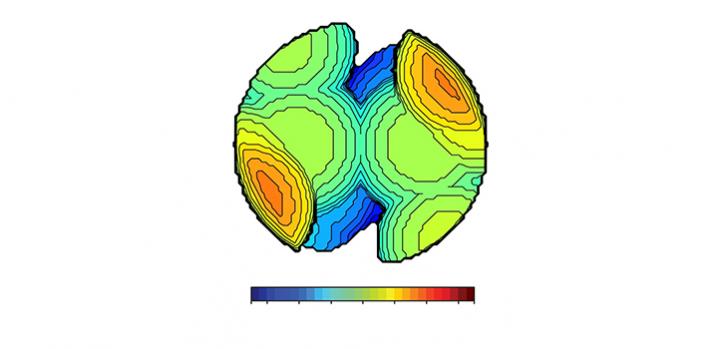
Each map uses color-coding to convey the three-dimensional geometry of the chemical groups forming the functional heart of a catalyst, known as the catalytic pocket (see images). The data to build a map can come from several techniques, such as x-ray crystallography and quantum mechanics calculations, which indicate the identity and position of each atom in the catalytic pocket.

This helps researchers better understand how known catalysts function, while also guiding exploration of chemical modifications that could adjust the structures to make better catalysts.

“We are building an important bridge between the experimental and computational approaches,” Falivene explains. She adds that the growing popularity of the topographic steric maps helps other chemists to appreciate the significance of the work done by theoretical chemists like herself.

“Using the maps explains the importance of combining experimental and theoretical approaches better than my words have been able to do,” she observes. “They can be used with any class of catalysts, from reactivity promoted by simple organic molecules, to that promoted by transition metal complexes, and large metalloenzymes, where a metal is hosted inside a protein.” Metalloenzymes catalyze some of the most crucial reactions of life.

Work at KAUST continues to enhance the method including developing machine learning approaches to rapidly screen the potential of possible new catalysts.

“This perspective article is important because it officially states the validity and value of the topic,” says Falivene. She describes it as a new starting point that brings together the early, less formal achievements to promote wider use and further development of the maps.

###

Media Contact
Carolyn Unck
[email protected]
966-054-470-0408

Original Source

https://discovery.kaust.edu.sa/en/article/909/smart-reactions-through-online-design-of-catalytic-pockets

Related Journal Article

http://dx.doi.org/10.1038/s41557-019-0319-5

Tags: BiochemistryChemistry/Physics/Materials SciencesOpticsPolymer Chemistry
Share12Tweet8Share2ShareShareShare2

Related Posts

MitoCommun: Decoding Mitochondrial Communication Networks

MitoCommun: Decoding Mitochondrial Communication Networks

January 16, 2026
blank

Gender Variations in Biomarkers and Memory Decline in Alzheimer’s

January 16, 2026

Unveiling Genetic Diversity in Soybean Cyst Nematodes

January 16, 2026

Unlocking Soybean Root Traits: A Genome Study

January 15, 2026
Please login to join discussion

POPULAR NEWS

  • Enhancing Spiritual Care Education in Nursing Programs

    155 shares
    Share 62 Tweet 39
  • PTSD, Depression, Anxiety in Childhood Cancer Survivors, Parents

    147 shares
    Share 59 Tweet 37
  • Robotic Ureteral Reconstruction: A Novel Approach

    76 shares
    Share 30 Tweet 19
  • Study Reveals Lipid Accumulation in ME/CFS Cells

    53 shares
    Share 21 Tweet 13

About

We bring you the latest biotechnology news from best research centers and universities around the world. Check our website.

Follow us

Recent News

Carbon Fiber Boosts Zirconium Diboride in 3D Printing

Revolutionary Support Program for Families of Cancer Patients

Spatial Multiomics Uncovers Immune Dysfunction in Parkinson’s, IBD

Subscribe to Blog via Email

Enter your email address to subscribe to this blog and receive notifications of new posts by email.

Join 71 other subscribers
  • Contact Us

Bioengineer.org © Copyright 2023 All Rights Reserved.

Welcome Back!

Login to your account below

Forgotten Password?

Retrieve your password

Please enter your username or email address to reset your password.

Log In
No Result
View All Result
  • Homepages
    • Home Page 1
    • Home Page 2
  • News
  • National
  • Business
  • Health
  • Lifestyle
  • Science

Bioengineer.org © Copyright 2023 All Rights Reserved.