Though it is a common method to release trapped water in the ear canal, researchers say the acceleration of head shaking needed to free water can cause brain damage
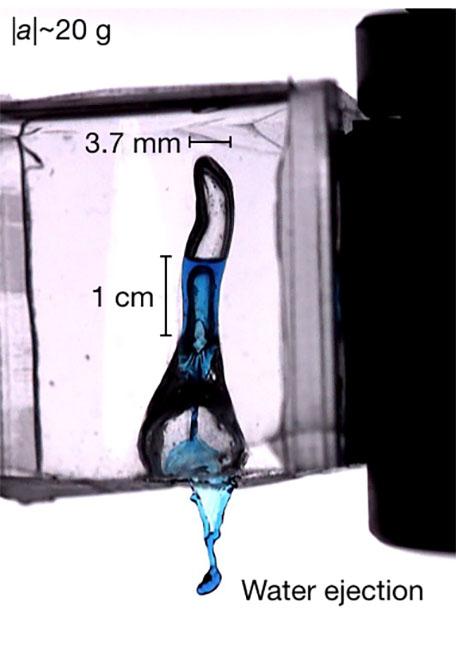
Credit: Anuj Baskota, Seungho Kim, and Sunghwan Jung
SEATTLE, November 23, 2019 — Trapped water in the ear canal can cause infection and even damage, but it turns out that one of the most common methods people use to get rid of water in their ears can also cause complications. Researchers at Cornell University and Virginia Tech show shaking the head to free trapped water can cause brain damage in small children.
Anuj Baskota, Seungho Kim, Hosung Kang, and Sunghwan Jung will present their findings at the American Physical Society’s Division of Fluid Dynamics 72nd Annual Meeting on Nov. 23 at 4:15 p.m. The conference takes place at the Washington State Convention Center in Seattle on Nov. 23-26, 2019.
“Our research mainly focuses on the acceleration required to get the water out of the ear canal,” said Baskota. “The critical acceleration that we obtained experimentally on glass tubes and 3D printed ear canals was around the range of 10 times the force of gravity for infant ear sizes, which could cause damage to the brain.”
For adults, the acceleration was lower due to the larger diameter of the ear canals. They said the overall volume and position of the water in the canal changes the acceleration needed to remove it.
“From our experiments and theoretical model, we figured out that surface tension of the fluid is one of the crucial factors promoting the water to get stuck in ear canals,” said Baskota.
Luckily, the researchers said there is a solution that does not involve any head shaking.
“Presumably, putting a few drops of a liquid with lower surface tension than water, like alcohol or vinegar, in the ear would reduce the surface tension force allowing the water to flow out,” Baskota said.
###
MORE MEETING INFORMATION
USEFUL LINKS
Main meeting website: https:/
Meeting technical program: http://meetings.
Invited talks: http://meetings.
Hotel information: https:/
GALLERY OF FLUID DYNAMICS
At the Annual Meeting, The Gallery of Fluid Motion will consist of posters and videos submitted by attendees illustrating the science and beauty of fluid motion. More information can be found here: https:/
PRESS REGISTRATION
We will grant free registration to credentialed journalists and professional freelance journalists. If you are a reporter and would like to attend, contact [email protected]. We can also help with setting up interviews and obtaining images, sound clips or background information.
LIVE MEDIA WEBCAST
A press briefing featuring a selection of newsworthy research will be webcast live from the conference on Monday, Nov. 25. Times and topics to be announced. Members of the media should register in advance at https:/
ABOUT DFD
The Division of Fluid Dynamics of the American Physical Society, established in 1947, exists for the advancement and diffusion of knowledge of the physics of fluids with special emphasis on the dynamical theories of the liquid, plastic and gaseous states of matter under all conditions of temperature and pressure. For more information about DFD, visit https:/
ABOUT APS
The American Physical Society (APS) is a nonprofit membership organization working to advance and diffuse the knowledge of physics through its outstanding research journals, scientific meetings, and education, outreach, advocacy, and international activities. APS represents over 55,000 members, including physicists in academia, national laboratories, and industry in the United States and throughout the world. For more information about APS, visit https:/
Media Contact
APS Communications
[email protected]