• HOME
  • NEWS
  • EXPLORE
    • CAREER
      • Companies
      • Jobs
    • EVENTS
    • iGEM
      • News
      • Team
    • PHOTOS
    • VIDEO
    • WIKI
  • BLOG
  • COMMUNITY
    • FACEBOOK
    • INSTAGRAM
    • TWITTER
Friday, September 25, 2026
BIOENGINEER.ORG
No Result
View All Result
  • Login
  • HOME
  • NEWS
  • EXPLORE
    • CAREER
      • Companies
      • Jobs
        • Lecturer
        • PhD Studentship
        • Postdoc
        • Research Assistant
    • EVENTS
    • iGEM
      • News
      • Team
    • PHOTOS
    • VIDEO
    • WIKI
  • BLOG
  • COMMUNITY
    • FACEBOOK
    • INSTAGRAM
    • TWITTER
  • HOME
  • NEWS
  • EXPLORE
    • CAREER
      • Companies
      • Jobs
        • Lecturer
        • PhD Studentship
        • Postdoc
        • Research Assistant
    • EVENTS
    • iGEM
      • News
      • Team
    • PHOTOS
    • VIDEO
    • WIKI
  • BLOG
  • COMMUNITY
    • FACEBOOK
    • INSTAGRAM
    • TWITTER
No Result
View All Result
Bioengineer.org
No Result
View All Result
Home NEWS Science News Chemistry

Birds of a feather flock together, but how do they decide where to go?

Bioengineer by Bioengineer
November 19, 2019
in Chemistry
Reading Time: 3 mins read
0
IMAGE
Share on FacebookShare on TwitterShare on LinkedinShare on RedditShare on Telegram

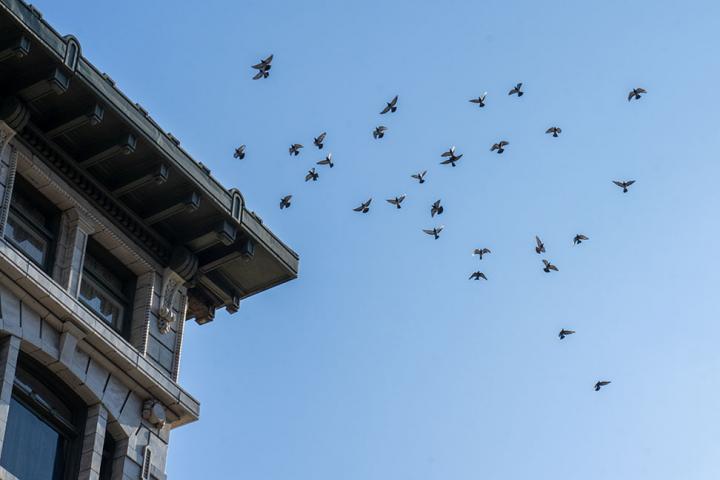
Researchers propose a new method of studying coordinated behavior in biological systems, which they use to study pigeon flights
IMAGE

Credit: Angie Bandari


WASHINGTON, D.C., November 19, 2019 — Coordinated behavior is common in a variety of biological systems, such as insect swarms, fish schools and bacterial colonies. But the way information is spread and decisions are made in such systems is difficult to understand.

A group of researchers from Southeast University and China University of Mining and Technology studied the synchronized flight of pigeon flocks. They used this as a basis to explain the mechanisms behind coordinated behavior, in the journal Chaos, from AIP Publishing.

“Understanding the underlying coordination mechanism of these appealing phenomena helps us gain more cognition of the world where we live,” said author Duxin Chen, an assistant professor at Southeast University in China.

Previously, it was believed that coordinated behavior is subject to three basic rules: Avoid collision with your peers, match your speed and direction of motion with the rest of the group, and try to stay near the center. The scientists examined how every individual pigeon within a flock is influenced by the other members and found the dynamics are not so simple.

The researchers studied the flights of three flocks of 10 pigeons each. Every bird’s position, velocity and acceleration were sampled with time, and the researchers used this data to determine which pigeons have a direct impact on each individual in the group, constructing a causal network that can be used to further observe the deep interaction rules.

They determined a number of trends in flock motion. Depending on factors, like its location in the flock, every pigeon has neighbors it influences as well as neighbors it is influenced by. Additionally, the influencers are likely to change throughout the flight.

“Interestingly, the individuals closer to the mass center and the average velocity direction are more influential to others, which means location and flight direction are two factors that matter in their interactions,” Chen said.

Though pigeon social patterns were not considered, the researchers found flight competition to be intensive, and previous work has shown flight hierarchies are independent of pigeon dominance factors.

The authors suggest their method is sufficiently general to study other coordinated behaviors. Next, they plan to focus on the collective behaviors of immune cells.

###

The article, “Inferring causal relationship in coordinated flight of pigeon flocks,” is authored by Duxin Chen, Yuchen Wang, Ge Wu, Mingyu Kang, Yongzheng Sun and Wenwu Yu. The article will appear in Chaos on Nov. 19, 2019 (DOI: 10.1063/1.5120787). After that date, it can be accessed at http://aip.scitation.org/doi/full/10.1063/1.5120787.

ABOUT THE JOURNAL

Chaos is devoted to increasing the understanding of nonlinear phenomena in all disciplines and describing their manifestations in a manner comprehensible to researchers from a broad spectrum of disciplines. See http://chaos.aip.org.

Media Contact
Larry Frum
[email protected]
301-209-3090

Related Journal Article

http://dx.doi.org/10.1063/1.5120787

Tags: BiologyChemistry/Physics/Materials SciencesMathematics/StatisticsSocial/Behavioral ScienceSystems/Chaos/Pattern Formation/Complexity
Share12Tweet8Share2ShareShareShare2

Related Posts

Tea Compounds Show Surprising Power Against Cancer and Aging Proteins

Tea Compounds Show Surprising Power Against Cancer and Aging Proteins

September 25, 2026
Volcanic Rock Buoys Could End Microplastic Pollution in Oyster Farms

Volcanic Rock Buoys Could End Microplastic Pollution in Oyster Farms

September 25, 2026

Metal-Organic Framework Nanoparticles Turn Biopolymer Hydrogel into Antibacterial Wound Dressing

September 25, 2026

Fig Latex and Sodium Phytate Team Up to Tenderize and Protect Cooked Beef

September 25, 2026
Please login to join discussion

POPULAR NEWS

  • New Study Maps How Hospital AI Turns Information Chaos into Faster, Cheaper Care

    29 shares
    Share 12 Tweet 7
  • AI Forecasting Reshapes Doctor Schedules in a Pediatric Emergency Room

    29 shares
    Share 12 Tweet 7
  • Damiana Plant Polysaccharides Extend Lifespan in Worms and Flies, Study Finds

    29 shares
    Share 12 Tweet 7
  • Forever Chemicals in Pregnancy Tied to Higher Gestational Diabetes Risk, Vitamin D May Blunt the Effect

    29 shares
    Share 12 Tweet 7

About

We bring you the latest biotechnology news from best research centers and universities around the world. Check our website.

Follow us

Recent News

New Study Maps How Hospital AI Turns Information Chaos into Faster, Cheaper Care

AI Forecasting Reshapes Doctor Schedules in a Pediatric Emergency Room

Damiana Plant Polysaccharides Extend Lifespan in Worms and Flies, Study Finds

Subscribe to Blog via Email

Enter your email address to subscribe to this blog and receive notifications of new posts by email.

Join 85 other subscribers
  • Contact Us

Bioengineer.org © Copyright 2023 All Rights Reserved.

Welcome Back!

Login to your account below

Forgotten Password?

Retrieve your password

Please enter your username or email address to reset your password.

Log In
No Result
View All Result
  • Homepages
    • Home Page 1
    • Home Page 2
  • News
  • National
  • Business
  • Health
  • Lifestyle
  • Science

Bioengineer.org © Copyright 2023 All Rights Reserved.