Credit: ©Science China Press
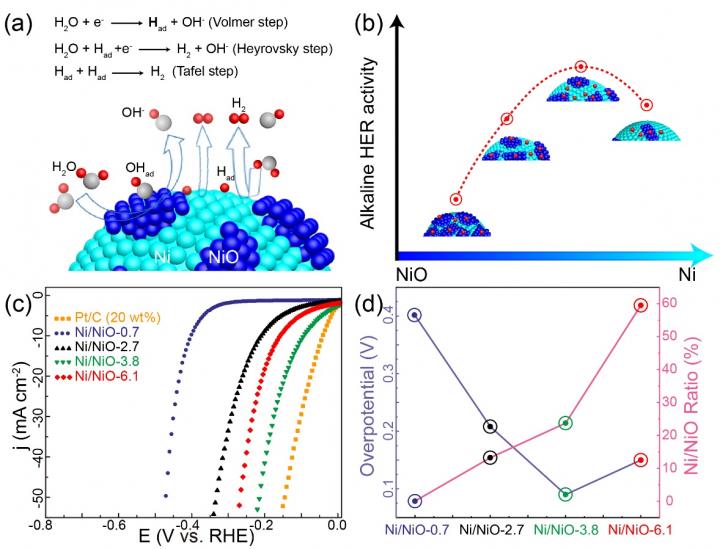
Electrocatalytic reaction, like other heterogenous catalytic reaction, commonly consists of multiple elementary reaction steps. For example, alkaline hydrogen evolution reaction (HER) involves: H2O + e- ?Had + OH- (Volmer step) and H2O + Had + e- ? H2 + OH- (Heyrovsky step) or Had + Had ? H2 (Tafel step). Compared with acidic HER, the Volmer step in alkaline electrolyte requires appropriate water molecule adsorption energy and extra energy to dissociate water molecule, leading to much slower kinetics. Designing the multiple active sites on catalyst surface for targeting each elementary step and investigating their influence on electrocatalytic performance would provide new insights into the electrocatalytic process and advance the design of efficient electrocatalysts, although it is still challenging and has not received much attention yet.
Recently, Professors Jin-Song Hu and Li-Jun Wan from Institute of Chemistry, Chinese Academy of Sciences and their collaborators designed the nanocrystals with tunable Ni/NiO heterosurfaces to target Volmer and Heyrovsky/Tafel steps in the alkaline hydrogen evolution reaction (HER) and discovered that such bicomponent active sites on the surface should be balanced for promoting HER performance.
The DFT calculations were firstly performed and predicted that NiO can accelerate the dissociation of water (Volmer step) while metallic Ni can promote the formation of H2 from adsorbed hydrogen Had (Heyrovsky/Tafel step). A series of well-dispersed Ni/NiO nanocrystals model catalysts were subsequently synthesized by preparing Ni nanocrystals, followed by natural oxidation. The surface Ni/NiO ratios of these nanocrystals could be regulated by controlling the nanocrystal size since the natural oxidation of Ni nanocrystal is dependent on its size. The existence of Ni/NiO heterogeneous interface was evidenced by means of spherical aberration electron microscopy, low-energy electron energy loss spectroscopy and Raman spectroscopy. The X-ray photoelectron spectroscopic analyses gave the surface Ni/NiO ratios from 0% to 59.5% as the nanocrystal size increased from 0.7 nm to 6.1 nm. The systematic electrochemical tests showed that the activity of alkaline HER was in a volcanic-shape relationship with the Ni/NiO ratio for these nanocrystals. The nanocrystal with an average size of 3.8 nm and a surface Ni/NiO ratio of 23.7% delivered the best HER activity in terms of a low overpotential of only 90 mV at 10 mA cm-2 and a small Tafel slope of 41 mV dec-1. Such performance is superior to other Ni-based analogues. The turnover frequency (TOF) calculations corroborated the fastest reaction at this Ni/NiO ratio. In contrast, when the Ni/NiO ratio on the surface of the nanocrystals decreased or increased, the alkaline HER performance decreased accordingly.
Moreover, in order to exclude the influence from nanocrystal size, the authors further post-oxidized the same catalysts to modulate the surface Ni/NiO ratios. Electrochemical tests drew the similar conclusions that when the surface Ni/NiO ratio was about 20%, the catalyst presented the best alkaline HER performance.
This work suggest that integrating multiple component active sites with suitable composition ratio is effective for balancing elementary reaction steps and thus promoting the alkaline HER. The findings might guide the exploration of efficient electrocatalysts for HER and other heterogenous catalytic reactions.
###
See the article:
Steering Elementary Steps towards Efficient Alkaline Hydrogen Evolution via Size-Dependent Ni/NiO Nanoscale Heterosurfaces.
Lu Zhao, Yun Zhang, Zhonglong Zhao, Qing-Hua Zhang, Lin-Bo Huang, Lin Gu, Gang Lu, Jin-Song Hu,* Li-Jun Wan*
Natl Sci Rev. 2019, nwz145.
https:/
Media Contact
Jin-Song Hu
[email protected]
Related Journal Article
http://dx.